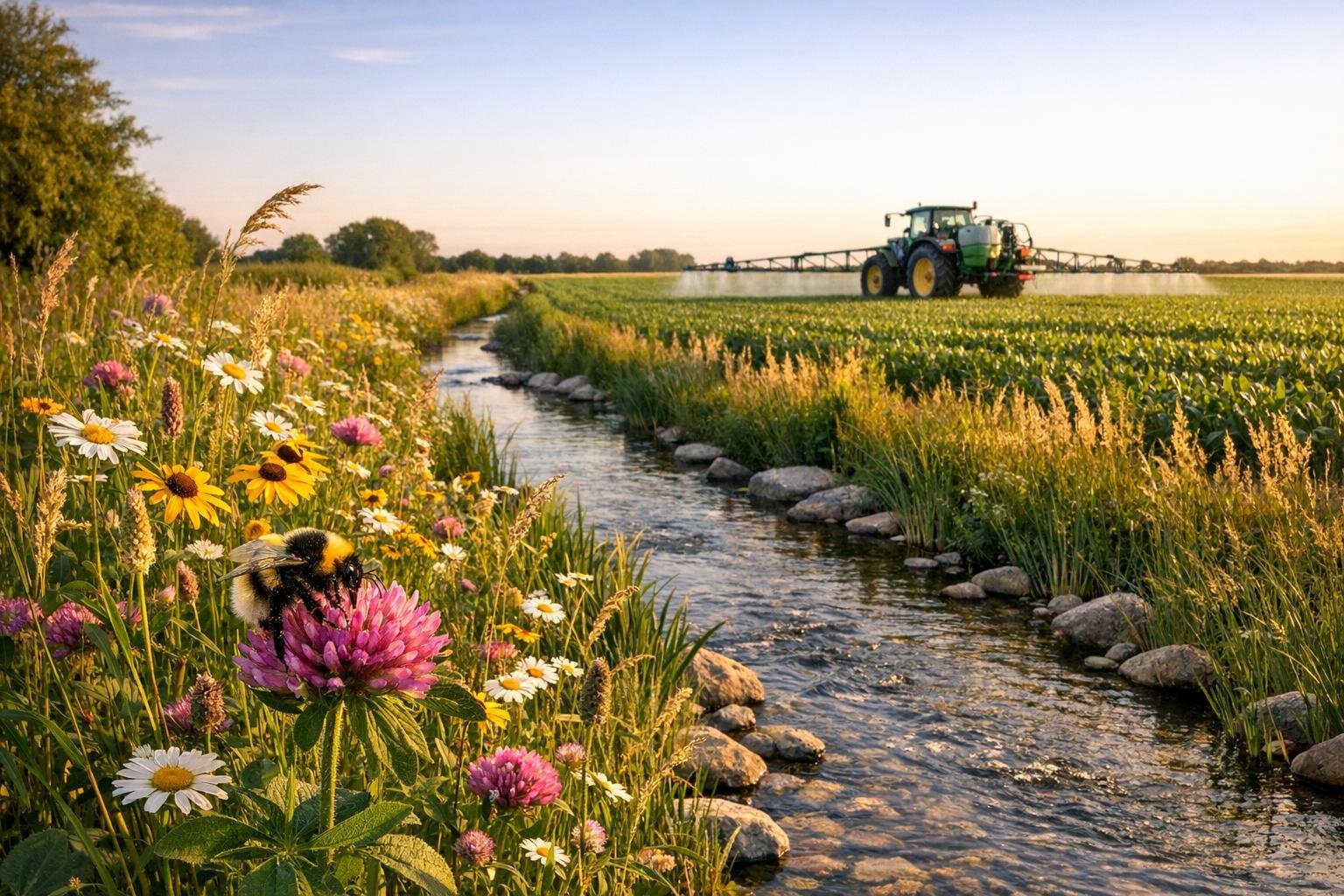
Buffer zones are critical for reducing pesticide drift, which can harm pollinators, aquatic life, plants, and soil microorganisms. However, creating effective buffer zones involves more than just measuring distance. Factors like droplet size, wind speed, and application methods play a major role in pesticide spread. Research shows that standard buffer zones often fail to fully protect sensitive areas, highlighting the need for additional measures like windbreaks and drift-reduction technologies.
Key points:
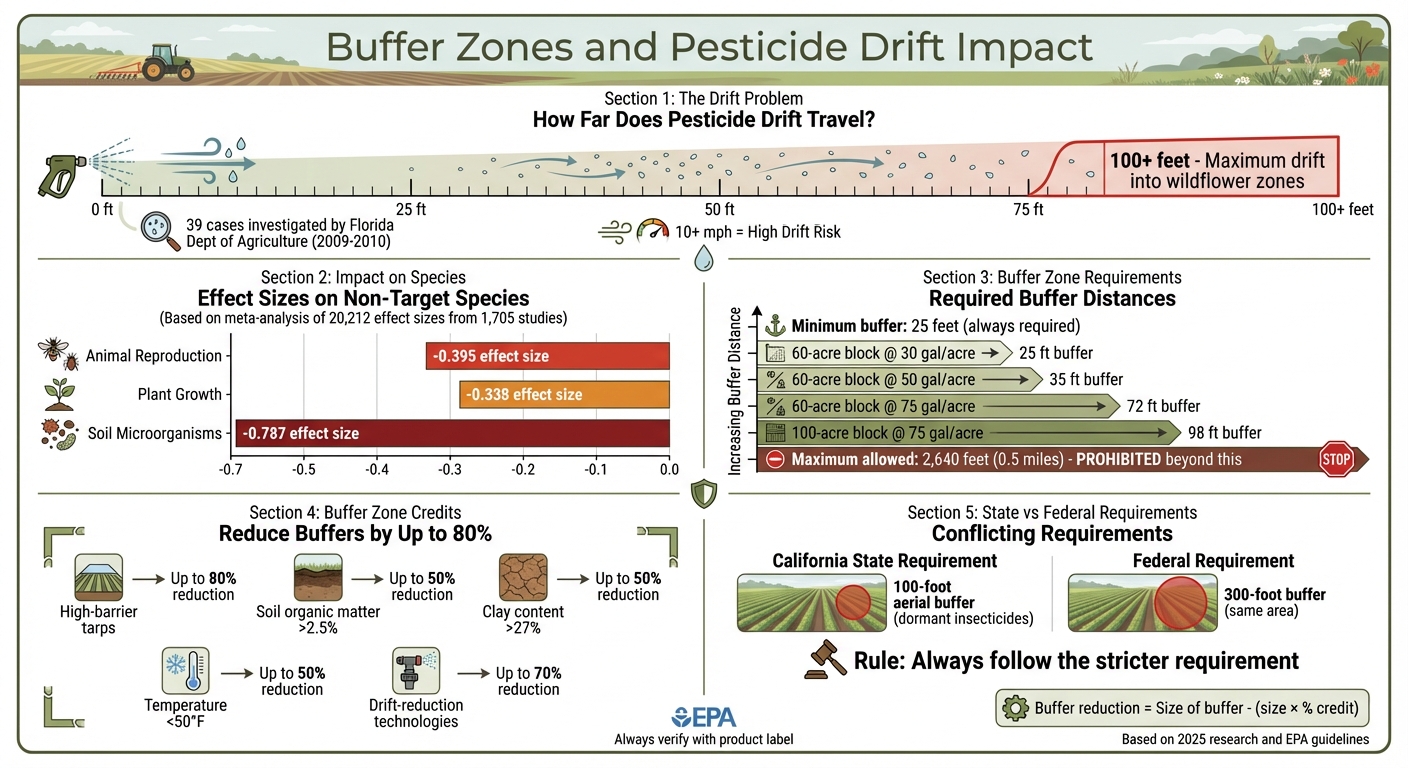
- Pesticide drift can extend over 100 feet, affecting ecosystems and species not targeted by the application.
- Buffer zones are required by the EPA to protect endangered species, but these requirements can be complex and vary by state and federal laws. For example, applicators can maintain compliance through Oklahoma applicator recertification and similar state-specific programs.
- Tools like the EPA Buffer Zone Calculator and drift-reduction technologies improve compliance and reduce risks.
- Proper training is essential to navigate regulations, calculate buffer zones, and implement protective measures effectively.
Pesticide Drift Impact on Non-Target Species and Buffer Zone Requirements
Webinar on Mitigation Measures to Protect Endangered Species from Pesticides
sbb-itb-c4006de
The Problem: How Pesticides Harm Non-Target Species
Pesticides don’t just stay where they’re applied – they spread, affecting countless species they were never meant to harm. According to a 2025 meta-analysis that reviewed 20,212 effect sizes from 1,705 studies, pesticide exposure consistently suppresses growth, reproduction, and behavior in non-target species. Beyond outright killing organisms, pesticides can cause subtler but equally damaging effects, like stunted growth, altered behavior, and reduced reproductive success.
This problem cuts across all levels of the food chain. Animals may suffer from nervous system disruptions or lower survival rates. Plants often experience reduced pollen viability and issues with photosynthesis. Even microorganisms, which are vital for healthy soil, can have their spore germination inhibited or cell membranes damaged. This weakens soil health and disrupts the symbiotic relationships that many plants depend on.
What Causes Pesticide Drift
One of the main culprits behind unintended pesticide exposure is drift – when pesticide droplets travel beyond their intended area. And droplet size is the key factor. As F. M. Fishel and J. A. Ferrell from the University of Florida IFAS explain:
The overwhelming factor influencing drift is droplet size.
Smaller droplets, especially those under 100 microns, stay airborne longer and are easily carried away from the target area.
Weather conditions also play a big role. Wind speeds over 10 mph can push droplets far off-course, while “dead calm” conditions might indicate a temperature inversion – when cooler air is trapped near the ground under warmer air – allowing pesticides to drift for over a mile. Low humidity and high temperatures make things worse by speeding up evaporation, shrinking droplet size, and increasing drift potential.
Human error adds to the problem. Mistakes like using the wrong nozzle, setting boom heights too high, or ignoring weather conditions can significantly increase drift. For example, raising a boom from 8 feet to 22 feet can increase drift deposits 25 feet downwind by up to 2.5 times. Between 2009 and 2010, the Florida Department of Agriculture and Consumer Services investigated 39 cases of pesticide drift, highlighting the widespread nature of the issue.
Understanding these factors is crucial to grasping the broader risks pesticides pose to ecosystems.
Species and Ecosystems at Risk
Pesticide drift doesn’t just harm individual organisms – it threatens entire ecosystems.
Pollinators, like bees, are especially at risk. In the U.S., pesticide exposure has been linked to declining populations of hundreds of wild bee species. Research on highbush blueberry farms found that pesticide levels remain consistent up to 105 feet from the application site, suggesting that even standard buffer zones might not be enough to shield pollinator habitats.
Aquatic life is also highly vulnerable. Neonicotinoid insecticides, for example, have been shown to harm amphibians, while fish exposed to pesticides in waterways often experience disrupted neural function. According to the meta-analysis, animal reproduction dropped significantly, with an effect size of -0.395.
Plants don’t escape unscathed either. Non-target plants can suffer from reduced pollen viability and disruptions in carbohydrate metabolism, leading to smaller overall growth. Sensitive crops like grapes and tomatoes are particularly affected, with plant growth reductions measured at an effect size of -0.338 across multiple pesticide types.
Soil microorganisms, such as arbuscular mycorrhizal fungi, are another casualty. These fungi play a critical role in nutrient cycling, but pesticides can reduce their biomass and disrupt their reproduction, with a notably negative effect size of -0.787. This not only impacts soil health but also the plants that rely on these microorganisms for essential nutrients.
The ripple effects of pesticide drift are vast, impacting everything from pollinators to soil health, and underline the need for more careful pesticide application practices.
Challenges: Meeting Regulatory Requirements
Meeting regulatory requirements is no walk in the park for pesticide applicators. The process is riddled with intricate label guidelines, precise calculation rules, and a maze of overlapping state and federal laws. These complexities can make even routine applications a logistical headache. Let’s break down the challenges.
No-Spray Zones and Label Requirements
Buffer zone requirements on pesticide labels are far from straightforward. It’s not just about measuring a distance and steering clear. Applicators must rely on product-specific look-up tables that factor in the broadcast equivalent rate and the size of the application block. These tables dictate the exact distance required between the pesticide application area and sensitive zones.
The calculations can quickly complicate things. If your specific rate or block size isn’t listed in the table, you’re required to round up to the next highest value. This often results in larger buffer zones than anticipated. For example, on a 60-acre block, using 30 gallons per acre requires a 25-foot buffer. Increase the rate to 50 gallons per acre, and the buffer jumps to 35 feet. At 75 gallons per acre, it balloons to 72 feet.
There are also hard limits to consider. The minimum buffer zone is 25 feet, no exceptions. On the other end of the spectrum, if your calculations require a buffer zone exceeding 0.5 miles (2,640 feet), the application is outright prohibited. This can leave applicators with tough choices: divide the field into smaller sections, lower the application rate, or abandon the treatment altogether.
While the EPA offers a Buffer Zone Calculator to assist with these computations, applicators must always double-check results against the product label, which serves as the final legal authority if discrepancies arise. Credits can reduce buffer zones by up to 80%, but managing these credits adds another layer of complexity. Following these rules to the letter is essential to protect non-target species and understand the differences between pesticide drift and buffer zones to ensure compliance.
State and Federal Laws
Navigating the patchwork of state and federal laws brings its own set of challenges. These laws often overlap, and in many cases, they conflict.
Federal buffer zones, established by the EPA under the Endangered Species Act (ESA), aim to protect specific species such as Pacific salmon and steelhead. However, state regulations can impose entirely different requirements. For example, California enforces a 100-foot aerial buffer for dormant insecticides, while federal court-ordered buffers for the same areas require 300 feet. When faced with such conflicts, applicators must follow the stricter rule to remain compliant.
Adding to the confusion, some federal buffer requirements – especially those stemming from litigation – don’t appear on pesticide labels but are still legally binding. A notable example is the 2014 settlement of Northwest Center for Alternatives to Pesticides v. EPA, which reinstated mandatory no-spray buffers to protect endangered Pacific salmon and steelhead in California, Oregon, and Washington. This settlement introduced 60-foot buffers for ground applications and 300-foot buffers for aerial applications for five active ingredients: carbaryl, chlorpyrifos, diazinon, malathion, and methomyl.
But enforcement isn’t always straightforward. George Farnsworth, Chief of the Enforcement Branch at the California Department of Pesticide Regulation, highlighted the issue:
Applying a pesticide in violation of the more restrictive 300-foot buffer zone is not a label violation and cannot be enforced by the county agricultural commissioner.
This creates a tricky situation where applicators could face legal consequences through court orders but not through standard regulatory channels. To stay compliant, applicators must frequently consult tools like "Bulletins Live!" and "Salmon Mapper" for geographically specific pesticide use restrictions that go beyond label instructions. Since the list of affected pesticides and protected areas changes regularly, checking these resources before every application is essential to avoid legal pitfalls.
Solutions: How to Implement Buffer Zones
Navigating the complexities of buffer zones might seem daunting, but with the right approach, it becomes manageable. The trick lies in understanding how to calculate distances, selecting suitable buffer types, and leveraging tools to simplify the process. Here’s a breakdown of practical strategies that can be applied in real-world scenarios.
Calculating Buffer Zone Distances
Pesticide labels often include product-specific lookup tables that help determine buffer zone distances based on your application rate and block size. For instance, applying metam sodium at 50 gallons per acre on a 100-acre block requires a 50-foot buffer, while increasing the rate to 75 gallons per acre bumps the buffer up to 98 feet. If your specific rate or block size isn’t listed, always round up to the nearest value.
The EPA offers a Buffer Zone Calculator to streamline these calculations. However, it’s crucial to double-check the results against the product label. As the EPA emphasizes:
Applicators must verify that the buffer zone results from the calculator are consistent with the buffer zone requirements on product labels. If there are any discrepancies, the label must be followed.
Buffer zone credits can significantly reduce required distances – by as much as 80% – when specific conditions or technologies are met. For example, using high-barrier tarps, soil with organic matter above 2.5%, clay content over 27%, or temperatures below 50°F can qualify. To calculate a reduced buffer zone, use this formula:
Size of buffer zone – (size of buffer zone × percentage credit) = size of reduced buffer zone.
If the result ends in 0.5 or higher, round up to the nearest whole number. Keep in mind that the minimum buffer is always 25 feet. If a calculation exceeds 2,640 feet (half a mile), the application is prohibited. In such cases, consider dividing the field into smaller blocks or reducing the application rate.
These detailed calculations provide the foundation for choosing the most effective buffer zone type.
Types of Buffer Zones
Buffer zones vary in their effectiveness. Research shows that while wildflower strips may look beneficial, they often fall short on their own. Adding physical windbreaks, like hedgerows or tree lines, can significantly improve protection by intercepting pesticide drift. These barriers act as a physical shield, offering better results than open strips of wildflowers.
Aquatic buffers, which are subject to stricter state and federal protections for endangered species, typically require larger distances compared to terrestrial buffers. Selecting the right buffer type not only ensures compliance but also helps protect nearby ecosystems.
Tools and Methods for Buffer Zone Management
To complement these strategies, various tools and methods can enhance buffer zone management. Drift-reduction technologies, such as specialized nozzles and adjustable spray pressure systems, help minimize the production of fine droplets that contribute to drift. Slowing tractor speeds during application also reduces drift potential.
For soil fumigants, equipment like the Symmetry™ system and high-barrier tarps can limit off-gassing and qualify for buffer zone credits. These tools are especially useful for achieving effective pest control in smaller areas.
Timing is another critical factor. Spraying during calm periods, such as early mornings or evenings, can reduce drift risks. Additionally, keeping detailed records – such as soil test results, temperature readings, and documentation of the technologies used – ensures compliance during inspections and helps secure all eligible credits when calculating buffer zones.
Training for Pesticide Applicators
Staying ahead in pesticide application means more than just following buffer zone strategies. It demands continuous education to meet ever-changing regulations and technical requirements. Properly implementing buffer zones isn’t as simple as measuring distances. Applicators must understand how to interpret label look-up tables, calculate broadcast equivalent rates based on block size and fumigant quantities, and apply credits that can shrink buffer zones by as much as 80%. Achieving this level of expertise requires ongoing training.
The rules surrounding pesticide use are constantly shifting. For example, the list of pesticides impacted by endangered species regulations and mandatory no-spray zones changes frequently. Applicators must consult updated bulletins before every application to stay compliant. With such complexities, formal state-approved training programs are invaluable.
As Bayer Crop Science highlights:
The rules are legally binding for the use of most products so breaching the regulations could result in enforcement action, including prosecution, against the operator or employer.
State-Approved Online Training for Buffer Zones
Platforms like Online Pest Control Courses offer state-approved training that focuses on environmental protection, pesticide regulations, and buffer zone management. These courses provide CEU and CCU credits, accessible from various devices, with instant certificate downloads upon completion. Topics include label interpretation, the use of digital compliance tools (like the EPA’s Bulletins Live! Two), and applying credits based on factors like soil organic matter, clay content, or high-barrier tarps .
State-specific requirements are also covered. For instance, Iowa’s Bee Rule prohibits commercial applicators from using pesticides toxic to bees between 8 a.m. and 6 p.m. within one mile of a registered hive. Since such regulations vary by location, state-approved training ensures applicators are equipped to avoid violations. Courses also teach how to use tools like state registries and digital platforms to keep up with regulatory updates.
How Education Improves Compliance
Structured training programs do more than clarify regulations – they make compliance manageable. Applicators learn to use tools like the EPA Buffer Zone Calculator, document their compliance efforts, and navigate state-specific registries such as DriftWatch or BeeCheck .
This education also simplifies the certification process. Instead of rushing to meet requirements when renewal deadlines approach, applicators can earn CEU and CCU credits throughout the year while deepening their expertise. This proactive approach reduces stress and reinforces critical knowledge, such as maintaining a minimum 25-foot buffer or adhering to restrictions on applications exceeding 2,640 feet (half a mile).
Conclusion
Buffer zones play an important role in minimizing pesticide drift, but they can’t do the job alone. Research conducted by the USDA, Cornell, and Michigan State in 2025 revealed that pesticide drift can extend up to 100 feet into wildflower zones. This highlights the need for additional measures like drift reduction technologies, windbreaks, and precise application techniques to address the issue effectively. These technical requirements also add to the already high compliance burden for pesticide applicators.
Staying compliant requires a high level of accuracy. Applicators must navigate complex lookup tables, account for soil-based credits, and keep up with changing regulations. With minimum buffer distances starting at 25 feet and restrictions reaching up to 0.5 miles (2,640 feet), even a single misstep could lead to enforcement actions or legal consequences.
Training is a critical part of overcoming these challenges. Resources like Online Pest Control Courses help applicators master label interpretation, use tools like the EPA Buffer Zone Calculator, and implement effective drift reduction strategies. These skills are essential for protecting both their licenses and the environment.
Successful pest management goes beyond simply following the rules. It requires understanding the reasons behind the regulations and applying them correctly. Combining technical know-how with practical tools helps ensure compliance while safeguarding pollinators, beneficial insects, and sensitive ecosystems.
FAQs
How do I know my buffer zone is big enough?
To figure out if your buffer zone is adequate, check the look-up tables provided on product labels. These tables consider factors like the application rate and the size of the area being treated. Additionally, you can consult the EPA guidelines, which outline the necessary distances to help reduce risks to bystanders. Following these resources closely is key to ensuring the safety of non-target species.
What’s the best way to reduce pesticide drift fast?
The fastest way to cut down on pesticide drift is to use buffer zones, pick nozzle sizes that create the correct droplet size, and adjust for weather conditions to reduce airborne movement. These measures help safeguard non-target species while ensuring pesticides are applied effectively.
Where do I check endangered-species buffer rules for my area?
To find out about endangered-species buffer rules in your area, you can use the EPA’s Pesticide Use Limitations Areas (PULAs) or check the endangered species protection bulletins and core maps provided by the EPA. These tools offer clear details on required no-spray buffer zones designed to safeguard non-target species.