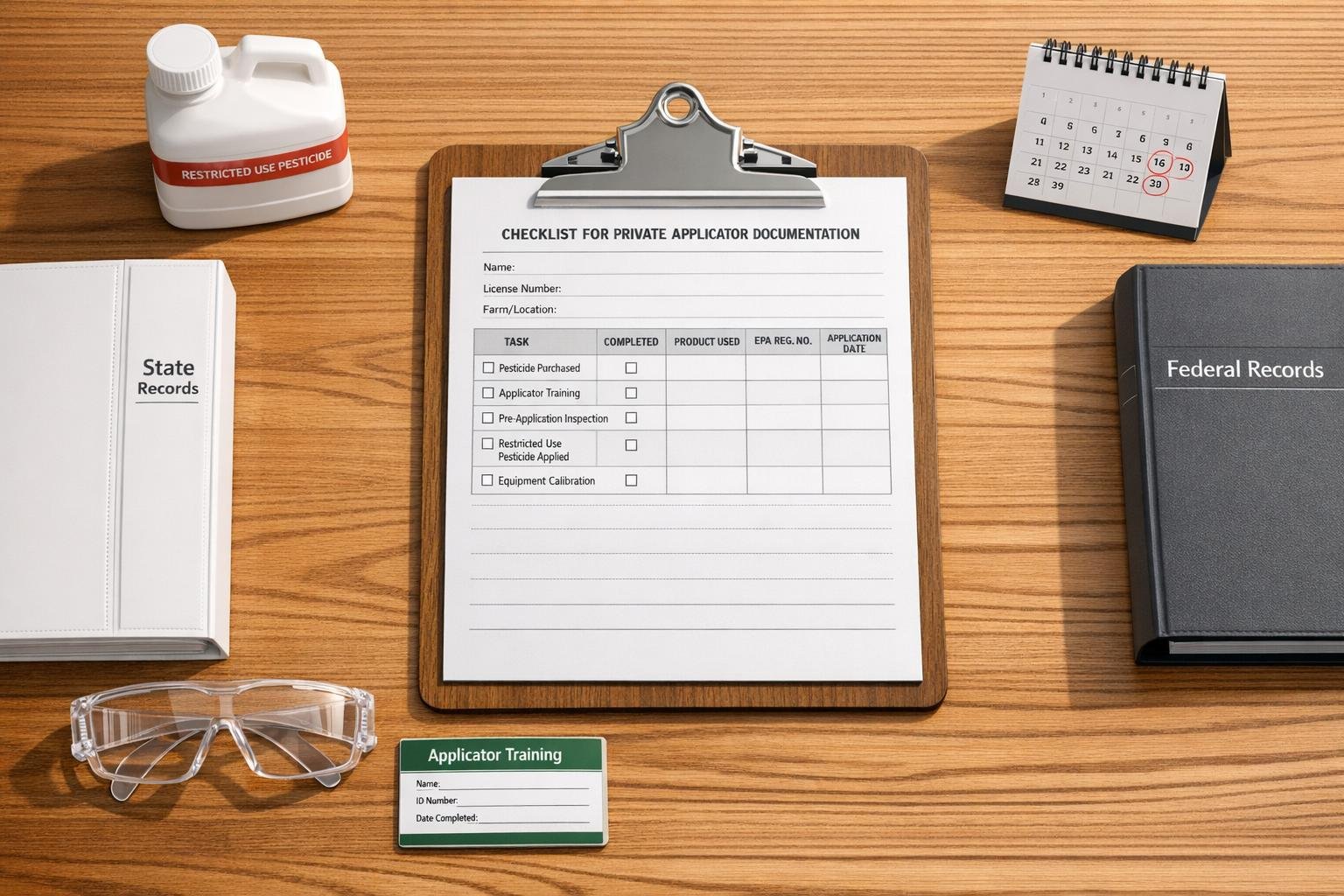
Private applicators are legally required to document restricted-use pesticide (RUP) applications accurately and on time. Federal law mandates that records must be completed within 14 days and kept for 2 years, though some states impose stricter rules. For example, Pennsylvania requires documentation within 24 hours and retention for 3 years. Non-compliance can lead to fines starting at $750 for first offenses and $1,100+ for repeat violations.
To stay compliant, here’s what you need to document for every RUP application:
- Applicator name, license number
- Product name, EPA registration number
- Total amount applied, treated area size
- Crop/commodity treated, location details
- Date, start/stop times, and restricted-entry intervals (REI) if applicable
States like Maryland and Delaware may also require weather data and equipment details. Certification records, training documentation, and safety measures (e.g., respirator fit tests) are equally important. Keep records organized and accessible for audits or emergencies. Whether using paper or digital tools, ensure compliance with federal and state timelines.
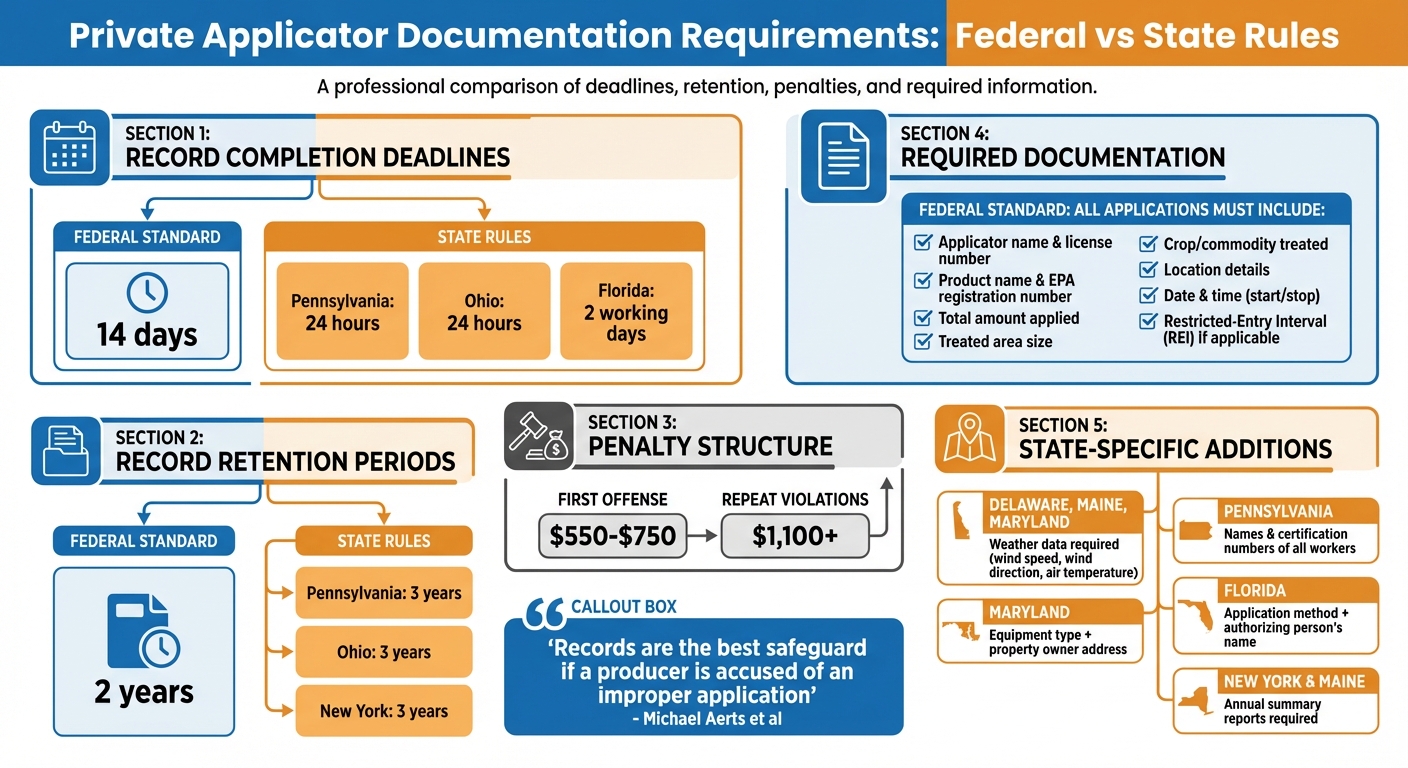
Federal vs State Pesticide Record Requirements Comparison Chart
Pesticide Application Records Checklist
Required Information for Each Application
Federal law mandates that private applicators keep detailed records for every restricted-use pesticide (RUP) application. These records must include the applicator’s name, license number, product name, EPA registration number, total amount applied, treated area size, crop or commodity treated, and the exact location of the application. Be sure to take the EPA Registration Number directly from the product label.
If handlers are involved, additional Worker Protection Standard (WPS) details are required, such as the application date, start and stop times, active ingredients, and the Restricted-Entry Interval (REI). For Pennsylvania, you also need to document the specific hour the application was completed if the pesticide has a reentry time. Location details must be precise – use GPS coordinates, maps, USDA Farm Service Agency field numbers, or legal property descriptions.
For spot treatments under 1/10th of an acre in a single day, federal law permits simplified records. These should include the date, product name, EPA number, total amount used, and a location description labeled as a "spot application". Keep in mind, "Total Amount" refers to the entire product used, while "Rate" specifies the amount per unit.
"Records are the best safeguard if a producer is accused of an improper application that causes drift, personal injury, or potential water-quality impairment." – Michael Aerts, O. Norman Nesheim, and Frederick M. Fishel
Beyond federal guidelines, states may have their own additional requirements. For example, those seeking an Oklahoma exterminator license must adhere to specific state-mandated training and recordkeeping protocols.
State-Specific Documentation Rules
While federal law allows up to 14 days to complete records, some states enforce tighter deadlines. For instance, Pennsylvania and Ohio require records to be finalized within 24 hours of application, while Florida allows two working days.
Some states also demand more detailed documentation. Delaware, Maine, and Maryland require weather data, including wind speed, wind direction, and air temperature, to be recorded on-site. Maryland further requires the type of equipment used and the property owner’s address.
Record retention periods also vary. While federal law sets a two-year minimum, Pennsylvania, Ohio, and New York require records to be maintained for three years. Both New York and Maine mandate annual summary reports, with New York’s due by January 15th. Pennsylvania also insists on listing the names and certification numbers of all individuals involved in the application, including non-certified workers under direct supervision. In Florida, you must document the application method and the name of the person authorizing the treatment.
sbb-itb-c4006de
Certification and Training Records Checklist
Active Certification Documents
It’s crucial to keep your state-issued private applicator certification up to date. Using an expired license to apply restricted-use pesticides is a violation of federal law. Federal guidelines mandate recertification every 3 to 5 years, which usually involves completing continuing education courses.
"Applicators must be recertified periodically to maintain certification. This generally requires continuing education courses every 3-5 years." – EPA
Stay on top of your license expiration dates and renew them promptly. If you’re supervising non-certified assistants, make sure to document their roles alongside your certification number. Follow both federal and state retention rules for these records. Additionally, pair your certification records with detailed training documentation to ensure compliance with safety standards and specialized application requirements.
Additional Training Documentation
In addition to basic certification, it’s important to keep records of any specialized training or safety protocols mandated by state regulations or specific product guidelines. For instance, if you’re working with fumigants or other tightly regulated products, you’ll need documentation showing you’ve completed the necessary certification exams or state-required training. Maintain a master list of all applicators, including their certification numbers and any specialized training records.
For products that require respiratory protection, you should have written proof of medical clearance, annual fit test results, and respirator training records. Under the Worker Protection Standard (WPS), you’re also required to document annual training for all workers and handlers. However, certified applicators are exempt from the annual WPS handler training requirement.
Platforms like Online Pest Control Courses (https://onlinepestcontrolcourses.com) offer state-approved recertification courses. These courses provide instant certificate downloads, making it easier to keep your documentation current while earning the continuing education credits needed for license renewal.
Pesticide Record Keeping
Safety and Compliance Records
Keeping up with safety measures and equipment compliance is a critical part of managing a private applicator documentation system.
Safety Data Sheets and PPE Records
Under the Worker Protection Standard (WPS), you need to post the Safety Data Sheet (SDS) for every pesticide applied – or with a restricted-entry interval (REI) still active in the past 30 days – in a central hazard area. This area should also include a pesticide safety poster and key records. If a pesticide label doesn’t clearly list the active ingredient’s common name, the SDS can help identify it correctly.
For pesticides requiring respiratory protection, maintain individual handler files that include medical clearance, annual fit test results, and respirator training records. Using standardized forms, like the "WPS Employee Respirator Record Form", can simplify this process. It’s also smart to have a Pesticide Emergency Response Sheet on hand, listing contact information for the nearest medical facility and local fire department.
Beyond SDS and personal protective equipment (PPE) records, keeping detailed equipment logs is equally important for meeting compliance standards.
Equipment Maintenance and WPS Documentation
Keep a sprayer calibration record that includes the date, equipment ID, nozzle types, pressure, and flow rates. These logs should be saved for at least three years.
Additionally, document all equipment cleaning and winterizing procedures. For pesticides with an REI exceeding 48 hours, post warning signs at the treated areas along with the central SDS display. Also, ensure annual WPS training records for workers and handlers are properly documented – though certified applicators are exempt from this requirement.
Accurate and organized records not only ensure compliance but also help maintain safety for everyone involved. For more industry insights and updates, visit our pest control blog.
Document Storage and Retention Guidelines
Once you’ve gathered your documentation, it’s crucial to store it in a way that ensures both easy access and compliance with legal retention rules. Federal law mandates that certified private applicators keep records of Restricted Use Pesticide (RUP) applications for at least 2 years. However, state requirements can be stricter – like in Pennsylvania, where records must be kept for 3 years. This section highlights practical storage methods to ensure compliance and accessibility.
It’s essential to stick to the required timelines. Federally, records must be completed within 14 days, but some states require them to be finalized within 24 hours. Additionally, these records need to be readily available in emergencies, particularly for medical professionals dealing with pesticide exposure cases.
Storage Method Comparison
There are several ways to store your records, each with its own benefits. The USDA Agricultural Marketing Service notes, "No standard Federal form is required, so that pesticide recordkeeping can be integrated into the applicator’s current recordkeeping systems". Below is a comparison of common storage methods:
| Storage Method | Advantages | Retention Period | Accessibility Notes |
|---|---|---|---|
| Paper Files/Logbooks | Simple to use in the field; no risk of software issues; no technical skills needed | 2 years (Federal) / 3 years (State) | Must be well-organized to avoid losing pages or documents |
| Digital Records/Apps | Easy to search; saves space; helps track inventory | 2 years (Federal) / 3 years (State) | Should be printable for regulatory purposes; ensure long-term file access |
| Invoices/Note Cards | Combines recordkeeping with existing business documents | 2 years (Federal) / 3 years (State) | Must include all required details like EPA numbers and application rates |
By choosing the right storage method, you’ll not only meet legal requirements but also make compliance reviews and emergency responses smoother.
For those opting for digital storage, ensure files remain accessible for 4–6 years. Use software that can generate clear, printable records. A hybrid system – combining digital tools with printed templates for field use – can also be a smart choice. As Carol Black from Pesticide Environmental Stewardship wisely points out, "A prudent applicator always records significantly more information than the minimum requirements".
Conclusion
Maintaining accurate and complete documentation is crucial for protecting your operation, workers, and surroundings. Each record you keep – whether it’s application logs or Safety Data Sheets – serves as a solid paper trail showing that you’re handling pesticides responsibly and within the law. When agencies like the Ohio Department of Agriculture request your records, having them well-organized reflects professionalism and compliance.
Good recordkeeping does more than just meet legal requirements; it also provides legal protection. Federal guidelines mandate keeping records for at least two years, while states like Pennsylvania and Ohio extend that requirement to three years. Missing or incomplete records can lead to civil penalties, starting at $550 for a first offense and climbing to $1,100 or more for repeated violations. Beyond avoiding fines, proper records also help you monitor chemical use, ensure accurate equipment calibration, and act quickly in emergencies.
Documenting pesticide applications on the day of use – or within 14 days – helps ensure accuracy and reduces the chance of errors. This is particularly important in situations where medical professionals need immediate access to pesticide label details after an exposure incident. Be sure your records include all required application details to stay compliant.
Regular training is key to maintaining good documentation practices. Regulations evolve, and ongoing education helps you stay up to date. Platforms like Online Pest Control Courses offer state-approved training that covers documentation rules, Worker Protection Standard compliance, and best practices for recordkeeping. These courses include topics like pesticide laws, safety measures, and management strategies, and they’re accessible on any device, with instant certificate downloads upon completion.
FAQs
What counts as a restricted-use pesticide (RUP) application?
A restricted-use pesticide (RUP) application refers to the use of pesticides that are specifically classified as RUPs. These pesticides aren’t available for general public use because they can pose risks to the environment or cause harm if not handled with extra precautions. To ensure safety and regulatory compliance, only certified applicators – or those working directly under their supervision – are allowed to apply these pesticides.
How do I know my state’s deadline and retention rules?
Check your state’s pesticide regulations – they might impose stricter rules than federal laws. For instance, while federal laws typically require keeping records for at least 2 years, some states extend that to 2-3 years and may include extra rules about submitting or granting access to those records. To stay compliant, visit your state’s regulatory agency website or reach out directly for details about deadlines and documentation requirements.
What’s the easiest way to record spot treatments correctly?
To properly document spot treatments, it’s important to include all the key details. Start with the date and location of the treatment. Then, describe the area treated and specify the exact spots where the pesticide was applied. Be sure to record the weather conditions, the pesticide brand and EPA registration number, the concentration used, and the size of the treated area.
Thorough and accurate records not only help you stay compliant with regulations but also ensure your recordkeeping is organized and effective.