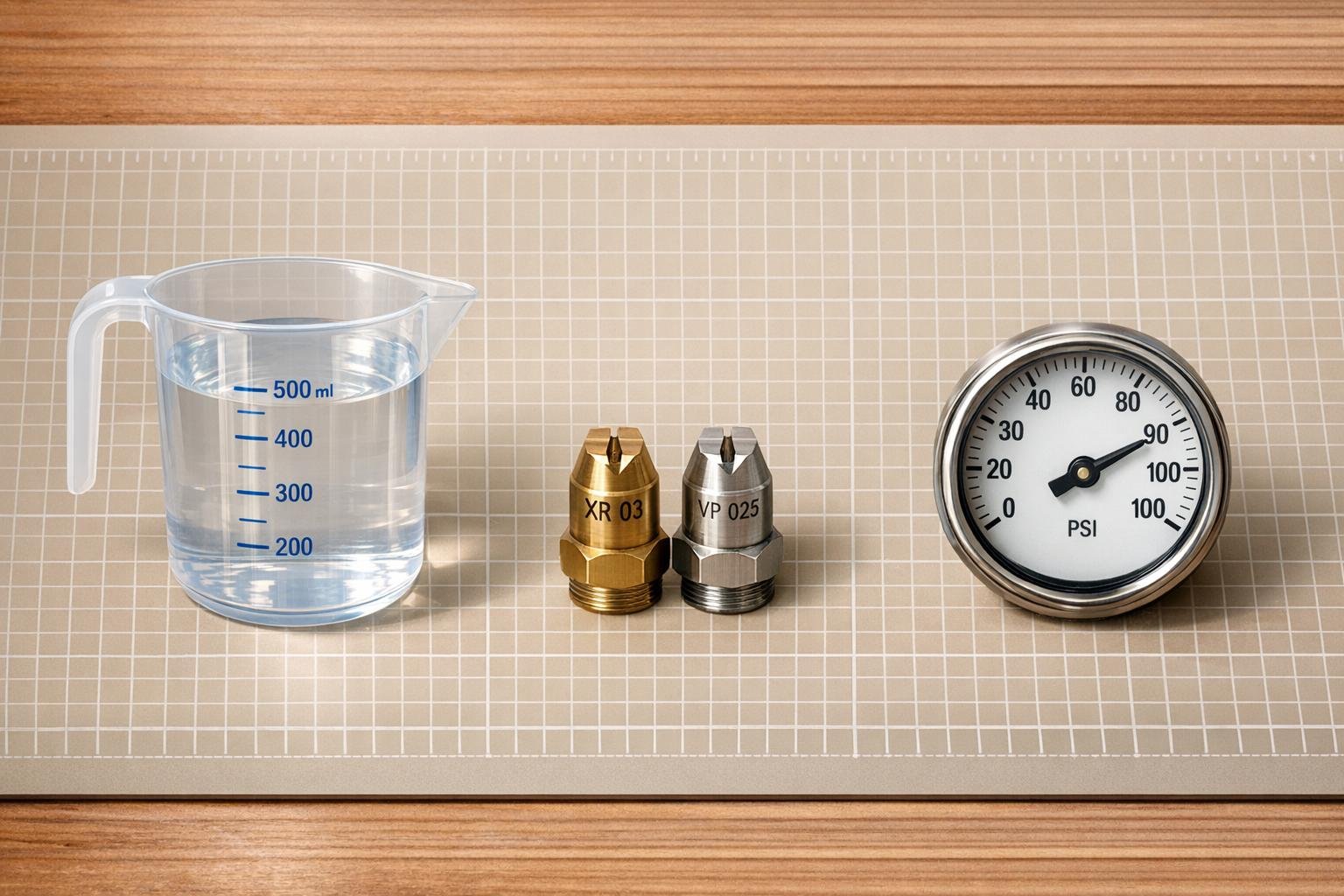
When applying pesticides, accurate calibration is key to saving money, protecting crops, and reducing risks. Tools like jugs, nozzles, and gauges play distinct roles in ensuring correct application rates. Here’s a quick summary:
- Jugs measure liquid output (GPM) and are beginner-friendly but require precise timing, a skill often covered in exterminator training courses.
- Nozzles control flow rates and spray patterns but need regular maintenance and proper material selection.
- Gauges monitor system pressure and ensure consistency but need pairing with other tools for volume measurement.
Each tool has specific strengths and limitations, making the right combination essential for effective pesticide application.
Quick Comparison
| Tool | Purpose | Strength | Weakness | Best For |
|---|---|---|---|---|
| Jugs | Measures liquid output (GPM) | Affordable; simple for beginners | Timing-sensitive; manual effort | Stationary calibration |
| Nozzles | Controls flow and spray pattern | Durable options for precision control | High maintenance; wears over time | Long-term field use |
| Gauges | Monitors system pressure | Reliable for consistent pressure | Can’t measure volume directly | Pressure checks and system monitoring |
Using these tools together ensures precise pesticide application, reduces waste, and minimizes costly errors.
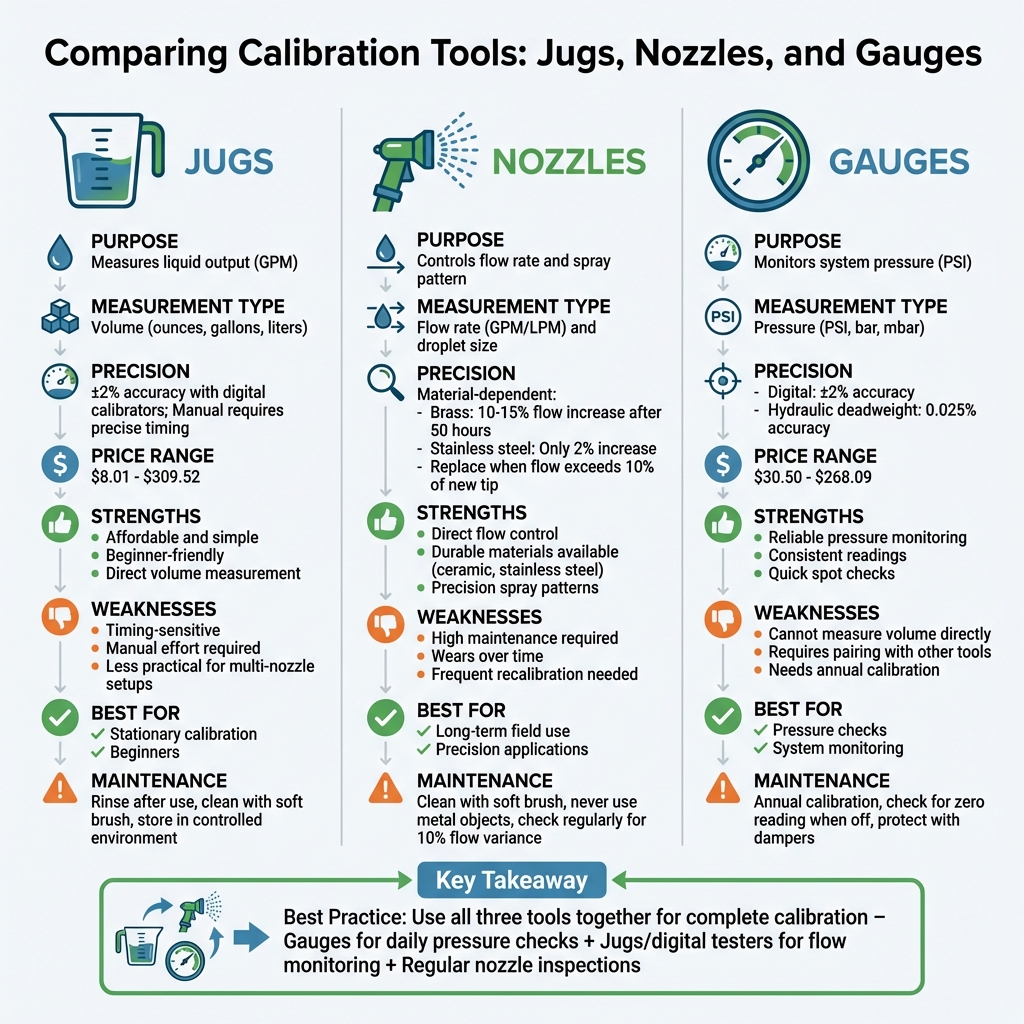
Pesticide Calibration Tools Comparison: Jugs vs Nozzles vs Gauges
1. Jugs
Measurement Type
Calibration jugs are tools for measuring liquid volume – commonly in ounces, gallons, or liters – and determining the flow rate (Gallons Per Minute, GPM) from individual sprayer nozzles. They work by capturing the actual output of a nozzle over a specific time frame, typically one minute. This ensures that the sprayer applies the correct amount of chemical. Unlike pressure gauges, which measure PSI, jugs directly measure the liquid output, providing the foundation for accurate flow rate calculations.
Precision
Using jugs for manual calibration requires precise timing with a stopwatch and a quick calculation – dividing the measured ounces by 128 to determine GPM. Digital calibrators, such as the SpotOn SC-2, simplify this process with ±2% accuracy and deliver results in just 10 seconds, eliminating potential timing errors. According to Maryland applicator recertification and general industry recommendations, spray tips should be replaced when their flow rate exceeds that of a new tip by 10%. It’s worth noting that brass nozzles, after about 50 hours of use, can increase flow by 10% to 15%, while hardened stainless steel nozzles typically see only a 2% increase in flow rate.
Ease of Use
When calibrating manually, jugs require consistent operating pressure and precise timing. The process involves collecting water from the nozzle for exactly one minute and comparing the measured volume to the manufacturer’s specifications. Digital calibrators simplify this by instantly displaying key data like GPM, liters per minute (LPM), and even tip wear percentage. To ensure accurate results, it’s crucial to clean nozzle screens and strainers beforehand. This step helps ensure that the readings reflect the nozzle’s actual condition rather than being skewed by blockages.
Maintenance Requirements
Proper care of calibration jugs is essential for accurate and reliable performance. After each use, clean the jug thoroughly with water and a soft brush, like a toothbrush. Avoid using sharp or metal objects, such as pocket knives, as they can damage the nozzle orifice and compromise future measurements. Dedicate the jug exclusively to pesticide calibration to prevent cross-contamination. Store it in a controlled environment and inspect it regularly for signs of rust, leaks, or physical damage. This routine helps maintain the jug’s integrity and ensures long-term accuracy.
sbb-itb-c4006de
2. Nozzles
Measurement Type
Nozzles play a key role in calibration by managing flow rate, breaking liquid into droplets, and shaping the spray into a specific pattern. The type of nozzle determines the measurement outcome. For instance, flat-fan nozzles are designed for medium droplets, making them suitable for broadcast or banding herbicides. Flooding and full cone nozzles, on the other hand, produce larger droplets that resist drifting, ideal for pre-plant herbicides. Meanwhile, hollow cone nozzles create finer droplets, perfect for penetrating crop canopies when applying insecticides or contact herbicides. Adjusting the orifice size is the simplest way to modify the sprayer’s output. These design specifics are critical to achieving precise performance. Understanding these technical details is a key part of Michigan applicator recertification and professional development.
Precision
The accuracy of a nozzle depends largely on its material and the conditions under which it operates. Material choice matters: brass nozzles, for example, can experience a 10–15% increase in flow after just 50 hours of use, whereas stainless steel maintains much better consistency. To ensure a uniform spray pattern, nozzles on a boom should be identical in size, type, and material. Ideally, individual nozzle output should not vary by more than ±5% from one another. Pressure management is equally important – doubling the flow rate requires increasing pressure by a factor of four, which can lead to excessive drift [3,12]. Consider this: a 100-micron droplet can drift about 50 feet in a 3 mph breeze, while a 10-micron droplet might travel as far as 3,000 feet.
Ease of Use
Choosing the correct nozzle can simplify calibration significantly. Operating nozzles within the manufacturer’s recommended pressure range – usually between 15 and 40 PSI for standard herbicides – helps maintain proper spray patterns and reduces drift [1,12]. To ensure uniformity, collect output from each nozzle for one minute and visually inspect the spray pattern on dry concrete [1,12]. Boom height also plays a critical role: for 80-degree flat-fan nozzles spaced 20 inches apart, the boom should be positioned 17 to 19 inches above the target.
Maintenance Requirements
"Spraying nozzles are precision-engineered components. Never blow through a nozzle or poke with wires or pins – even the slightest damage to the orifice will alter flow rate, angle, and spray distribution." – SprayTrac
To clean blocked nozzles, soak them in warm, soapy water, gently scrub with a soft toothbrush, and use compressed air to clear any remaining debris [15,16]. Sprayer filters should also be regularly checked and rinsed under running water to prevent clogs. Replace nozzles when their flow rate exceeds that of a new nozzle by more than 10%, or at least once a year, even if no visible wear is apparent [12,16]. Keep a brand-new nozzle on hand as a reference to compare against used ones. Additionally, ensure the filter mesh size matches the nozzle size – for example, use a 100-mesh filter for nozzle sizes 01–03 and a 50-mesh filter for sizes 04–08.
How to Calibrate Your Sprayer [8-Step Guide + Formula]
3. Gauges
Gauges take the precision of sprayer systems to the next level by verifying pressure and flow rates with accuracy, complementing the work of jugs and nozzles in measurement and flow management.
Measurement Type
Gauges are used to measure system pressure (PSI, bar, mbar), individual nozzle flow rates (GPM, LPM, oz/min), and total application rates (GPA, LPH). Pressure gauges ensure your sprayer maintains consistent pressure during operation, while digital calibrators determine the actual liquid volume discharged from each nozzle. Many modern digital gauges simplify the process by automatically converting units and calculating application rates. They even help detect nozzle tip wear by comparing current flow rates to original specifications, combining this data with pressure readings for thorough calibration.
Precision
The accuracy of gauges can vary widely based on the type you choose. For instance, hydraulic deadweight testers can achieve an impressive 0.025% accuracy and handle pressures up to 16,000 PSI, making them ideal for lab environments. On the other hand, digital handheld calibrators offer ±2% accuracy and deliver results in just 10 seconds. To ensure reliability, industry standards recommend selecting a gauge with a higher accuracy rating than the device you’re measuring. Additionally, spray nozzle tips should be replaced when the flow rate exceeds the original by 10%. This level of precision is key to maintaining consistent performance in the field.
Ease of Use
Modern digital gauges are designed for simplicity. Many, like the SpotOn Sprayer Calibrator Model SC-2 (priced between $199.00 and $285.15), automatically calculate application rates and detect nozzle tip wear. For fieldwork, portable, battery-powered handheld calibrators are ideal for quick spot checks, while deadweight testers are best suited for lab use, where maximum precision is required. Quick-attach pressure testers, which snap directly onto nozzle fittings, provide a more accurate reading of the pressure at the tips compared to relying on a central tank gauge. To ensure consistent accuracy, choose a pressure gauge with a total range at least twice your maximum expected reading.
Maintenance Requirements
"Most pressure instrumentation comes with a certificate from the manufacturer that deems the instrument to be accurate for up to a year. After that point, readings could become less accurate." – Shawn S., Instrumart
Annual calibration is essential – ideally at the start of the spraying season – using a certified standard. Always verify that the gauge reads zero when the pump or boom valve is off to confirm it’s functioning correctly. Check for rust or signs of wear, and replace the gauge if needed. To extend the lifespan of your gauge, consider installing a gauge protector or damper to minimize damage from line pulsations. For calibration tasks, glycerin-filled stainless steel gauges are a solid choice due to their durability and resistance to wear. Proper maintenance ensures your gauges deliver reliable readings for effective spraying. Staying current with Mississippi applicator recertification and other state-specific training ensures you remain compliant with these calibration standards.
Advantages and Disadvantages
Here’s a quick breakdown of the key strengths and weaknesses of the tools discussed earlier. Each tool serves a specific purpose, making them better suited for certain calibration tasks.
Jugs stand out as the most beginner-friendly option, especially with the 1/128th acre method, where the number of fluid ounces collected directly translates to gallons per acre applied. They’re affordable, ranging from $8.01 for a 16 oz jug to $309.52 for professional-grade 5-gallon containers, and require only a rinse after use. However, their accuracy depends on precise timing, making them ideal for stationary calibration but less practical for rapid multi-nozzle setups.
Nozzles, on the other hand, offer direct control over flow rates and spray patterns. Their performance depends heavily on the orifice size and material. Durable materials like ceramic or hardened stainless steel are more reliable, with only about a 2% flow rate change after 50 hours of use, compared to a 10%-15% increase for brass nozzles. However, nozzles demand regular maintenance, including cleaning with a soft-bristled brush and frequent recalibration, even with minimal wear.
When it comes to system pressure, gauges ensure consistency. These tools are excellent for monitoring pressure, with options ranging from $30.50 for basic stainless steel models to $268.09 for specialized testers. As John Long, Extension Agricultural Engineer, explains:
"The actual accuracy of the gauge is not as important as its ability to give the same reading each time the same pressure is produced".
Gauges need periodic checks against a reference standard and protection from pressure fluctuations using dampers. Their main limitation is that they can’t measure volume directly, requiring them to be paired with other tools for full calibration.
| Tool Type | Primary Strength | Main Weakness | Best For |
|---|---|---|---|
| Jugs | Simple volume measurement at a low cost | Timing-sensitive accuracy | Beginners; stationary calibration |
| Nozzles | Precision flow control with durable materials | High maintenance; frequent recalibration | Long-term precision; field use |
| Gauges | Reliable, repeatable pressure readings | Can’t measure volume directly | Pressure monitoring; system checks |
Selecting the right tool – or combining several – depends on your specific calibration goals, available budget, and the level of precision you require. Accurate tools are essential for effective pesticide application.
Conclusion
Selecting the right calibration tool comes down to matching the tool with your specific application needs. For beginners or stationary checks, jugs offer an affordable and simple option. However, since they rely on manual timing and visual readings, they demand careful attention to detail. Nozzles, on the other hand, require regular maintenance, especially when working with abrasive formulations. For tasks involving wettable powders, investing in ceramic or hardened stainless steel nozzles is a smart choice to prevent waste caused by increased flow rates.
Gauges play a crucial role in monitoring system pressure, ensuring that nozzles operate at their ideal PSI. While absolute precision might not always be necessary, consistent readings under the same conditions are essential for reliable performance.
When it comes to field applications, the choice of tools often depends on the equipment being used. For large-scale broadcast applications, digital flow meters like the SpotOn SC-2 ($285.15) are a great option, as they significantly speed up multi-nozzle checks. Conversely, smaller equipment like backpack sprayers can be calibrated effectively with basic measuring containers marked in ounces.
For most applicators, having a mix of these tools is the best approach. Use gauges for daily pressure checks, rely on jugs or digital testers for periodic nozzle flow monitoring, and inspect nozzles regularly to catch potential issues early. This combination helps avoid costly mistakes and ensures efficient pesticide application.
Accurate calibration does more than save resources – it aligns with best practices recognized across the industry. For those looking to enhance their skills, Online Pest Control Courses offers state-approved training on calibration techniques, equipment maintenance, and application strategies. These courses provide CEUs and instant certificates, making it easier to stay current and meet recertification requirements.
FAQs
What’s the fastest way to check if my nozzles are worn out?
To check for worn nozzles, collect the spray output from each nozzle into a calibrated container over a 30-second period. Then, compare the collected flow to the nozzle’s original specifications. If any nozzle’s flow rate deviates by more than ±5%, it’s time to replace it. This helps maintain precise application and avoids uneven coverage.
Do I need both a jug and a pressure gauge to calibrate correctly?
No, you don’t always need to use both tools. Calibration tools like jugs, catch cans, and pressure gauges each have specific purposes and can be used independently or together depending on your needs. For example, jugs are designed to measure flow rates, while pressure gauges are used to check and maintain the correct system pressure. Some calibration methods prioritize measuring output volume, while others focus on pressure. While combining these tools can enhance precision, it’s not always required to achieve accurate calibration.
Which nozzle material is best for abrasive products like wettable powders?
When dealing with abrasive products like wettable powders, choosing the right nozzle material is crucial to avoid excessive wear. Hardened steel or other wear-resistant alloys work best, as they can handle the abrasive nature of these products and last longer. On the other hand, plastic nozzles are better suited for less abrasive liquids. They aren’t a good option for wettable powders because they wear out faster and are more prone to clogging or damage.