
Pesticide applicators have a critical responsibility to ensure public safety and environmental protection. Ethics training is key to maintaining professionalism and avoiding conflicts of interest, which can compromise decision-making and trust. Here’s what you need to know:
- Conflicts of Interest: These arise when personal or financial interests interfere with professional judgment. Examples include financial ties to manufacturers, accepting gifts, or negotiating future employment while making decisions.
- Legal Framework: The Federal Insecticide, Fungicide, and Rodenticide Act (FIFRA) and EPA regulations require applicators to demonstrate competency, disclose conflicts, and follow proper pesticide use.
- Common Scenarios: Misusing pesticides, off-label use, or failing to disclose financial incentives can lead to penalties, including fines and certification suspension.
- Training Importance: Ethics training helps applicators identify conflicts, disclose them properly, and adhere to professional standards.
Online training options provide flexibility, covering essential topics like financial disclosure and proper pesticide use, ensuring compliance with state and federal regulations. Maintaining transparency, integrity, and safety is vital for protecting public trust and the industry’s reputation.
What Are Conflicts of Interest in Pesticide Application?
Defining Conflict of Interest
A conflict of interest arises when an applicator’s personal or financial interests interfere with their ability to make unbiased professional decisions. Federal guidelines define this as participating "personally and substantially" in a decision where there is a direct or "imputed financial interest" involved. For pesticide applicators, this includes situations where external factors – such as financial incentives, gifts, or business ties – could cloud their judgment about safety and effectiveness.
When these conflicts affect decision-making, they can result in the "unnecessary or ineffective use" of pesticides or even outright misuse. Federal law is clear: using a pesticide in a way that contradicts the pesticide label is a violation, regardless of any financial motivations. As mentioned earlier, enforcement measures are in place to address such breaches and uphold professional integrity.
Let’s look at some examples of how these conflicts play out in real settings.
Common Conflict Scenarios in Pest Control
Here are some typical situations where conflicts of interest might arise for pesticide applicators:
- Financial Ties to Manufacturers: For example, an applicator who owns stock in a pesticide company might face a conflict when recommending that company’s products to clients.
- Gifts and Incentives: Accepting a $100 gift certificate or an all-expenses-paid trip from a product manufacturer in exchange for promoting their products creates a biased financial incentive. Such actions are not just unethical but can also lead to severe consequences, including criminal penalties of up to five years in prison and fines of up to $50,000. Civil penalties can reach $50,000 per violation or the value of the improper compensation, whichever is greater.
- Dual Compensation: Taking payment from an outside source for duties that fall under your official role is another common issue.
- Negotiating Future Employment: Failing to recuse yourself from decisions involving a company while discussing potential employment opportunities with them presents a clear conflict.
For government applicators, the stakes are particularly high. For instance, loosening inspection standards in return for gifts qualifies as an illegal gratuity under federal law. Even unpaid activities can create conflicts. A forest ranger advocating for a cooperative agreement on behalf of a non-profit board they belong to is one such example.
Federal regulations also extend conflict-of-interest rules to include the financial interests of close family members, such as a spouse or minor child, as well as organizations where the applicator holds a leadership role. Recognizing these potential pitfalls is a critical step toward developing effective ethical practices and management strategies in pesticide application.
sbb-itb-c4006de
Legal and Ethical Guidelines for Conflict of Interest Management
State and Federal Regulations for Pesticide Applicators
The Federal Insecticide, Fungicide, and Rodenticide Act (FIFRA), outlined in 7 U.S.C. 136i and 136w, establishes the legal framework for pesticide applicators’ conduct. Under FIFRA, the Environmental Protection Agency (EPA) created 40 CFR Part 171, which sets nationwide standards for state certification programs. These regulations impact roughly 1 million certified pesticide applicators across the United States. According to federal law, applicators must prove their competency – demonstrating the ability to use pesticides responsibly without causing undue harm. This includes practicing proper product stewardship and providing accurate, clear communication about exposure risks to both customers and the public.
As the EPA explains:
States are required to cite in their certification plans specific laws and regulations demonstrating they have legal authority to assess both civil and criminal penalties against private applicators and commercial applicators.
These legal requirements not only ensure compliance but also establish a foundation for ethical behavior within the industry.
Core Ethical Principles for Professional Conduct
Beyond the legal obligations, ethical principles play a critical role in guiding pesticide applicators and preserving public trust. Key principles include:
- Objectivity: Personal financial interests must not interfere with professional judgment. Even the appearance of bias should be avoided to maintain credibility.
- Transparency: Full disclosure of any potential conflicts of interest is essential, ensuring decisions remain impartial and trustworthy.
- Integrity: Honest conduct is non-negotiable. This means refusing gifts or benefits from individuals or organizations that could influence regulatory decisions or procurement processes. Research highlights how financial conflicts can skew judgment, making vigilance crucial.
- Environmental Responsibility: Balancing human needs with ecological preservation is vital. Using practices like Integrated Pest Management (IPM) helps minimize chemical use and protect non-target species.
- Scientific Accuracy: Data must be handled responsibly, with conclusions drawn from reliable, evidence-based research. Manipulating findings to serve financial interests undermines scientific credibility.
How to Manage and Reduce Conflicts of Interest
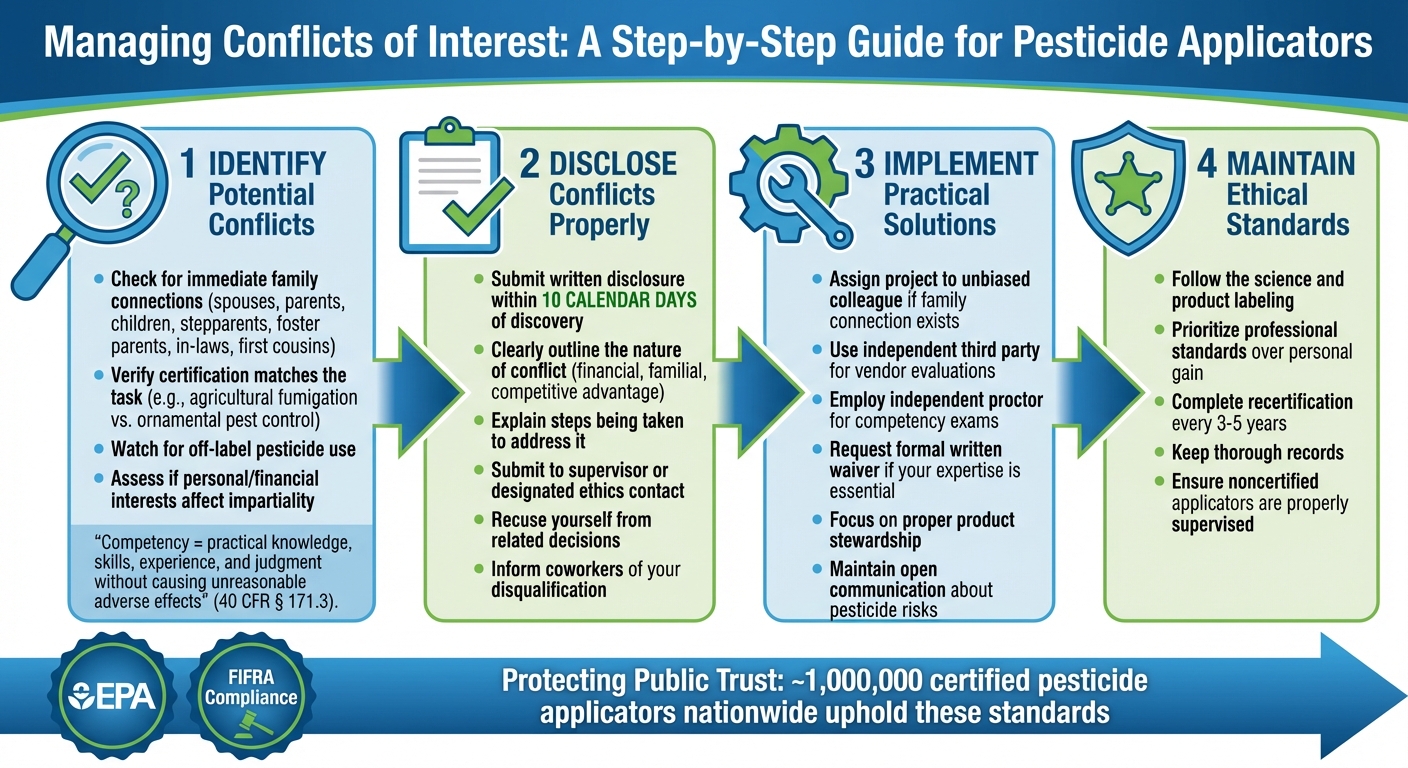
4-Step Conflict of Interest Management Process for Pesticide Applicators
Identifying Potential Conflicts
Recognizing potential conflicts is a critical step in maintaining ethical practices, especially in pesticide application. Federal regulations define "immediate family" broadly, including not only spouses, parents, and children but also stepparents, foster parents, in-laws, and even first cousins (the child of a parent’s sibling). If you’re planning to apply pesticides on property owned or managed by any of these relatives, you may be stepping into a conflict of interest.
It’s also essential to ensure your exterminator certification aligns with the task at hand. For example, performing agricultural fumigation when you’re only certified for ornamental pest control isn’t just a legal issue – it’s an ethical one too. Similarly, using pesticides off-label violates competency standards and raises questions about whether external pressures are affecting your judgment. According to 40 CFR § 171.3, competency involves having the "practical knowledge, skills, experience, and judgment necessary to perform functions associated with restricted use pesticide application without causing unreasonable adverse effects". If personal or financial interests are clouding your impartiality, take a step back and reassess the situation.
Once you’ve identified a potential conflict, the next step is prompt and transparent disclosure.
Disclosing Conflicts Properly
The Environmental Protection Agency (EPA) requires conflicts to be disclosed in writing within 10 calendar days of discovery. Your disclosure should clearly outline the nature of the conflict – whether it’s financial, familial, or related to a competitive advantage – and explain the steps you’re taking to address it. This might involve eliminating, neutralizing, or mitigating the conflict.
After submitting your disclosure to your supervisor or designated ethics contact, recuse yourself from any related decisions. Let coworkers know about your disqualification to ensure transparency. Acting quickly and openly protects trust within your team and reinforces ethical standards in the industry.
Practical Solutions for Managing Conflicts
Once a conflict has been disclosed, taking clear steps to resolve it is essential. For example, if a family connection is involved, assign the project to a colleague who can approach it without bias. When working with product demonstrations or vendor relationships, consider bringing in an independent third party to evaluate recommendations. This ensures decisions are based on technical merit rather than financial incentives.
In cases where competency exams are required, use an independent proctor to maintain fairness. If your expertise is absolutely necessary for a project despite the conflict, you may request a formal written waiver from your supervisor or regulatory body, provided the conflict doesn’t significantly undermine integrity. Throughout all applications, focus on proper product stewardship and maintain open communication with customers about pesticide risks.
When commercial pressures clash with environmental safety or public welfare, the ethical choice is clear: follow the science, adhere to product labeling, and prioritize professional standards over personal or financial gain.
Online Ethics Training for Pesticide Applicators
Advantages of Online Ethics Training
Online ethics training offers a flexible alternative to the rigid schedules of in-person sessions. With around 1,000,000 certified pesticide applicators and approximately 930,000 noncertified applicators across the United States, this adaptability is crucial. Self-paced courses let you complete training on your own time, making it easier to meet requirements without disrupting your routine.
These online modules, designed to be completed in about an hour, cover essential topics like Financial Disclosure, Conflict of Interest, Representation, and Misuse of Position. To keep learners engaged, interactive elements such as polls or questions appear roughly every 10 minutes. Additionally, the platforms ensure compliance by requiring participants to view at least 50 minutes of pesticide-related content for each credit hour.
After finishing the course, you can immediately print your certificate or have it sent electronically to state regulatory officials. This is especially helpful when recertification deadlines – typically every 3 to 5 years – are approaching. Platforms like Online Pest Control Courses make it easy to manage training and meet conflict-of-interest guidelines efficiently.
Ethics Training Through Online Pest Control Courses
Online Pest Control Courses offers state-approved training tailored to pesticide applicators, adhering to EPA standards, including the 2017 Certification of Pesticide Applicators rule. The platform’s mobile-friendly design allows you to complete modules on a smartphone, tablet, or laptop – wherever you have internet access. This convenience is critical for professionals who can’t afford to take a full day off for training.
To ensure certification integrity, the platform verifies your identity using a government-issued photo ID. Before signing up, double-check that the course is approved in your state, territory, or tribe, as requirements can vary beyond federal guidelines. The platform also offers a 30-day money-back guarantee and instant certificate delivery, making it easy to provide proof of training to your state lead agency without delays.
Conclusion: Maintaining Ethical Standards in Pesticide Application
Ethics training is far more than a box to check – it’s a cornerstone of public safety and professional credibility. By following pesticide labels and addressing conflicts responsibly, you help prevent misuse that can harm people, pollute water, and impact non-target organisms. The EPA underscores this duty: "EPA takes very seriously our duty to ensure that, when used according to label instructions, pesticides can be used safely".
Ethical conduct is also the backbone of certification. States have the authority to suspend or revoke certifications for misusing pesticides or falsifying records. The industry’s reputation relies on every applicator upholding these standards.
Certification and proper supervision go hand in hand as ethical obligations that protect public trust. Recertification every 3 to 5 years isn’t just about compliance – it’s about staying informed on safety protocols and application methods. The updated Certification of Pesticide Applicators rule strengthens safety standards, aiming to prevent $13.2 to $24.3 million in annual losses from pesticide-related incidents. If you oversee noncertified applicators, it’s your ethical duty to ensure they’re well-trained and supervised. Keep thorough records, verify their qualifications, and maintain open communication during applications. This level of stewardship safeguards workers, clients, and the environment while fostering trust essential for long-term success.
Always adhere to pesticide labels. Using a registered pesticide in a way that contradicts its labeling isn’t just illegal – it erodes the profession’s integrity. By committing to transparency, ongoing education, and proactive conflict resolution – bolstered by state-approved online training – you’re elevating the standards and reputation of the pest control field.
FAQs
What is considered a conflict of interest for pesticide applicators?
A conflict of interest happens when a pesticide applicator’s personal financial stakes – like owning property, holding investments, or having business ties – might interfere with their duty to act in the best interest of the public or their clients. For instance, these financial connections could sway their decisions or professional behavior.
When do I need to disclose a conflict, and to whom?
When a conflict of interest arises, it’s essential to disclose it immediately. You should notify either the designated ethics official or your supervisor, typically through a written statement or an email. This approach ensures you meet ethical requirements while maintaining proper documentation.
What should I do if a client or vendor offers me gifts or incentives?
You should never accept gifts or incentives from sources that are not allowed or if the offer is tied to your official role. It’s important to politely refuse any gift solicitations to avoid potential conflicts of interest and to uphold ethical standards in your professional conduct.