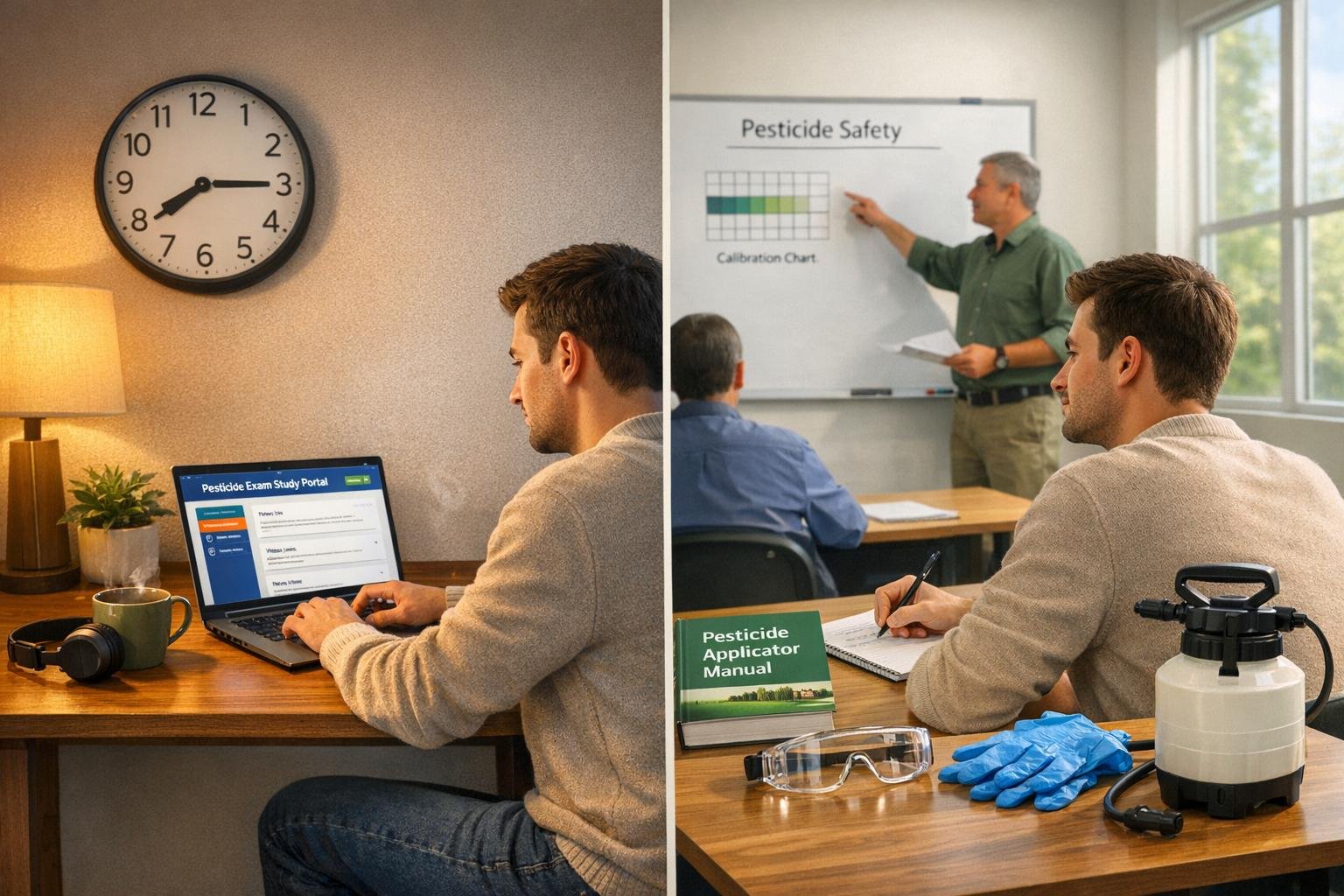
Preparing for a pesticide applicator certification exam means choosing between online and in-person training. Both options cover the same core topics like pesticide laws, safety, and application techniques, but they differ in flexibility, cost, and learning style. Here’s a quick breakdown:
- Online Prep: Flexible scheduling, study from home, and lower travel costs. Requires self-discipline, a reliable computer, and internet.
- In-Person Prep: Hands-on learning, real-time instructor feedback, and networking opportunities. Fixed schedules and travel costs can be challenging.
Quick Comparison
| Factor | Online Prep | In-Person Prep |
|---|---|---|
| Flexibility | Study anytime, anywhere | Fixed dates and locations |
| Interaction | Virtual (email, chat, forums) | Face-to-face with instructors |
| Cost | Convenience fees ($12.60–$26) | Travel and lodging expenses |
| Pace | Self-paced | Instructor-led |
| Hands-On Practice | Limited | Available |
| Technology Needs | Computer, webcam, internet | None |
Your choice depends on your learning style, schedule, and resources. Online is ideal for those with tight schedules and a strong sense of discipline, while in-person is better for those who prefer structured, interactive environments.
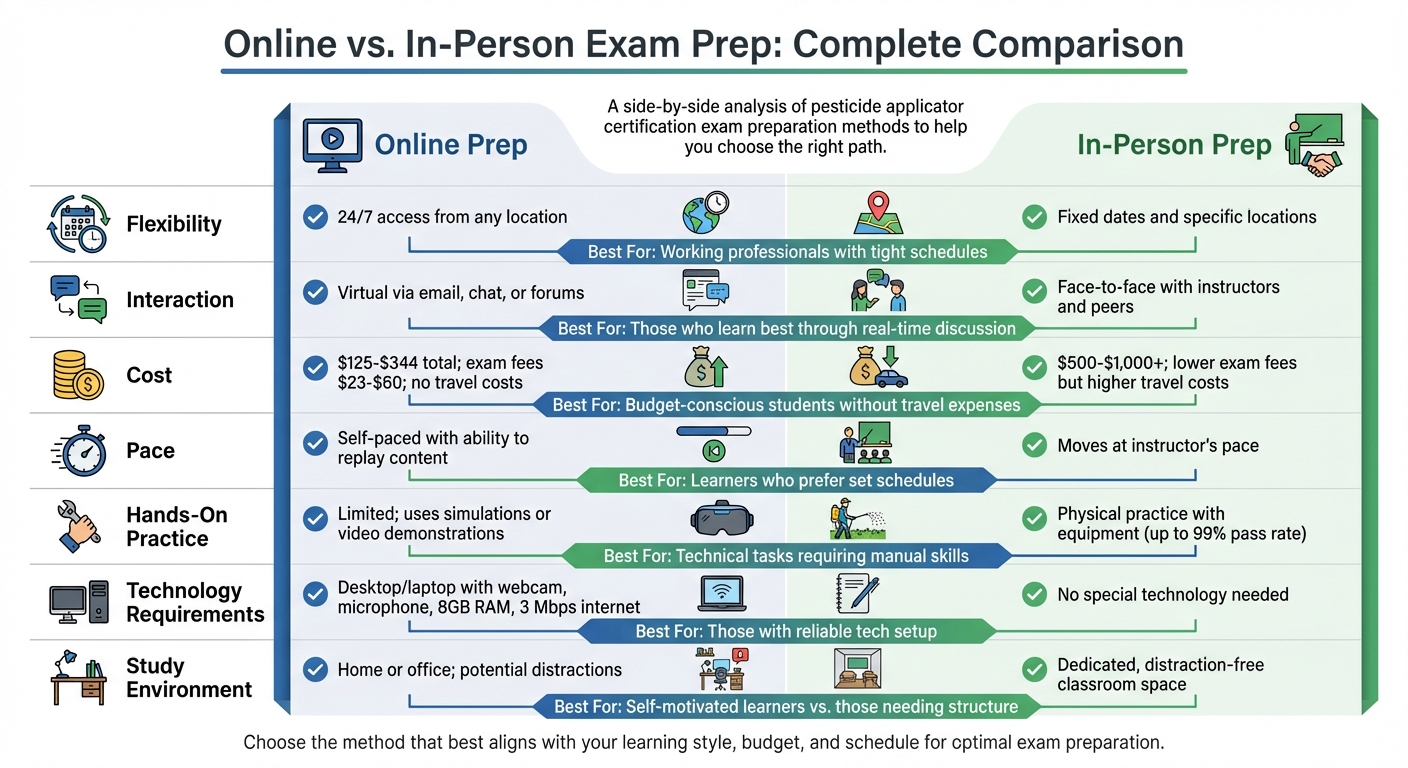
Online vs In-Person Pesticide Exam Prep Comparison Chart
Online Exam Prep: Pros and Cons
Benefits of Online Exam Prep
Online exam preparation brings a level of flexibility that’s hard to beat. You can study and take exams whenever it suits you, 24/7, which eliminates the hassle of scheduling around rigid time slots or commuting. This not only saves time but also makes studying more convenient.
Brett Bultemeier, an Extension Assistant Professor at UF/IFAS, explained the added cost advantages:
"We hope this online option will save applicators both time and money. When you factor in travel time and testing time, a pesticide applicator may spend half a day or more to sit for an in-person exam."
While online exams do come with convenience fees – ranging from $12.60 in Illinois to $26 in Florida – they offset costs like fuel and time away from work. Platforms like Online Pest Control Courses offer state-approved CEU and CCU courses that are accessible on any device. These courses cover a wide range of topics, including pesticide laws, formulations, environmental impact, and pest management strategies, and they even provide instant certificate downloads upon completion.
Another perk? The testing environment itself. Taking exams from the comfort of your home or office can help ease stress compared to sitting in a crowded, unfamiliar setting. Bultemeier noted that this can significantly reduce testing anxiety. For instance, in North Carolina, when the online option became available in March 2021, 1,202 people registered for online exams within just six months.
However, despite these advantages, there are some notable drawbacks to consider.
Drawbacks of Online Exam Prep
While the flexibility of online exam prep is a major plus, it also comes with its own set of challenges. For starters, the technology requirements can be a hurdle. You’ll need a desktop or laptop with a functioning webcam and microphone – tablets and smartphones are usually not allowed. On top of that, a stable internet connection and specific software like the Guardian browser are mandatory.
In North Carolina, online exams are recorded and monitored by human proctors. Examinees must even perform a 360-degree camera pan of their surroundings to prove they’re not using unauthorized materials. As John Feagans, Manager of Licensing at NCDA&CS, explained:
"If there’s ever an issue with the testing, we get an email from Everblue. They send video clips of what they’re referring to with an explanation from the proctor… We have a pretty low tolerance because it is new, and we don’t want anyone figuring out a way to cheat the system."
Another challenge is the need for strong self-discipline. Without in-person guidance, you’re responsible for navigating the multi-step registration process and testing your equipment ahead of exam day. Proctors can only help with technical issues, not with the exam content itself. Additionally, if you need to schedule an exam on short notice (less than 72 hours in advance), you might face an extra fee of up to $12.
Online Exam Prep: Pros and Cons Table
| Advantages | Disadvantages |
|---|---|
| 24/7 scheduling flexibility | Requires a desktop/laptop with a webcam and microphone |
| No travel time or fuel costs | Convenience fees ($12.60–$26 per exam) |
| Study from home or office | Limited to technical support for issues |
| Reduced testing anxiety in a familiar setting | Strict proctoring with low tolerance for irregularities |
| Instant certificate downloads | Requires high self-discipline |
| State-approved CEU/CCU credits | Not available for all license types or states |
sbb-itb-c4006de
In-Person Exam Prep: Pros and Cons
Benefits of In-Person Exam Prep
In-person exam preparation stands out for its direct, face-to-face interaction. These courses offer structured guidance, where instructors can provide real-time feedback and immediate answers to questions. This is especially helpful when dealing with challenging topics like pesticide laws, application techniques, or Integrated Pest Management (IPM) strategies.
Another major perk is the opportunity for hands-on learning. Unlike online programs, in-person settings allow participants to practice under professional supervision. This means you can observe safety demonstrations, try out techniques, and receive instant corrections. As OSHA Outreach Courses points out, "In-person classes excel in [hands‑on training], allowing you to practice and receive feedback on your techniques".
The classroom environment itself is often free from the distractions of home or work. Plus, these sessions create opportunities to network with other professionals in the pest control industry. You can exchange experiences, learn from peers, and build connections that might help your career in the long run.
Some states also offer specialized "Short Courses" tailored to specific certification categories, such as Ornamental and Shade Trees, Lawn and Turf, or Right-of-Way and Weeds. For example, Washington State University charges $60 per day for early bird registration (when booked 14 days in advance) and $90 per day for regular registration. Additionally, states like Washington provide courses in Spanish for Private Applicators, ensuring accessibility for more diverse communities.
However, despite these advantages, in-person prep does have its own set of challenges.
Drawbacks of In-Person Exam Prep
While in-person prep has its strengths, it also comes with logistical hurdles. One of the main issues is the lack of scheduling flexibility. Classes are held at specific times – such as 1:30 p.m. to 4:30 p.m. – which can conflict with work or personal commitments. Additionally, many states only offer these courses during limited "recertification seasons", like winter or spring.
Unlike online prep, which eliminates travel, in-person courses require commuting to a physical location. This adds time and costs, especially for those living in remote areas. Expenses for fuel, lodging, and meals can quickly add up. Jacques Wong, CEO and Director of Education at PNC Learning, highlights this point: "Physical exams can be time‑consuming and take many resources to set up by the institutions".
Time commitment is another drawback. Beyond the actual class hours, commuting can eat into your day. And unlike online courses, where you can set your own pace, in-person classes follow a fixed schedule. This can feel restrictive for learners who prefer to move faster – or slower – through the material.
In-Person Exam Prep: Pros and Cons Table
| Advantages | Disadvantages |
|---|---|
| Face-to-face teaching with real-time Q&A | Fixed class times and rigid schedules |
| Hands-on practice with actual equipment | Requires physical presence at specific locations |
| Immediate instructor feedback on techniques | Travel expenses (fuel, lodging, meals) |
| Professional networking opportunities | Time-intensive due to commute requirements |
| Distraction-free learning environment | Limited availability (seasonal offerings) |
| Group learning from peers’ experiences | Higher overall costs compared to online options |
Online vs. In-Person: Side-by-Side Comparison
Coverage of Core Pesticide Topics
Whether you go for online or in-person preparation, the core curriculum remains the same. You’ll delve into pesticide laws, safety measures, pest identification, application techniques, and Integrated Pest Management (IPM) strategies in both formats. The difference lies in how the material is delivered, not what’s being taught.
In-person sessions often create a more structured environment, which some find helpful for staying focused. These sessions also allow for immediate clarification of regulations and on-the-spot problem-solving for complex calculations. On the other hand, online preparation typically breaks the material into modular lessons – such as 11 lessons based on the National Pesticide Applicator Certification Core Manual – and includes digital quizzes to reinforce learning.
But the real differences emerge when you consider factors like scheduling, cost, and accessibility.
Schedule Flexibility, Cost, and Access
When it comes to scheduling, online preparation offers unmatched flexibility. Many programs allow you to book exam appointments any time – day or night – seven days a week. In contrast, in-person options are tied to specific dates and times, often during limited recertification periods like winter or spring. John Feagans, Licensing Manager at NCDA&CS, highlights the convenience of online testing:
"For many, [in-person testing] takes at least half of a workday. For companies that send several employees to a testing site at once, it can have a major affect on staffing for that day. So the convenience of online testing is a significant appeal".
Cost is another factor to weigh. Online prep eliminates travel expenses but often includes convenience fees ranging from $23 to $60. In-person prep generally has lower exam fees, but travel and lost work time can add up.
Accessibility depends heavily on your resources. Online options require a desktop or laptop with a webcam, microphone, and high-speed internet. Tablets and mobile devices usually aren’t compatible with proctored exams. Meanwhile, in-person prep doesn’t rely on technology but is limited to specific locations, which can be challenging for those in remote areas.
Online vs. In-Person: Full Comparison Table
| Factor | Online Prep | In-Person Prep | Best For |
|---|---|---|---|
| Flexibility | 24/7 access from any location | Fixed dates and specific locations | Working professionals with tight schedules |
| Interaction | Virtual via email, chat, or forums | Face-to-face with instructors and peers | Those who learn best through real-time discussion |
| Cost | Eliminates travel costs; exam fees of $23–$60 | Lower exam fees but higher travel and time costs | Budget-conscious students without travel expenses |
| Pace | Self-paced with the ability to replay content | Moves at the instructor’s pace | Learners who prefer set schedules |
| Hands-On Practice | Limited; uses simulations or video demonstrations | Physical practice with equipment | Technical tasks requiring manual skills |
| Technology Requirements | Requires a desktop/laptop with a webcam, microphone, and high-speed internet | No special technology needed | Those with a reliable tech setup |
| Study Environment | Home or office; potential distractions | Dedicated, distraction-free space | Self-motivated learners vs. those needing structure |
How to Choose the Right Prep Method
What to Consider Before Deciding
Before diving into your prep method, make sure to check your state’s licensing rules. Not every certification category is available for online testing in all states. For instance, Florida initially limited online testing to just five categories: Core, Private Applicator, Aquatics, Right-of-Way, and Ornamental and Turf. Additionally, some states may require in-person training or supervised testing sessions.
Next, confirm your technical setup if you’re considering online preparation. You’ll need a computer with at least 4 CPU cores, 8 GB of RAM, a webcam, and a reliable internet connection that provides at least 3 Mbps. Keep in mind that Chromebooks, tablets, and mobile devices are not compatible with proctored exams. To avoid surprises, test your equipment using ProctorU‘s tool and disable any remote access software like TeamViewer, AnyDesk, or GoToMyPC.
Think about your learning style and daily schedule. Online prep works well if you’re self-driven and juggling work or family obligations since it offers 24/7 access. On the other hand, if you thrive in a structured, interactive setting, an in-person classroom might be a better fit. Online testing also offers the advantage of a quiet, controlled environment, making it easier to concentrate compared to a busy testing center.
Timing your exam is another important factor. For example, in Illinois, exams passed before October 1 expire on December 31 of the same year, while those passed on or after October 1 remain valid through the next calendar year. Many states also require you to pass a general standards exam before taking specific applicator category exams. Keep in mind that Illinois limits exam attempts to three within a six-month period.
Once you’ve chosen the prep method that suits you best, it’s time to focus on effective study strategies to ensure success.
Study Tips for Exam Success
No matter which prep method you choose, sticking to a consistent study schedule is key – especially for online learners. Set aside dedicated time each week to go through your materials without interruptions.
Use study resources tailored to your chosen method. For instance, state-approved training modules from Online Pest Control Courses cover essential topics like pesticide laws, formulations, pest management strategies, and their environmental impact. If you’re studying digitally, take advantage of keyword search features to quickly find specific topics or regulations.
If you’re taking an online exam, test your equipment well ahead of time. Download any required browsers, such as Guardian, and check that your webcam and microphone are functioning properly. Choose a quiet, distraction-free space for the exam. If the test involves math, practice showing blank scratch paper to your camera, as this is often required for remote proctoring.
Lastly, register early to avoid delays in licensing. It’s a good idea to test and apply for certification well before the new year – starting around October 1 for the following year is a smart move. Also, ensure that each employee has a unique account to prevent exam cancellations or licensing complications.
National Pesticide Applicator Certification Core – Practice Exam
Conclusion
Deciding between online and in-person prep depends on your situation, learning style, and specific needs. Online preparation stands out for its flexibility and affordability, typically ranging from $125 to $344, compared to $500–$1,000 or more for in-person courses. It’s a great fit if you’re self-driven, juggling work or family responsibilities, or prefer studying in a familiar environment. That said, it requires solid self-discipline to stay on track.
On the other hand, in-person prep provides structure, immediate feedback, and opportunities to connect with others. For some technical certification programs, this hands-on approach has even resulted in passing rates as high as 99%. However, it comes with higher costs, fixed schedules, and travel time that could take up a significant chunk of your day.
As Jacques Wong, CEO of PNC Learning, explains:
"This is more about a student’s preference and needs than a format’s superiority".
Ultimately, there’s no one-size-fits-all solution. The key is choosing the format that aligns with your personal circumstances and study habits.
Before making your choice, double-check your state’s licensing requirements, ensure your technical setup is ready for online prep if needed, and evaluate whether you work better with structure or independently. Once you’ve decided, commit to a consistent study routine and rely on state-approved training modules from Online Pest Control Courses to cover essential topics. With a focused approach, you’ll be well-prepared for exam success and future career opportunities.
FAQs
Can I take my state’s pesticide exam online?
Yes, certain states do allow online pesticide exams. For instance, Illinois and Florida offer remotely-proctored exams, allowing individuals to take the test from any location with internet access. Meanwhile, states like Minnesota provide online options specifically for recertification. Since availability differs by state, it’s best to check with your local pesticide agency to see if online testing is available in your area.
What equipment do I need for an online proctored exam?
To get started, you’ll need a desktop or laptop computer running Windows 10 or later or macOS 11 or later – mobile devices won’t work for this. Make sure you have a stable internet connection with at least 1 Mbps upload and 2 Mbps download speeds. You’ll also need a working webcam and microphone, ensuring your face is fully visible. Lastly, use the Google Chrome browser with the Proctorio extension installed.
Which prep format is better for hands-on skills?
In-person preparation tends to excel when it comes to hands-on skills. It allows for direct practice, live demonstrations, and instant feedback – all of which are key to mastering physical techniques. While online preparation works well for theoretical learning and offers the convenience of self-paced study, it often falls short in building practical skills. For tasks that demand hands-on expertise, the interactive and immediate nature of in-person training is usually the better option.