Bees are essential for pollination, supporting about one-third of the food we consume and contributing $16 billion annually to U.S. agriculture. However, their presence in high-traffic areas like schools and playgrounds can create safety risks. Integrated Pest Management (IPM) provides a structured, science-based approach to address these challenges while protecting pollinators.
Key Points:
- IPM minimizes risks to people and bees by prioritizing non-chemical methods, like habitat adjustments and sanitation.
- Action is only taken when pest populations exceed thresholds, avoiding unnecessary treatments.
- Targeted chemical use is a last resort, applied with specific timing to limit harm to bees.
Why It Matters: Bee populations face significant stressors, including pesticide exposure and habitat loss, with U.S. honeybee colonies experiencing annual losses of 30–40%. IPM helps reduce these pressures, ensuring safer coexistence between pollinators and public health needs.
Core IPM Strategies:
- Monitoring & Identification: Regular scouting and accurate pest identification help determine when interventions are necessary.
- Non-Chemical Methods: Techniques like brood interruption and proper hive placement reduce stress on bees and control pests effectively.
- Chemical Applications: Used sparingly and with precision, ensuring minimal impact on bees and their products.
Balancing Pollinator Conservation with Pesticide Application using IPM
sbb-itb-c4006de
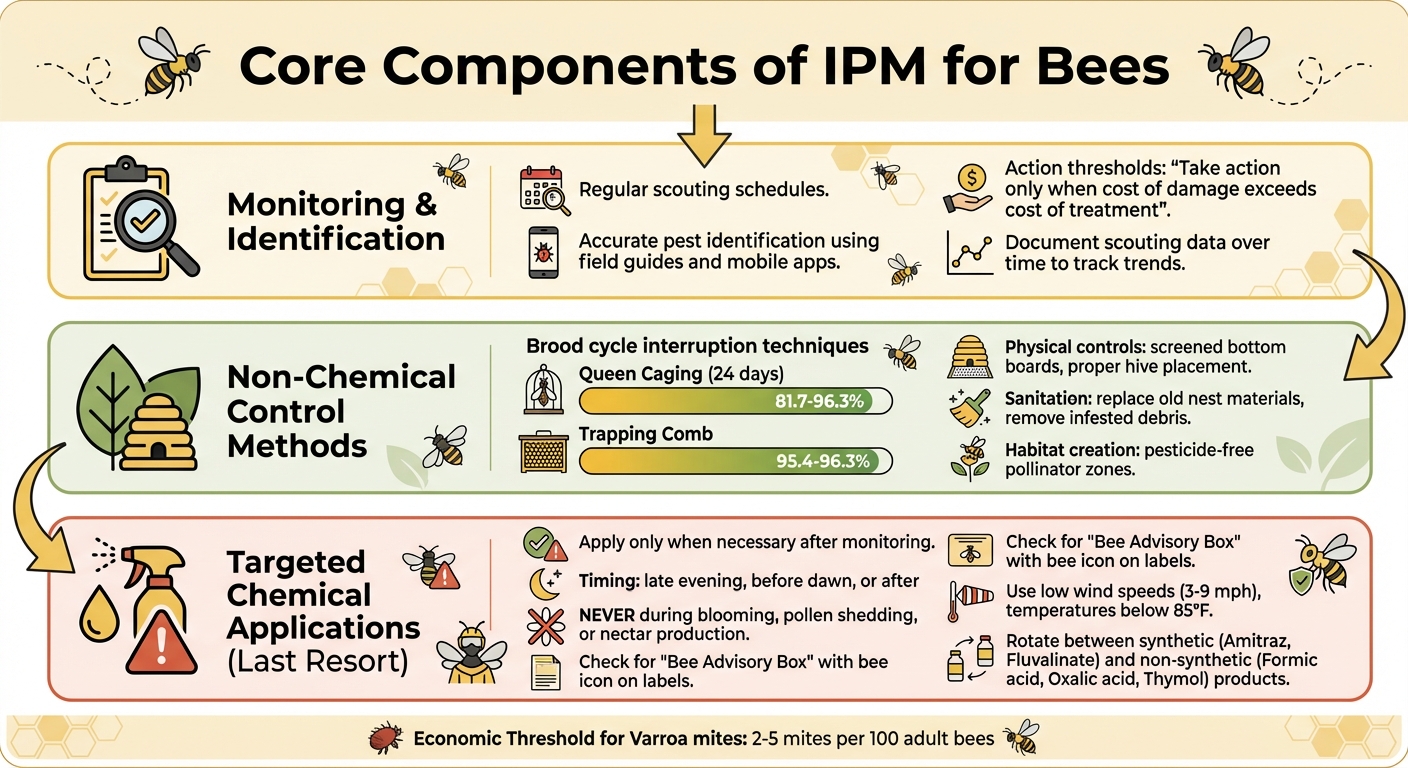
Core Components of IPM for Bees
Three Core Components of Integrated Pest Management for Bees
Integrated Pest Management (IPM) for bees combines three key strategies to protect pollinator health while minimizing risks. These strategies work together to create a flexible, effective approach that pest control professionals can adapt to various public health needs.
Monitoring and Identification
Regular scouting is the backbone of effective IPM. A consistent scouting schedule helps detect pests, diseases, and plant damage early, allowing for timely intervention before problems escalate.
Accurate pest identification is equally important. As Bee City USA highlights:
It’s essential to correctly identify a pest in order to know its biology and how to break its life cycle.
Providing field teams with tools like reference books, mobile apps, or pocket guides ensures reliable species identification. This accuracy is critical for applying the right control measures.
Action thresholds play a key role in decision-making. Eric Mader from the Xerces Society explains:
Action is only taken when the cost of the potential damage exceeds the cost of the treatment.
By documenting scouting data over time, professionals can track trends, evaluate when interventions are necessary, and monitor beneficial insects that contribute to natural pest control. This data-driven approach ensures interventions are precise and effective.
Non-Chemical Control Methods
Cultural and physical controls are the foundation of bee IPM, addressing stressors like pesticide exposure, overcrowding, poor shelter, unsanitary nesting conditions, and food shortages.
One effective non-chemical method is brood cycle interruption. Field trials conducted by Jernej Bubnič and Marco Pietropaoli in Slovenia and Italy (2018) demonstrated the success of two strategies for managing varroa mites. The "Trapping Comb" technique, which confines the queen to a single frame, achieved over 95% efficacy in both locations. When paired with a single oxalic acid treatment, this method also reduced viral loads of Deformed Wing Virus and Acute Bee Paralysis Virus. Another approach, "Queen Caging", involved confining the queen for 24 days and showed efficacy rates between 81.7% and 96.3%.
Physical controls, such as using screened bottom boards, help remove mites, while proper hive placement avoids damp or extreme conditions. Regular sanitation, like replacing old nest materials and removing infested debris, disrupts pest life cycles without chemicals. For example, the City of Madison Engineering Department has transformed road medians into shortgrass prairies and "bee lawns", creating pesticide-free habitats for pollinators.
When non-chemical methods fall short, targeted chemical applications may be considered as a last resort.
Targeted Chemical Applications
Targeted chemical treatments build on monitoring and non-chemical strategies, ensuring they are used only when necessary. These treatments must focus on the specific pest, minimize toxicity to bees, and avoid contamination of hive products like wax, honey, and pollen.
Timing and method are critical for minimizing harm. Pesticides should be applied when bees are not foraging – preferably late evening, before dawn, or after dusk – and never during plant blooming, pollen shedding, or nectar production. Steps like lowering application heights, controlling windspeed, and using larger droplet nozzles can reduce pesticide drift.
Always check the product label for the "Bee Advisory Box", marked with a diamond-shaped bee icon, which warns about pollinator toxicity. Interestingly, the highest levels of contaminants in hives often come from products applied by beekeepers, not external sources, making careful selection and proper use of chemicals essential.
Research and Case Studies on IPM for Bees
Brood Interruption Techniques
In the summer of 2018, researchers in Slovenia and Italy tested two brood interruption methods aimed at targeting Varroa mites during their phoretic phase – when they are on adult bees rather than hidden inside brood cells.
The Trapping Comb method, followed by a 4.2% oxalic acid treatment, achieved an impressive efficacy rate of 95.4–96.3%. Meanwhile, the Queen Caging technique, which involved confining the queen for 24 days to temporarily stop egg-laying, showed varying results: 81.7% efficacy in Slovenia’s continental climate and 96.3% in Italy’s Mediterranean climate.
"Both the queen caging and trapping comb techniques, followed by an oxalic acid treatment, can be considered effective varroa treatment strategies".
Viral loads of Deformed Wing Virus and Acute Bee Paralysis Virus were also tracked during these experiments. Notable reductions in these viruses were observed, but only with longer-term monitoring. These findings serve as a stepping stone for more advanced, multi-treatment strategies. For professionals looking to stay updated on similar industry developments, our pest control blog covers a wide range of emerging IPM research.
Multi-Treatment Approaches
Expanding on brood interruption methods, multi-treatment approaches enhance mite control further. For instance, research conducted at Cornell University‘s Dyce Laboratory showed that periodically removing capped drone brood effectively kept mite populations below the Economic Threshold. This method allowed beekeepers to skip spring chemical treatments. The technique works by exploiting the mite’s preference for drone larvae, where they reproduce at roughly twice the rate compared to worker brood.
A larger study spanning nine apiaries in six Mediterranean countries analyzed 178 colonies to compare two queen caging schedules. The results showed that caging queens 14 days before and 14 days after harvest (QC2) successfully reduced Varroa levels without impacting honey yield. On the other hand, caging queens 28 days before the main nectar flow (QC1) caused a significant drop in honey production – about 3–4 kg less per colony, or a 20–25% reduction.
Public Health Applications
Integrated Pest Management (IPM) strategies are designed to balance effective pest control with the protection of pollinators, using precise action thresholds. For Varroa mites, the generally accepted Economic Threshold is around 2–5 mites per 100 adult bees. When mite levels approach this range, targeted interventions can be deployed instead of broad-spectrum treatments.
To avoid resistance to chemical treatments, experts recommend rotating between synthetic products (e.g., Amitraz and Fluvalinate) and non-synthetic options (e.g., Formic acid, Oxalic acid, and Thymol). Regular monitoring is equally important – checking Varroa levels every 3–6 weeks or at least four times a year using alcohol wash or soapy water methods provides accurate population data. For larger apiaries with more than 10 colonies, sampling at least 10 colonies from both the center and outer edges ensures reliable results.
Implementing IPM as a Pest Control Professional
Pest control professionals are tasked with translating scientific principles into actionable practices, particularly when implementing Integrated Pest Management (IPM).
Training and Certification Requirements
In many cases, professional certification is legally required for pesticide applications that could impact pollinators. Some pesticide labels explicitly state that only certified applicators are permitted to use them, ensuring proper handling and reducing the risk of accidental exposure to pollinators. This reflects the complexity of IPM, which demands expertise beyond standard pest control techniques.
Key training areas include identifying pests and weeds correctly, understanding IPM fundamentals, and mastering scouting protocols to determine if established action thresholds are met. Professionals must also know how to interpret pesticide labels as legal documents, paying close attention to environmental hazard statements and advisories for non-target organisms. Training emphasizes the IPM hierarchy: starting with cultural strategies like sanitation and habitat adjustments, followed by physical and biological control methods, and resorting to chemical treatments only when necessary.
"An IPM plan can only be successful if the people doing work in the field are trained and have resources to support them." – Bee City USA
For those seeking certification or recertification, Online Pest Control Courses (https://onlinepestcontrolcourses.com) offers state-approved training programs. These courses cover essential topics such as pesticide laws, formulations, environmental considerations, and pest management techniques. The platform provides Continuing Education Units (CEUs) and Continuing Certification Units (CCUs), accessible across devices, with instant certificate downloads upon completion – simplifying compliance with state requirements.
Once certified, professionals can confidently apply these practices to ensure safer and more precise pest management.
Incorporating IPM into Daily Operations
Adopting IPM means moving away from routine, calendar-based treatments to interventions triggered by specific pest thresholds. For instance, monitoring Varroa mites in honey bee colonies involves sampling about 300 adult bees with ethanol or powdered sugar to assess infestation rates. When managing multiple apiaries, sampling at least eight colonies provides a reliable average infestation rate for the site.
Timing pesticide applications is critical to protecting pollinators. Apply treatments before dawn or after dusk when bees are less active, and avoid application during blooming periods. Additionally, consider environmental conditions: apply pesticides during low wind speeds (3–9 mph) and cooler temperatures (below 85°F) to reduce drift. Use coarse spray nozzles and maintain low boom heights for better precision. Opt for liquid sprays or granules instead of dusts, and steer clear of micro-encapsulated pesticides, which bees might mistake for pollen. If using insect traps for monitoring, avoid white-colored traps, as they can inadvertently attract and harm pollinators.
Thorough record-keeping is essential for turning IPM into a measurable and adaptable system. Document scouting results, pest counts, damage levels, actions taken, and their outcomes. This data allows for evaluating the effectiveness of strategies and making necessary adjustments. Many states now have Managed Pollinator Protection Plans (MP3s) – voluntary frameworks that promote collaboration between beekeepers and pesticide applicators. By notifying neighboring beekeepers before applying treatments, professionals can help prevent conflicts and reduce incidents of pesticide-related bee deaths.
Conclusion
Integrated Pest Management (IPM) plays a critical role in addressing public health concerns while also protecting pollinators. The strategies and examples discussed highlight its ability to balance these priorities effectively.
Balancing Public Health and Pollinator Protection
IPM achieves this balance by emphasizing non-chemical methods like biological controls, cultural practices, and crop rotation, using pesticides only as a last resort. This approach not only addresses public health needs but also safeguards pollinators, which are essential for pollinating about one-third of our food supply.
The shift toward Integrated Pest and Pollinator Management (IPPM) further incorporates pollinator health into pest control strategies, reducing both economic and ecological compromises. The benefits are clear: from 2017 to 2020, research by Pecenka et al. showed a 95% reduction in insecticide use in Indiana watermelon fields, alongside a 26% yield increase – adding up to $4,512.69 more per hectare. Similarly, minor changes, like delaying pesticide applications by 10 days in Pennsylvania apple orchards, cut pesticide residue in flowers by over 50%. These examples underscore how skilled practitioners are essential to successful IPM implementation.
The Importance of Education and Certification
Given the complexity of IPM methods, proper training and certification are vital. Certified professionals are better equipped to apply science-based strategies that protect both public health and pollinators.
For those looking to enhance their credentials, platforms like Online Pest Control Courses offer state-approved training on pesticide regulations, pest management techniques, and environmental considerations. With features like CEUs, CCUs, and instant certificate downloads, this resource ensures professionals stay up-to-date with evolving practices and regulations. Continuous education empowers practitioners to adopt effective, ecologically sound pest management solutions.
FAQs
When should I take action on bees in public areas?
When dealing with bees in public spaces, action should only be taken if their populations surpass specific, pre-established thresholds. Begin by using non-chemical methods to manage the situation. Reserve chemical treatments for extreme cases, ensuring pollinators are safeguarded and the surrounding environment is minimally affected.
How do I tell honey bees from wasps or yellowjackets?
Honey bees have fuzzy, hairy bodies that help them collect pollen efficiently, while wasps and yellowjackets have smooth, slender bodies with little to no hair. This difference in appearance isn’t just cosmetic – it reflects their distinct roles in nature. Wasps and yellowjackets are generally more aggressive, especially when protecting their nests, and they tend to sting more readily. Honey bees, on the other hand, are typically calmer and less likely to sting unless they feel threatened. Physically, honey bees are stockier and more robust, whereas wasps and yellowjackets have thinner, elongated bodies. These traits make it easier to tell them apart at a glance.
How can pesticides be applied without harming bees?
To keep bees safe while using pesticides, it’s important to follow integrated pest management (IPM) practices. Opt for pesticides that are less harmful to pollinators, use them during times when bees are less active – such as early morning or evening – and always stick to the label instructions and recommended practices. These measures reduce the risk to bees and help maintain their well-being.