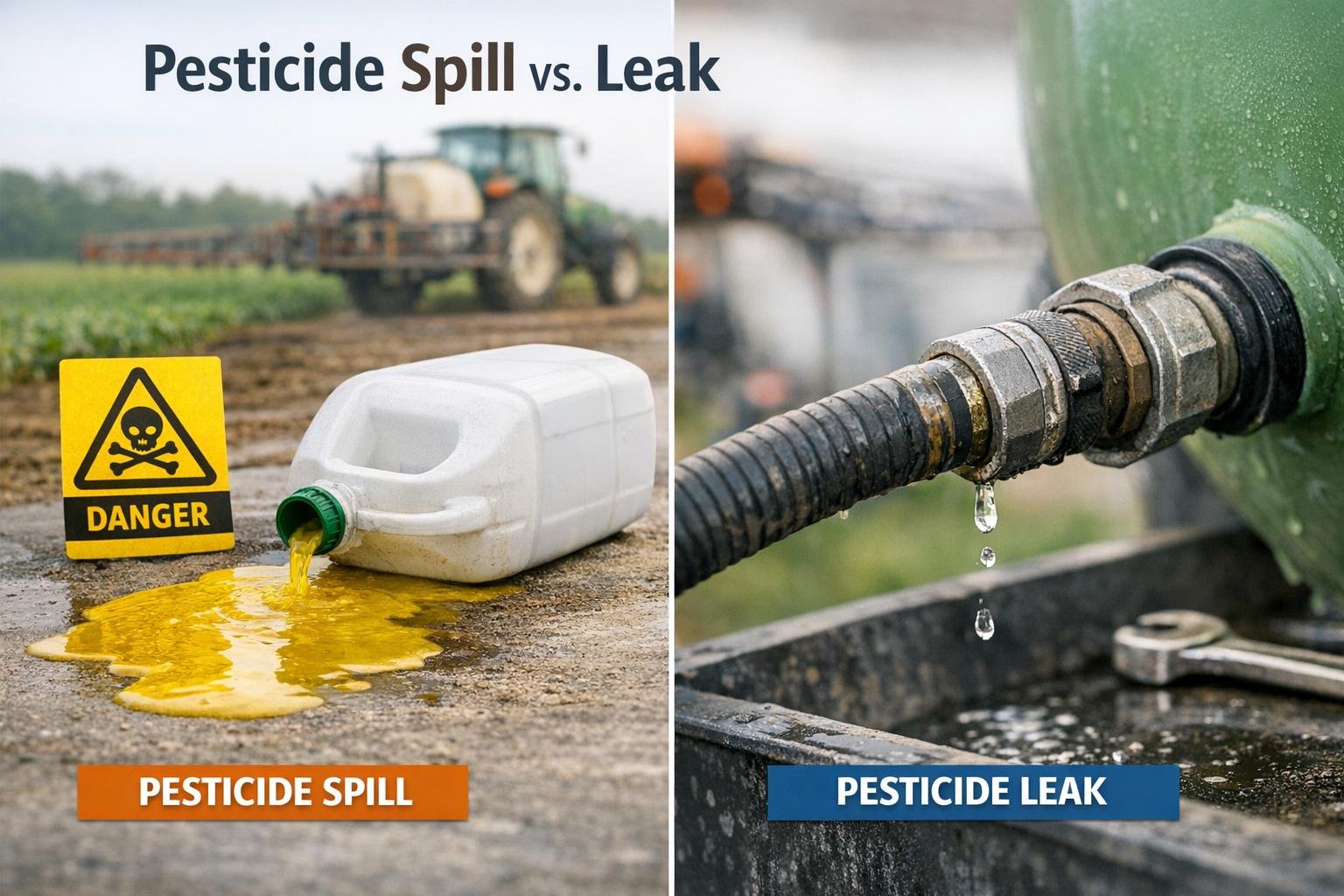
When dealing with pesticides, knowing the difference between a spill and a leak is critical for safety, compliance, and minimizing harm. Here’s the bottom line:
- Spills are sudden, large releases caused by accidents, like a container tipping over or a ruptured spray tank. They are obvious and require immediate action to prevent widespread contamination.
- Leaks are slow, gradual releases due to equipment wear or container damage. They can go unnoticed without regular inspections, leading to long-term contamination.
Key Takeaways:
- Spills happen quickly and are easier to spot. Response focuses on stopping the source, containing the spread, and cleaning up immediately.
- Leaks develop over time and often require inspections to detect. Prevention through maintenance and storage checks is key.
- Both require proper protective gear, containment measures, and disposal of contaminated materials.
Quick Tip: Always follow the "Three C’s" – Control, Contain, Clean Up – for both spills and leaks. Immediate action can prevent costly damage and legal issues.
For a detailed guide on handling these incidents, including prevention tips and emergency response steps, read on.
Pesticide Emergencies Spills and Fires
sbb-itb-c4006de
What Is a Pesticide Spill?
A pesticide spill occurs when pesticides are unexpectedly released during storage, transport, mixing, application, or disposal.
The severity of a spill can range from a minor incident, like a single cracked container leaking onto a concrete surface, to major emergencies, such as a tanker truck overturning on a highway or storage containers exploding. The response depends on the amount of pesticide released and where it happens.
Spills can happen for various reasons. Common causes include vehicle accidents during transportation, containers falling off trucks, barrels being punctured by forklifts, or equipment malfunctions like ruptured hoses and broken spray tips. Human error, especially during the mixing and loading of concentrates, is particularly risky. This step is widely considered the most dangerous part of handling pesticides. Jennifer M. Weisbrod, an Assistant Extension Educator at the University of Nebraska–Lincoln, highlights the importance of preparation:
No matter the cause or size of the spill, being prepared to manage it is important.
Understanding these causes underscores why immediate containment is so critical.
Quick action is essential when dealing with spills. The first step is to stop the source – plug leaks, transfer the contents, or shut off valves. Personal protective equipment (PPE) like chemical-resistant gloves, coveralls, and eyewear should be worn. The area must also be cordoned off to prevent further exposure since pesticides are toxic and can contaminate soil or water, requiring knowledge of pesticide hazards and first aid. The EPA describes pesticide spills as a "sudden threat" to public health or the environment due to the release of hazardous chemicals. If surface water is contaminated, cleanup becomes far more complex. To ensure safety, restrict access to the contaminated area and keep unauthorized individuals at least 30 feet away.
This immediate response protocol is crucial and sets the groundwork for understanding how spills differ from leaks, which will be discussed next.
What Is a Pesticide Leak?
A pesticide leak happens when chemicals are released gradually, unlike a spill that releases a large amount all at once. Leaks usually occur because of faulty equipment or damaged containers, resulting in small drips or trickles over time. These can go unnoticed for extended periods.
Some common culprits include corroded containers, cracked seals, loose connections, faulty valves, and damaged hoses. Corrosion may occur internally if the pesticide reacts with the container material or externally due to damp storage conditions or contamination from nearby leaks. Certain pesticide formulations, such as monocrotophos, dicrotophos, dichlorvos, and phosphamidon, are particularly corrosive and unsuitable for steel containers. These require alternatives like plastic, aluminum, or specially lined containers. Environmental factors also contribute – strong sunlight can weaken plastic bottles, and pests like rodents or termites can damage paper or fiber containers.
Detecting leaks is tricky because they release small amounts and often occur in storage areas or from minor equipment issues. Inspectors look for clues like “mystery drums” or dead vegetation near storage areas, which can hint at a long-term leak. Even though leaks involve smaller quantities than spills, their continuous nature can lead to groundwater contamination, persistent soil pollution, and toxic exposure to humans and animals. If left unchecked, soil affected by long-term pesticide leaks might be classified as hazardous waste, requiring costly cleanup efforts.
Preventing leaks starts with regular inspections. Check storage areas for signs of corrosion, cracks, or tears in containers. Before using equipment, inspect for loose connections or damage. If you find a leak in a small container (up to 55 gallons), immediately place it inside a larger, liquid-tight container to contain the release. These preventive measures work hand-in-hand with emergency responses designed for handling spills, as discussed earlier.
How Pesticide Spills and Leaks Differ
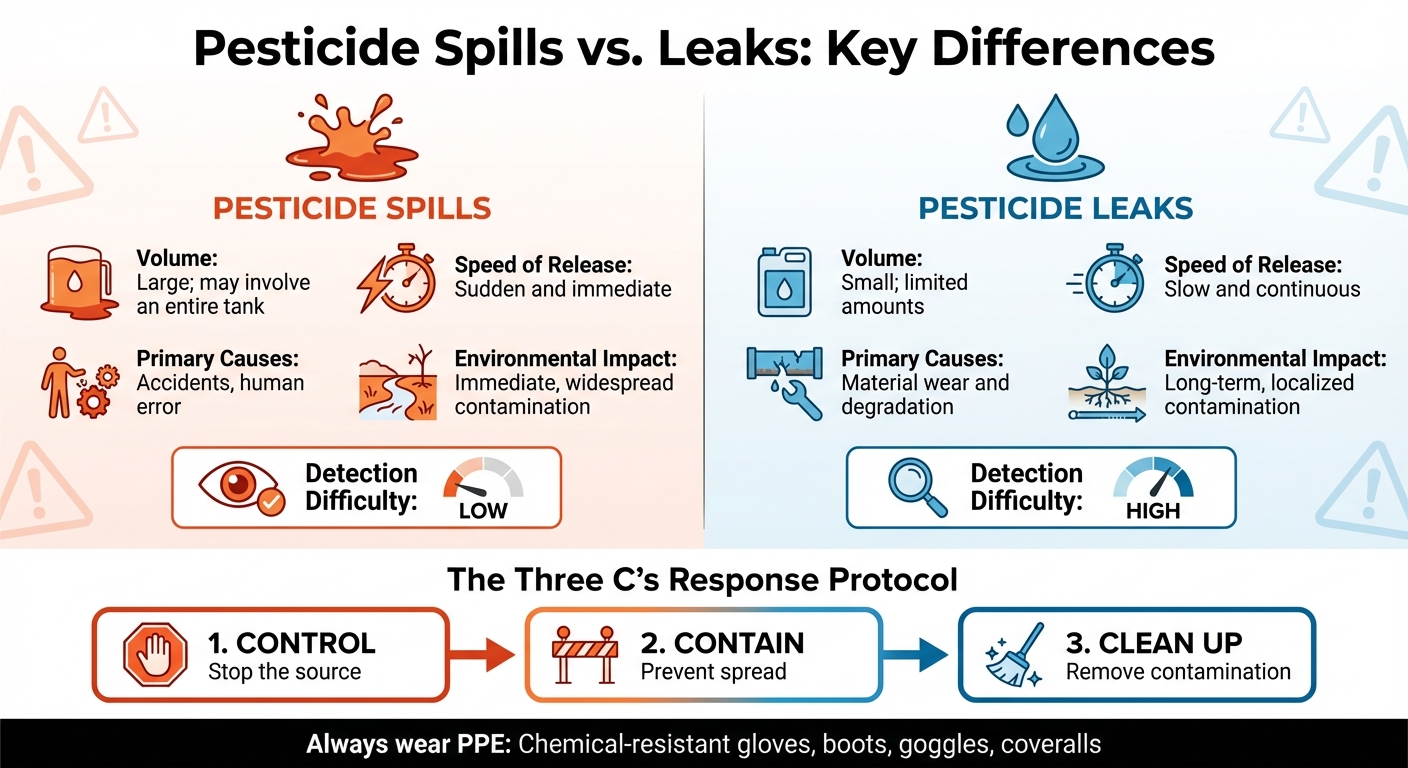
Pesticide Spills vs Leaks: Key Differences and Response Guide
This section highlights the main differences between pesticide spills and leaks, focusing on how they occur, their detection, and their potential impact.
Spills are sudden events – think of a tanker overturning or a container tipping over – that release large amounts of pesticides all at once. In contrast, leaks are more gradual, often caused by wear and tear on equipment or damaged seals, releasing small amounts over time.
The causes behind these incidents also vary. Spills are typically the result of accidents or human error, like dropping a container, mishandling equipment, or vehicle collisions. Leaks, on the other hand, are usually due to material failures, such as rust, cracks in plastic, or worn-out seals. Jennifer M. Weisbrod, Assistant Extension Educator at the University of Nebraska–Lincoln, explains:
Pesticide spills can range from being very minor (e.g., a single leaking pesticide container), to being a major spill, such as a tanker truck accident.
Detection is another key difference. Spills are easy to spot – there’s often a visible puddle or a strong odor. Leaks, however, can go unnoticed without routine inspections, increasing the risk of pesticide movement in the environment and prolonged contamination.
Comparison Table: Spills vs. Leaks
Here’s a quick breakdown of how spills and leaks differ:
| Feature | Pesticide Spills | Pesticide Leaks |
|---|---|---|
| Volume | Large; may involve an entire tank | Small; limited amounts |
| Speed of Release | Sudden and immediate | Slow and continuous |
| Primary Causes | Accidents, human error | Material wear and degradation |
| Visibility | Obvious; easy to detect | Subtle; requires inspections |
| Environmental Impact | Immediate, widespread contamination | Long-term, localized contamination |
Both spills and leaks require swift action, but understanding these distinctions helps in crafting the right response for each situation.
How to Respond to Pesticide Spills
When a pesticide spill occurs, quick and effective action is essential to minimize risks and hazards. Before anything else, ensure you’re properly protected by wearing chemical-resistant gloves, boots, splash goggles, and coveralls or an apron. Never begin cleanup without this protective gear.
In cases of large spills, fires, or immediate threats, evacuate the area and keep people and pets at least 30 feet away. Immediately call 911 for assistance. For smaller spills that you can safely manage, follow the Three C’s framework to guide your response.
The Three C’s Framework
Jennifer M. Weisbrod, an Assistant Extension Educator at the University of Nebraska-Lincoln, describes this method as follows:
The Three C’s – Control, Contain, Clean Up – provide a way to quickly organize and respond after a pesticide spill, whether it occurred during transport, storage, mixing and loading, or application.
- Control the source: Start by stopping the pesticide from spreading further. Upright any overturned containers, seal punctures, or place the leaking container into a larger, chemically resistant one. The priority here is to prevent more pesticide from escaping.
- Contain the spread: For liquid spills, use soil, sand, or absorbents to create a barrier that keeps the pesticide away from drains or water sources. For dry materials like dusts or powders, lightly mist them with water or cover them with a tarp to stop them from becoming airborne.
- Clean up safely: Absorb liquid spills with materials like cat litter, sand, or spill pillows, and then collect the waste into heavy-duty plastic bags or lined drums for disposal. Decontaminate the area using a neutralizing solution, such as a mixture of 30% household bleach and water, or hydrated lime.
Important: Never mix bleach and lime together, as this creates a dangerous chemical reaction. If the spill affects soil, remove the top 2 to 3 inches of contaminated earth and dispose of it as hazardous waste.
If the spill poses a threat to health, contaminates public roadways, or reaches water sources, notify the appropriate authorities immediately. The University of Nebraska-Lincoln provides guidance on when reporting is required:
Report a spill if there is any potential harm to human health or the environment . . . a spill is not reportable when it does not result in pesticide lost to the environment . . . such as when it occurs on a concrete floor or in an enclosed area.
For emergencies, call 911. For chemical spill reporting, reach out to the National Response Center at 1-800-424-8802, and for human poisoning cases, contact Poison Control at 1-800-222-1222. After completing the cleanup, thoroughly wash your hands, face, and any exposed skin with soap and water. Launder contaminated clothing separately to avoid cross-contamination.
Proper training in pesticide spill response is essential for safety. For state-approved pesticide safety training, including emergency response procedures, check out the courses offered at Online Pest Control Courses.
This structured approach to handling spills is distinct from the methods used for addressing gradual leaks, which will be covered in the next section.
How to Respond to Pesticide Leaks
Dealing with pesticide leaks requires a calm and methodical approach. Unlike sudden spills, leaks tend to develop gradually, giving you a chance to detect and manage them early. To address leaks effectively, follow the Three C’s framework: Control, Contain, and Clean Up.
Start by ensuring you’re wearing the appropriate protective gear. If the leak is coming from a small container with a crack, place it into a larger, chemically resistant container. For larger containers, such as 55-gallon drums, use bentonite or a polymer mix paste from your spill kit to plug the hole and stop the leak. If equipment or hoses begin to leak during transport, immediately relieve the system pressure and use a container to collect any remaining solution.
Once you’ve controlled the source, focus on containment. On hard surfaces like truck beds or pavement, surround the leak with absorbent tube socks – often called "snakes" – to keep the spill confined. For dry pesticide leaks, lightly mist the material with water to reduce airborne particles, or cover the area with a plastic tarp. After containing the leak, collect all contaminated absorbent materials and place them in heavy-duty plastic bags or lined drums for proper disposal.
Prevention is key to avoiding future leaks. Always carry a spill kit in every transport vehicle and at every location where pesticides are handled. A well-stocked spill kit should include personal protective equipment, absorbents like cat litter, containment snakes, a non-sparking shovel, heavy-duty plastic bags, and emergency contact information. Regularly inspect pesticide containers and storage areas for wear, punctures, or loose caps. Also, check drum tops for rainwater accumulation, as this can lead to rust and potential ruptures.
To further reduce the risk of leaks, ensure all containers are securely fastened during transport to prevent tipping or sliding – common causes of punctures and spills. Routine inspections can help you catch early signs of damage, such as cracks or corrosion, before they become serious problems. For more in-depth training on pesticide safety and leak prevention, consider state-approved courses offered by Online Pest Control Courses, which cover emergency response protocols and proper handling techniques.
Preventing Spills and Leaks During Transport
When transporting pesticides, avoiding spills and leaks is crucial to protecting both health and the environment. The first step is choosing the right vehicle. Always use a truck with a separate cargo area – preferably one with side rails and a tail rack – instead of the passenger compartment. This setup minimizes the risk of hazardous exposure and contamination. Before loading, inspect the truck bed for sharp objects like nails or stones that could puncture containers. Metal beds or synthetic liners are better options than wood, as they are easier to clean if contamination occurs.
Properly securing the load is just as important. Place dry pesticide formulations above liquid ones to prevent cross-contamination in case of a leak. Keep pesticides away from food, livestock feed, seed, and veterinary supplies. Use straps or brace bars to secure containers and prevent them from shifting or tipping during transit. For additional safety, enclosed and locked cargo boxes are ideal. If locking isn’t feasible, cover the load with a waterproof tarp. Be mindful of temperature conditions – extremes below 40°F or above 110°F can compromise the stability of chemicals and their containers.
Documentation and emergency supplies are non-negotiable. Always carry product labels and Safety Data Sheets (SDS) for every pesticide being transported. These documents are vital for guiding emergency responders in case of an incident. Equip your vehicle with a spill kit containing personal protective equipment (PPE), absorbents like cat litter, a shovel, a broom, heavy-duty plastic bags, and a fire extinguisher rated for chemical fires. Keep a cell phone and emergency contact numbers, including CHEMTREC at 1-800-424-9300, easily accessible.
The role of the vehicle operator is critical in ensuring readiness and response during transport:
"The vehicle operator is the best – and maybe the only – person capable of reacting to a spill or other mishap and most likely will need to assist or instruct first response emergency personnel as they arrive on the scene." – Penn State Extension
Before transport, inspect all containers to ensure they are securely closed, have legible labels, and are free of residue. Compliance with regulations is essential to prevent spills or leaks. If transporting pesticides in anything other than factory-sealed containers, the EPA Worker Protection Standard requires you to be trained as a WPS pesticide handler or hold a certified applicator license. For training, state-approved online courses are available through Online Pest Control Courses.
For loads classified as hazardous materials under U.S. Department of Transportation (DOT) guidelines – such as bulk containers over 119 gallons or shipments exceeding 1,000 pounds of pesticide – you may need a Commercial Driver’s License and appropriate vehicle placarding. However, farmers transporting agricultural pesticides within 150 miles of their farm may qualify for DOT exemptions if they carry no more than 502 gallons of liquid or 5,070 pounds of solid product.
Conclusion
This article has explored the differences between spills and leaks and why each requires a tailored approach to ensure safety and minimize risks.
Understanding how spills and leaks differ is crucial for protecting both people and the environment. Leaks often result from equipment failures – like cracked hoses or corroded containers – and need immediate action to stop the source. Spills, on the other hand, can range from small drips to large-scale incidents, requiring broader efforts to contain and clean up the area to prevent pesticides from contaminating soil or water sources.
The Three C’s – Control, Contain, Clean Up – are essential steps in managing these situations effectively. As Jennifer M. Weisbrod, Assistant Extension Educator at the University of Nebraska-Lincoln, points out:
"Proper training in handling pesticides is the number one way to prevent spills."
Beyond these steps, certification plays a key role in ensuring preparedness for emergencies. Certified applicators are trained to understand federal regulations like Reportable Quantities, know when to notify authorities (such as contacting CHEMTREC at 1-800-424-9300), and use Safety Data Sheets to guide first responders. They also learn critical techniques, such as maintaining a 30-foot isolation zone during cleanup or removing 2–3 inches of contaminated soil, to reduce potential harm. This level of preparation helps lower both the frequency and severity of incidents.
For those looking to enhance their skills, Online Pest Control Courses offers state-approved training programs covering pesticide safety, emergency response, and regulatory compliance. These courses provide the continuing education units required for certification and recertification, with instant certificate downloads available upon completion. The mobile-friendly format allows professionals to learn at their own pace.
Whether you’re transporting pesticides, mixing chemicals, or applying products in the field, state-approved training ensures you’re equipped to handle emergencies with confidence. By consistently applying these practices, pesticide handlers can protect their operations and the environment alike.
FAQs
When should I call 911 vs. handle it myself?
If a pesticide spill or leak presents a serious public health threat – such as involving over 25 gallons, spreading beyond the immediate area, being impossible to control, or causing severe health issues like seizures, unconsciousness, or difficulty breathing – call 911 immediately. For smaller, less critical spills, you can manage the cleanup yourself by following the appropriate safety procedures.
What should a pesticide spill kit include?
A proper pesticide spill kit needs to include chemical-resistant gloves, coveralls, boots, splash goggles, and a respirator to protect against exposure. For managing spills, it should have absorbent materials like spill pillows, clay, sawdust, or even kitty litter. Additionally, tools for containment, such as snakes or plugs, and sweeping compounds are essential. Cleanup tools like shovels and brooms round out the kit, ensuring quick and safe handling of emergencies.
Do I have to report every pesticide spill or leak?
If a pesticide spill or leak happens under uncontrolled conditions, surpasses specific reportable quantities, or threatens human health or the surrounding area, it must be reported. Federal and state laws dictate these reporting requirements, so it’s essential to understand and follow the regulations that apply in your location.