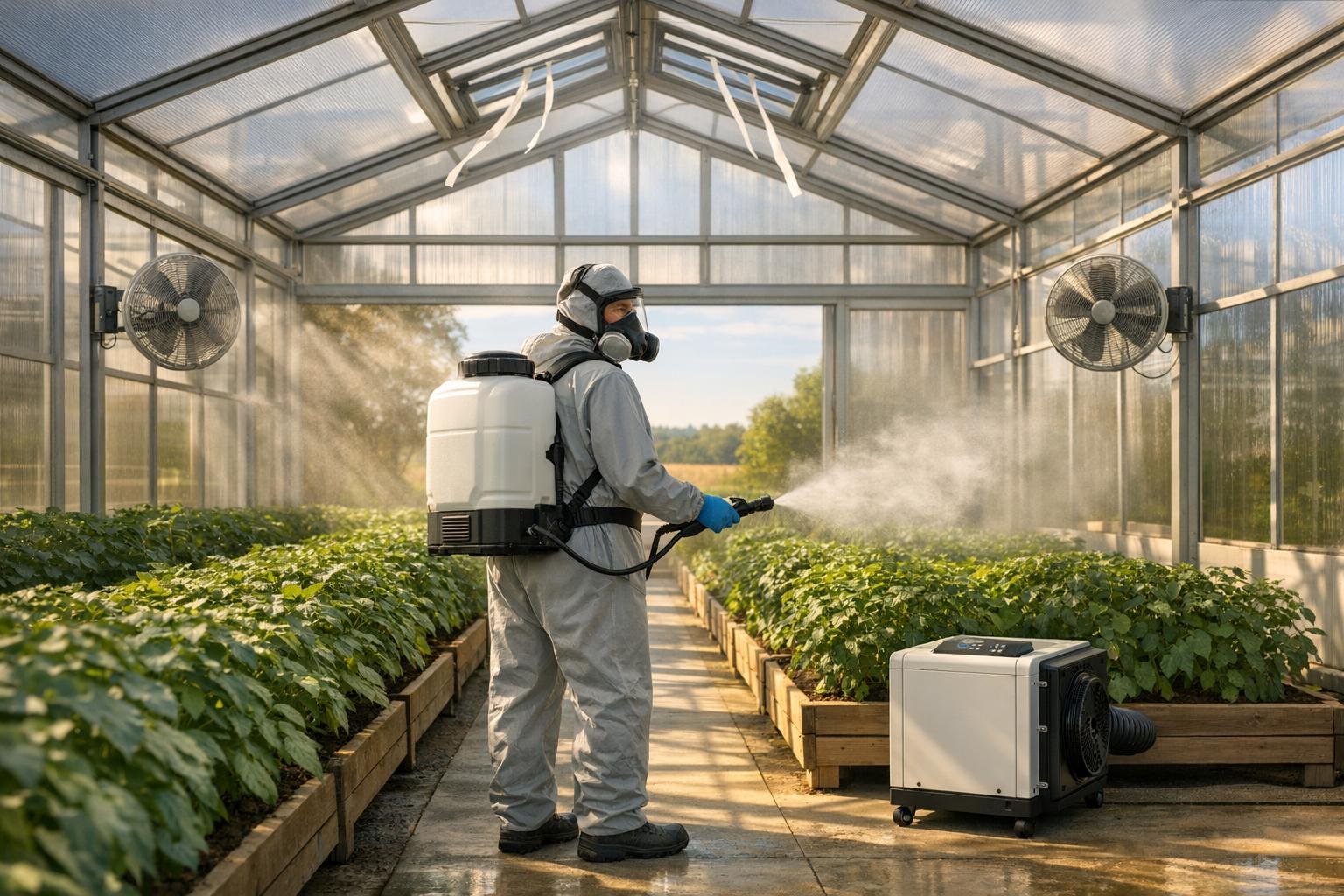
Pesticides can linger in the air, posing health risks to applicators and bystanders. Proper ventilation can reduce exposure by up to 87%, making it an essential safety measure for applicators. Key findings include:
- Indoor risks: Pesticide levels in greenhouses can remain elevated for up to 4 days.
- Air contamination: 97% of European agricultural air samples contained pesticides; 95% showed mixtures.
- Health concerns: Chronic exposure is linked to neurological conditions like Parkinson’s and Alzheimer’s.
- Ventilation tips: Open windows, use fans, and avoid application during high temperatures or poor weather conditions.
- Protective measures: Enclosed systems, air filtration, and proper application techniques significantly lower risks.

Pesticide Air Contamination Statistics and Ventilation Impact
Pesticide Air Contamination: What Studies Show
Detection Rates of Airborne Pesticides
Research highlights a troubling prevalence of pesticides in the air. In European agricultural regions, 97% of ambient air samples contained at least one pesticide, and 95% showed mixtures of multiple pesticides. Fungicides like folpet and fenpropidin were especially common, appearing in 40% to 57% of samples.
In California’s San Joaquin Valley, personal air monitoring revealed that 22% of adults had detectable pesticide levels in their breathing zones. For those involved in agricultural work, this figure rose to 43%. Within high-use areas like Shafter, 1,3-dichloropropene was identified in 25% of samples, with average concentrations of 253 ng/m³.
Indoor spaces aren’t exempt from contamination. Over 90% of household dust samples near farming areas tested positive for glyphosate, 2,4-D, and simazine. Indoor air tests have identified up to 12 different pesticides, with 80% of most people’s exposure occurring inside their homes.
"Our findings underscore the need for broader surveillance of pesticide exposure. Current measures are insufficient to capture exposure to several compounds with documented toxicological risks."
- Dr. Deborah Bennett, PhD, Public Health Sciences, University of California, Davis
These findings raise important questions about how pesticides end up in the air we breathe.
What Causes Air Contamination
To address the issue, it’s essential to understand how pesticides become airborne. During application, spray droplets can drift beyond the target area, causing primary contamination. Secondary drift occurs later, as pesticides volatilize or wind stirs up contaminated soil particles.
Environmental factors like high temperatures and sunlight can amplify pesticide volatilization, increasing airborne concentrations. For instance, a November 2025 field trial on λ-cyhalothrin applications in citrus orchards showed that optimized spray techniques reduced airborne residues by 87% and cut operator exposure by 85%.
Land use also plays a key role. A 2020–2022 study in Eastern Austria used passive air samplers across 15 regions and detected 67 different pesticide active ingredients. Even in areas like national parks, researchers found 10 to 33 pesticides in the air, showing that agricultural activity within 1 km can significantly affect air quality.
Indoor contamination often results from tracking in pesticide-laden soil, using outdoor-rated products indoors, or the re-release of pesticides from household surfaces. These findings highlight the importance of better ventilation and stricter application practices and federal laws to reduce exposure risks.
sbb-itb-c4006de
UC Davis study finds San Joaquin Valley residents breathe in concerning levels of pesticides
How Ventilation Affects Indoor Pesticide Exposure
Proper ventilation plays a key role in reducing airborne pesticide levels by increasing air exchange. In spaces with poor airflow, a "sealing effect" can occur, trapping high concentrations of pesticides in the air. Lowering these airborne concentrations significantly reduces the risk of inhalation exposure, a serious health concern. Considering that people spend over 80% of their time indoors, ensuring good air exchange during and after pesticide application is crucial. For instance, a study in Hebei Province revealed that pesticide use in greenhouses is nearly four times higher per hectare compared to open fields, highlighting the importance of ventilation in such settings.
"Ventilation is found to be a minor but non-negligible loss mechanism, crucial to maintain an acceptable air quality since it definitively withdraws transfluthrin from the room volume." – ScienceDirect
Temperature and humidity also influence pesticide behavior. High levels of both can speed up pesticide volatilization, while natural ventilation relies on differences between indoor and outdoor temperatures to be effective.
Ventilation Methods to Improve Air Quality
To reduce airborne pesticide levels, open windows and use fans during and immediately after application. Leave the area for 2–4 hours, then ventilate for at least 30 minutes to restore air quality. Mixing or diluting pesticides outside or in well-ventilated spaces – even if the treatment is for indoor areas – can also help lower airborne concentrations. When treating outdoor areas like lawns or gardens, keeping windows and doors closed prevents pesticide drift from contaminating indoor air.
Pesticide levels are usually highest right after application but decrease over time as they are ventilated out or absorbed by surfaces. Boosting ventilation during activities that release high levels of pollutants – such as applying flea and tick treatments or using disinfectants – can be especially effective.
Room Design and Material Effects
The design of a room and the materials used within it also impact how long pesticides persist indoors. Porous surfaces, like untreated wood or vinyl flooring, tend to hold onto pesticide residues longer than nonporous materials. Additionally, in dark indoor conditions, pesticide surface concentrations can remain stable for up to 140 days due to the lack of degrading factors like sunlight, moisture, or soil microbes.
"Pesticides included in this study were found to be highly persistent in a dark indoor environment with surface concentrations virtually unchanged after 140 days." – Lukas Oudejans, U.S. EPA
Furnishings such as carpets and textiles can act as reservoirs for pesticides, collecting particles from both indoor applications and outdoor tracking. For example, a study of social housing found at least one pesticide in 89% of tested units, with residues lingering in house dust for decades after certain chemicals were banned. Simple practices like adopting a shoes-off policy and regular cleaning can reduce the amount of contaminated soil brought indoors. Opting for nonporous flooring like tile or hardwood instead of wall-to-wall carpeting can also limit pesticide-laden dust accumulation. Additionally, repairing cracks and crevices in walls and floors can help prevent pest infestations, reducing the need for chemical treatments.
Spray Drift and Volatilization: How Pesticides Enter the Air
How Spray Drift and Volatilization Work
Pesticides can enter the air through two main processes: spray drift and volatilization. Spray drift happens during application when pesticide droplets, dust, or granules are carried away from the target area by the wind. Volatilization occurs later, as pesticides transition from liquid or solid forms into vapor, which then moves with air currents – sometimes hours or even days after application.
"Pesticide spray drift is the movement of pesticide dust or droplets through the air at the time of application or soon after, to any site other than the area intended." – U.S. EPA
The size of the droplets plays a big role in spray drift. Smaller droplets, especially those under 150 microns (µm), stay airborne much longer than larger ones. For instance, a 20 µm droplet can take around 4 minutes to fall 10 feet and may travel as far as 1,100 feet in a 3 mph wind. In contrast, a larger 400 µm droplet falls the same distance in just 2 seconds and travels only about 8.5 feet under the same conditions. Overall, the U.S. loses an estimated 70 million pounds of pesticides annually due to drift.
Temperature inversions significantly increase the risk of drift. This phenomenon occurs when cooler air near the ground is trapped beneath a warmer layer, causing fine droplets (200 microns or smaller) to remain suspended in the air. These droplets can then travel miles when wind speeds pick up. A dramatic example of this was seen in 2017, when dicamba vapor drift damaged over 2.5 million acres of crops across the Midwest and South. In one case, a peach grower was awarded $265 million in damages after his 1,000-acre orchard was harmed by dicamba that volatilized and drifted off-target.
Both spray drift and volatilization are heavily influenced by temperature and weather conditions.
Temperature Effects on Pesticide Emissions
Higher temperatures can amplify volatilization by increasing vapor pressure and causing droplets to shrink, making them more susceptible to wind. For example, under conditions of 50°F, 80% humidity, and 10 mph winds, about 1% of a pesticide spray drifts 30 feet. But at 86°F with 40% humidity, the drift doubles to 2%, and with 15 mph winds, it nearly quadruples to 3.5%.
"The higher the temperature and lower the humidity, the faster evaporation occurs. As a result of evaporation, spray droplet size decreases." – Mark Hanna and Kristine Schaefer, Iowa State University
To minimize risks, avoid applying pesticides when temperatures exceed 85°F, as volatilization becomes much more likely. Look out for signs of temperature inversions, such as dew, frost, fog, or smoke that stays stationary – these conditions trap pesticide vapors near the ground. The best application conditions include light, steady winds of 3 to 10 mph blowing away from sensitive areas, moderate temperatures, and humidity levels above 50%.
Safe Application and Ventilation Practices
Ventilation Before and After Application
Effective ventilation is a key step in reducing exposure to pesticides. Following proper procedures not only improves air quality but also ensures compliance with safety standards.
Start by ventilating the area before applying pesticides. Cover air ducts and openings to prevent contaminants from spreading. Turn off HVAC systems and seal openings to stop the distribution of pesticide particles.
During the application, create a directed airflow by channeling fresh air from an entry point toward an exhaust area. This setup helps push vapors away from workers. For liquid applications, use low pressure to minimize the formation of fine particles. If you’re working in an enclosed space, ensure that the exhaust fan’s capacity is about 10% higher than the supply fan’s to maintain negative pressure. A smoke tube test can confirm whether the negative pressure is working effectively.
After application, speed up drying and vapor removal by opening windows and running fans. Avoid allowing anyone to re-enter the space until the area is completely dry and any off-gassing has stopped. Be aware that shaded or damp areas may take longer to dry. When using exhaust fans, direct the air outdoors to a safe location, far from people and neighboring buildings’ air intakes. For outdoor applications, only apply pesticides in dry weather conditions.
EPA Guidelines for Reducing Exposure
In addition to ventilation strategies, the EPA has set guidelines to help minimize risks for both applicators and bystanders.
The Application Exclusion Zone (AEZ) is a key safety measure. It creates a buffer zone around pesticide application equipment to keep people at a safe distance. The required distance is 100 feet for aerial spraying, air blast equipment, fumigants, or fine sprays like mist, fog, or smoke. For medium or larger droplets sprayed more than 12 inches above the soil, the buffer is 25 feet. If anyone enters this zone – even briefly – the application must stop immediately until the area is clear.
"Pesticide handlers must temporarily suspend the application if workers or other people are in the AEZ, whether those people are on- or off-establishment." – U.S. EPA
For fumigant applications, a written Fumigant Management Plan (FMP) is required. This document outlines steps to prevent exposure and respond to emergencies. Buffer zones should also be maintained around the application site to allow airborne residues to disperse safely. If you’re using tarps for soil fumigants, wait at least 5 days after application before perforating the tarps. Additionally, allow a minimum of 2 hours between perforation and tarp removal. Mechanical tools, such as ATVs equipped with cutting devices, can help you maintain a safe distance during tarp removal.
The EPA’s Agricultural Worker Protection Standard provides safeguards for over 2 million agricultural workers and pesticide handlers across more than 600,000 establishments in the U.S..
Air Filtration Systems for Pesticide Removal
Once ventilation has helped reduce airborne pesticides, air filtration systems step in to provide an extra layer of protection. These systems are crucial for managing any residual pesticide contaminants that linger indoors, working in tandem with proper ventilation.
How Multi-Stage Filtration Systems Work
To effectively reduce pesticide contamination indoors, air filtration systems must tackle both particles and gases. This is where multi-stage systems come into play, using two distinct types of filters in sequence.
- The Particulate Filter: This first stage captures droplets and solid particles. Filters like high-efficiency particulate filters – often made with glass fiber or electrostatic materials – are capable of trapping fine sprays as small as 2.5 µm with an impressive 99.3% efficiency.
- The Vapor Filter: The second stage employs activated carbon granules to adsorb pesticide gases that evaporate from the droplets caught earlier. Without this stage, the evaporating droplets could release harmful vapors back into the air. Commercial-grade carbon filters typically achieve around 90% efficiency in capturing these vapors.
"Each type of filter is virtually ineffective against the other hazard, though pesticide filters are often composite, containing particulate and vapour filtration elements in series." – Biosystems Engineering Journal
To maximize effectiveness:
- Position the particulate filter before the carbon bed to prevent clogging.
- Ensure airtight seals to eliminate leakage. For example, a NIOSH evaluation showed that eliminating leaks reduced particle penetration from 0.11 to 0.004 for particles sized 0.3–0.4 µm.
It’s also important to monitor the carbon bed’s capacity. Once saturated, it can release the pesticides it has captured, so timely replacement is essential.
Why Standard HVAC Filters Fall Short
Although standard HVAC filters are common in many buildings, they are not designed to handle the specific challenges posed by pesticide contamination. Typically made from pleated paper or cellulose, these filters are built to capture dust and large debris – not the fine particles and vapors associated with pesticides.
Here’s how different filter types compare:
| Filter Type | Target Contaminant | Effectiveness Against Pesticides |
|---|---|---|
| Standard Pleated Paper | Large dust/debris | Low; ineffective against fine sprays and vapors |
| Glass Fiber / Electrostatic | Droplets and aerosols | High for particles; ineffective against vapors |
| Activated Carbon | Gases and vapors | High for vapors; ineffective against particles |
Without activated carbon, standard HVAC filters fail to trap 2.5-µm droplets or adsorb pesticide vapors. This allows captured droplets to evaporate, releasing pesticide application hazards into the air.
For spaces where volatile pesticides are present, a composite system is the best choice. Combining a HEPA-grade particulate filter with an activated carbon bed ensures effective removal of both particles and vapors. Additionally, regular inspections of gaskets and seals are critical to prevent air from bypassing the filters.
Training Applicators on Air Quality Management
Training applicators on air quality management connects scientific knowledge about air contamination with practical safety protocols. This blend of theory and practice highlights the importance of equipping applicators with the tools to manage air quality effectively.
Air Quality and Safety Training Programs
Good training takes complex scientific concepts like ventilation and turns them into straightforward, actionable steps. For instance, applicators are legally required to follow strict label instructions, including ventilation guidelines provided by manufacturers. But beyond these legal requirements, applicators need to understand how pesticides can contaminate the air. Spray drift and volatilization, for example, can spread pesticide residues up to 1,300 to 2,460 feet from the application site. Outdoor air concentrations of pesticides can also increase by 5 to 10 times during active spraying compared to off-season levels.
Another key issue is the "take-home pathway", where residues can be brought into homes. To prevent this, applicators should shower and change into clean clothes immediately after work to avoid transferring harmful residues to their families. Training programs also need to emphasize ventilation best practices, such as mixing concentrated formulas outdoors, increasing air exchange during and after application, and ensuring treated areas are unoccupied during application.
State-Approved CEU Courses for Applicators
To address these training gaps, several state-approved programs now focus on air quality management. For example, the Washington State Department of Agriculture offers an 8-hour course called "Air-blast Sprayer Calibration and Configuration." This program teaches applicators how to reduce pesticide drift and monitor weather conditions while earning 6 pesticide credits. Similarly, Oregon State University provides modules on topics like Personal Protective Equipment and Pesticide Transport, Storage, and Security. These modules cost $35 each and provide 1 CORE ODA credit.
For those looking for online options, Online Pest Control Courses (https://onlinepestcontrolcourses.com) offers state-approved training on air quality topics such as pesticide formulations, environmental effects, and pest management strategies. Their platform is user-friendly, offering CEUs and other credits that can be accessed on multiple devices. Applicators can even download certificates instantly upon course completion, making it convenient to stay up-to-date on ventilation best practices while meeting recertification requirements.
These targeted training programs play a vital role in helping applicators understand and implement ventilation measures, ensuring safer indoor air quality during pesticide applications.
Conclusion
Proper ventilation plays a key role in reducing pesticide exposure. Recent research highlights that using enclosed systems and fine-tuning equipment settings can significantly lower exposure risks.
Applicators who grasp the mechanics of ventilation can make better decisions in the field. For example, tools like an anemometer help monitor wind speeds, while maintaining cabin filters at 99.3% efficiency minimizes drift and shields operators from aerosol exposure. However, these technical measures are most effective when paired with hands-on training.
Christian J. Kuster from Bayer AG Crop Science Division emphasizes the importance of this approach:
"Characterizing potential human safety risks, especially in the case of a new application method, such as with drones, can help to ensure that operators are properly trained and have the right safety equipment in place to reduce the risks associated with handling and applying pesticides".
State-approved training programs that focus on ventilation strategies, equipment optimization, and environmental monitoring help applicators stay compliant while safeguarding their health and that of others.
For those looking to stay updated, Online Pest Control Courses (https://onlinepestcontrolcourses.com) offers state-approved training on pesticide air quality management. Their courses cover topics like formulations, environmental impacts, and safety protocols, with convenient features like instant certificate downloads and mobile access to credits. This makes it easier for applicators to keep up with best practices and meet recertification requirements.
FAQs
How long can pesticides stay in the air indoors?
Pesticides can stay suspended in indoor air for anywhere from a few days to several weeks after being applied. How long they linger depends on various factors, including how well the space is ventilated, the type of pesticide used, and the characteristics of the environment. Ensuring adequate ventilation is one effective way to shorten this time, helping to improve both air quality and safety indoors.
What weather conditions make pesticide drift worse?
Pesticide drift tends to increase when wind speeds exceed 8 miles per hour, as stronger winds carry droplets over longer distances. On the flip side, calm weather with temperature inversions can also be problematic. These inversions trap tiny droplets in the air, causing them to drift much farther than intended. Keeping a close eye on weather conditions is essential to reduce drift and apply pesticides safely.
Do I need activated carbon to filter pesticide vapors?
Activated carbon is commonly used to filter pesticide vapors. Its ability to adsorb volatile organic compounds (VOCs) and soluble contaminants makes it a reliable choice for improving air quality and ensuring safety during pesticide applications.