Passing the pesticide formulations exam is key to obtaining or maintaining your applicator license. This test ensures you’re prepared to handle chemicals safely, choose the right formulations, and follow label directions. Here’s what you need to know:
- What You’ll Learn: Topics include formulation types (e.g., WP, EC), mixing procedures, application math, and pesticide safety guidelines.
- Why It Matters: The exam confirms your ability to select and use pesticides correctly, minimizing risks to yourself, others, and the environment.
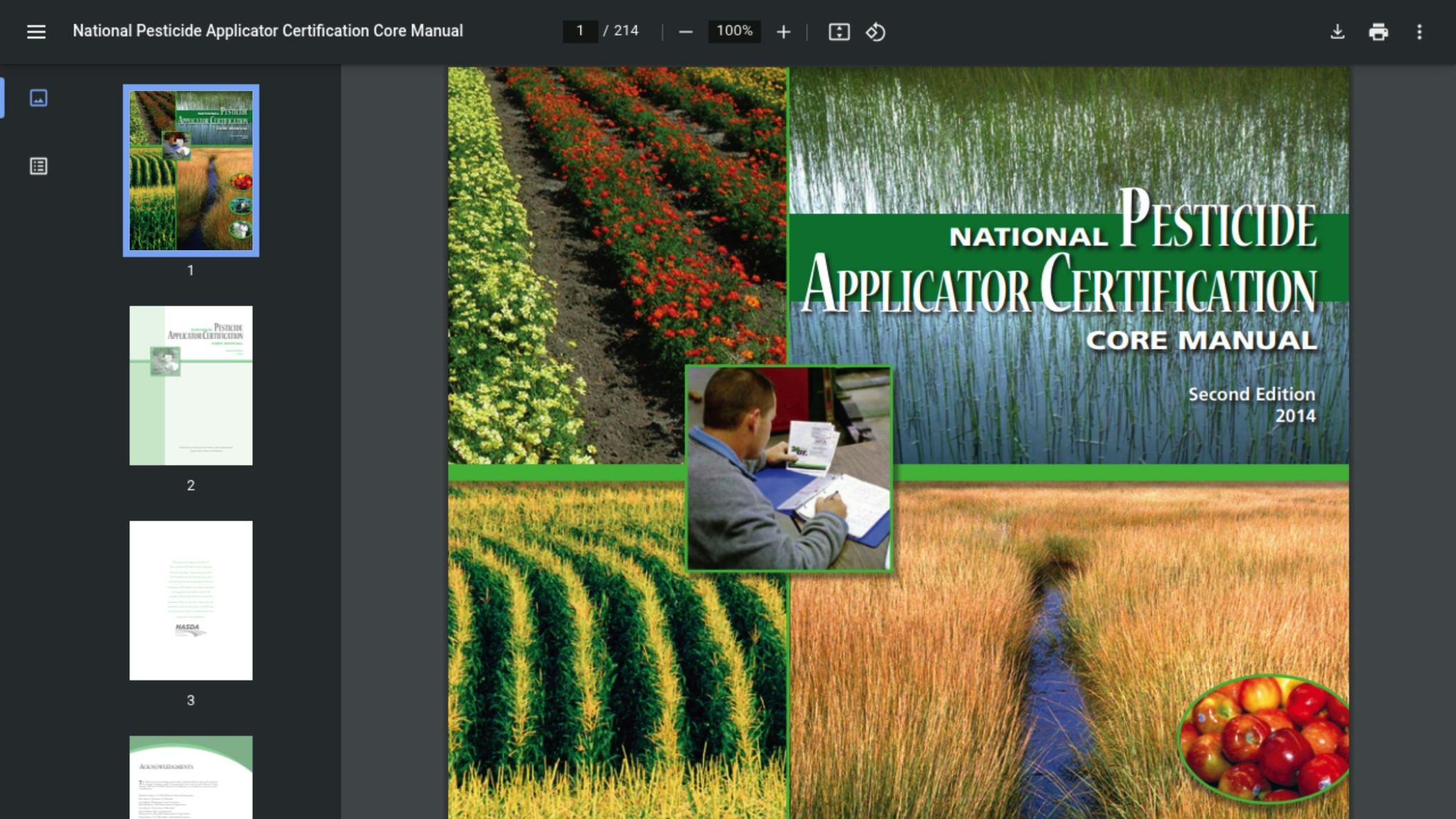
- Study Tips: Focus on formulation properties, label interpretation, and math calculations. Practice with sample questions and use trusted study resources like the National Pesticide Applicator Certification Core Manual.
Preparation requires understanding pesticide types, their benefits and drawbacks, and proper mixing techniques. Start with the basics, review key terms, and practice solving real-world scenarios to build confidence.
National Pesticide Applicator Certification Core Manual – Ch 4: Pesticide Formulations
sbb-itb-c4006de
Step 1: Learn the Basics of Pesticide Formulations
Before diving into exam questions, it’s crucial to understand the core principles of pesticide formulations. This foundational knowledge will make it easier to compare different formulations and tackle practical test scenarios. Simply put, a pesticide formulation is a mix of active and inert ingredients. The active ingredient (a.i.) is the chemical that controls or eliminates the target pest, while inert ingredients – often listed as "other ingredients" – serve to improve application, safety, and storage but don’t directly affect pests.
Core Terms and Definitions
Let’s break down some key terms you’ll encounter:
- Carrier: The main material (like water, oil, or mineral clay) that delivers the active ingredient to the target area.
- Adjuvant: A chemical additive that boosts the effectiveness or safety of the pesticide.
- Emulsifier: A specific type of adjuvant that helps oil-based formulations blend with water.
- Phytotoxicity: Damage to plants caused by unintended pesticide exposure.
It’s also important to differentiate between solutions, suspensions, and emulsions. A solution is a clear, stable mixture where the active ingredient is completely dissolved. Suspensions, on the other hand, are cloudy because they contain fine solid particles dispersed in liquid, requiring constant agitation to remain mixed. Lastly, an emulsion has a milky appearance and consists of tiny oil droplets dispersed in water (or vice versa) with the help of an emulsifier.
Now that you’re familiar with these terms, let’s look at the common types of pesticide formulations.
Main Formulation Types
Pesticide formulations come in a variety of forms, each with unique characteristics and uses.
Liquid Formulations
- Emulsifiable Concentrates (EC): These contain 25%-75% active ingredient and form a milky emulsion when mixed with water.
- Solutions (S): Fully dissolve in their carrier, eliminating the need for agitation after mixing.
- Flowables (F or L): Thick suspensions of fine solids in liquid that require moderate agitation to stay uniform.
- Ultra-Low Volume (ULV): Highly concentrated formulations, applied at very low rates – no more than 0.5 gallons per acre.
Dry Formulations
- Dusts (D): Contain 10% or less active ingredient and are prone to drifting.
- Granules (G): Coarse particles that are ready to use and typically applied directly to soil.
- Wettable Powders (WP): Highly concentrated powders (often 50% or more active ingredient) that form suspensions and need constant agitation.
- Water-Dispersible Granules (WDG): These can contain up to 90% active ingredient and are designed to minimize inhalation risks associated with fine dust.
Specialized Formulations
- Microencapsulated (M or ME): These use plastic coatings to slowly release the active ingredient over time.
- Baits (B): Contain less than 5% active ingredient combined with an attractant to lure pests.
Understanding these formulation types and their unique properties will help you make informed decisions about their use and application. This knowledge is essential for both practical and theoretical aspects of pesticide management.
Step 2: Compare Formulation Benefits, Drawbacks, and Uses
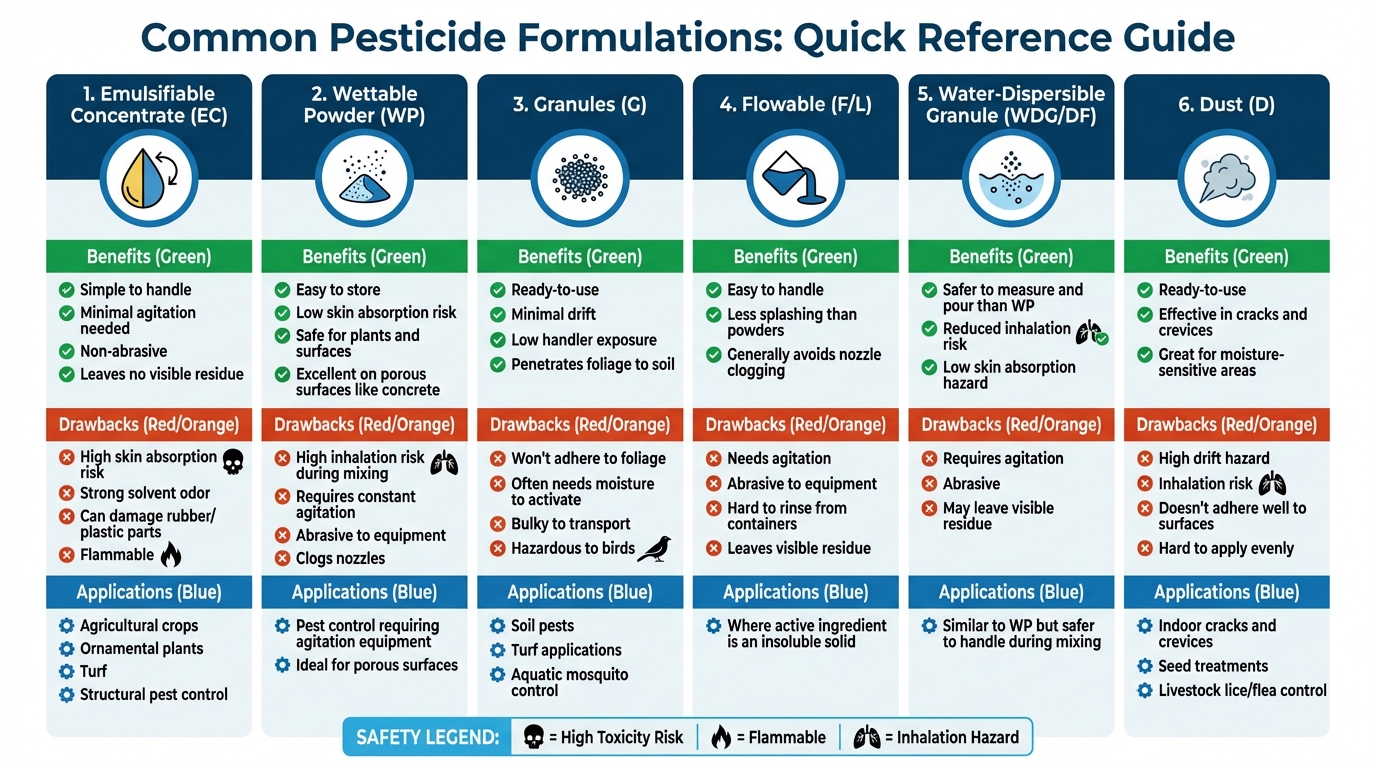
Pesticide Formulation Types: Benefits, Drawbacks, and Applications Comparison Chart
Choosing the right formulation often depends on understanding how it performs in specific scenarios. Exam questions frequently test your ability to align formulations with particular needs – like ensuring safety in sensitive environments, targeting specific pests effectively, or protecting treated surfaces from damage. Knowing the pros and cons of each formulation will help you answer these questions with confidence. The table below provides a side-by-side comparison to clarify these differences.
Comparison of Common Formulations
Pay close attention to the "Drawbacks" column, as it highlights safety and equipment-related concerns.
| Formulation Type | Benefits | Drawbacks | Typical Applications |
|---|---|---|---|
| Emulsifiable Concentrate (EC) | Simple to handle; minimal agitation needed; non-abrasive; leaves no visible residue. | High skin absorption risk; strong solvent odor; can damage rubber/plastic parts; flammable. | Agricultural crops, ornamental plants, turf, and structural pest control. |
| Wettable Powder (WP) | Easy to store; low skin absorption risk; safe for plants and surfaces; excellent on porous surfaces like concrete. | High inhalation risk during mixing; requires constant agitation; abrasive to equipment; clogs nozzles. | Useful for pest control requiring agitation equipment; ideal for porous surfaces. |
| Granules (G) | Ready-to-use; minimal drift; low handler exposure; penetrates foliage to soil. | Won’t adhere to foliage; often needs moisture to activate; bulky to transport; hazardous to birds. | Soil pests, turf applications, and aquatic mosquito control. |
| Flowable (F/L) | Easy to handle; less splashing than powders; generally avoids nozzle clogging. | Needs agitation; abrasive to equipment; hard to rinse from containers; leaves visible residue. | Applied where the active ingredient is an insoluble solid. |
| Water-Dispersible Granule (WDG/DF) | Safer to measure and pour than WP; reduced inhalation risk; low skin absorption hazard. | Requires agitation; abrasive; may leave visible residue. | Similar to WP but safer to handle during mixing. |
| Dust (D) | Ready-to-use; effective in cracks and crevices; great for moisture-sensitive areas. | High drift hazard; inhalation risk; doesn’t adhere well to surfaces; hard to apply evenly. | Indoor cracks and crevices, seed treatments, and lice/flea control on livestock. |
This table emphasizes critical safety and maintenance concerns. For instance, emulsifiable concentrates (ECs) carry a high risk of skin absorption due to petroleum-based solvents. On the other hand, wettable powders (WPs) pose inhalation hazards during mixing; wearing respiratory protection is essential when handling them. Water-dispersible granules (WDGs) provide similar performance to WPs but are designed as "dust-free" particles, significantly lowering inhalation risks during preparation.
Equipment maintenance is another key consideration. Solvents in ECs can degrade rubber and plastic parts, so hoses, gaskets, and seals should be inspected regularly . Abrasive formulations like WPs and flowables require frequent checks of nozzles and pumps. Additionally, flowables tend to settle during storage, so containers must be shaken thoroughly before use.
Step 3: Understand Pesticide Labels
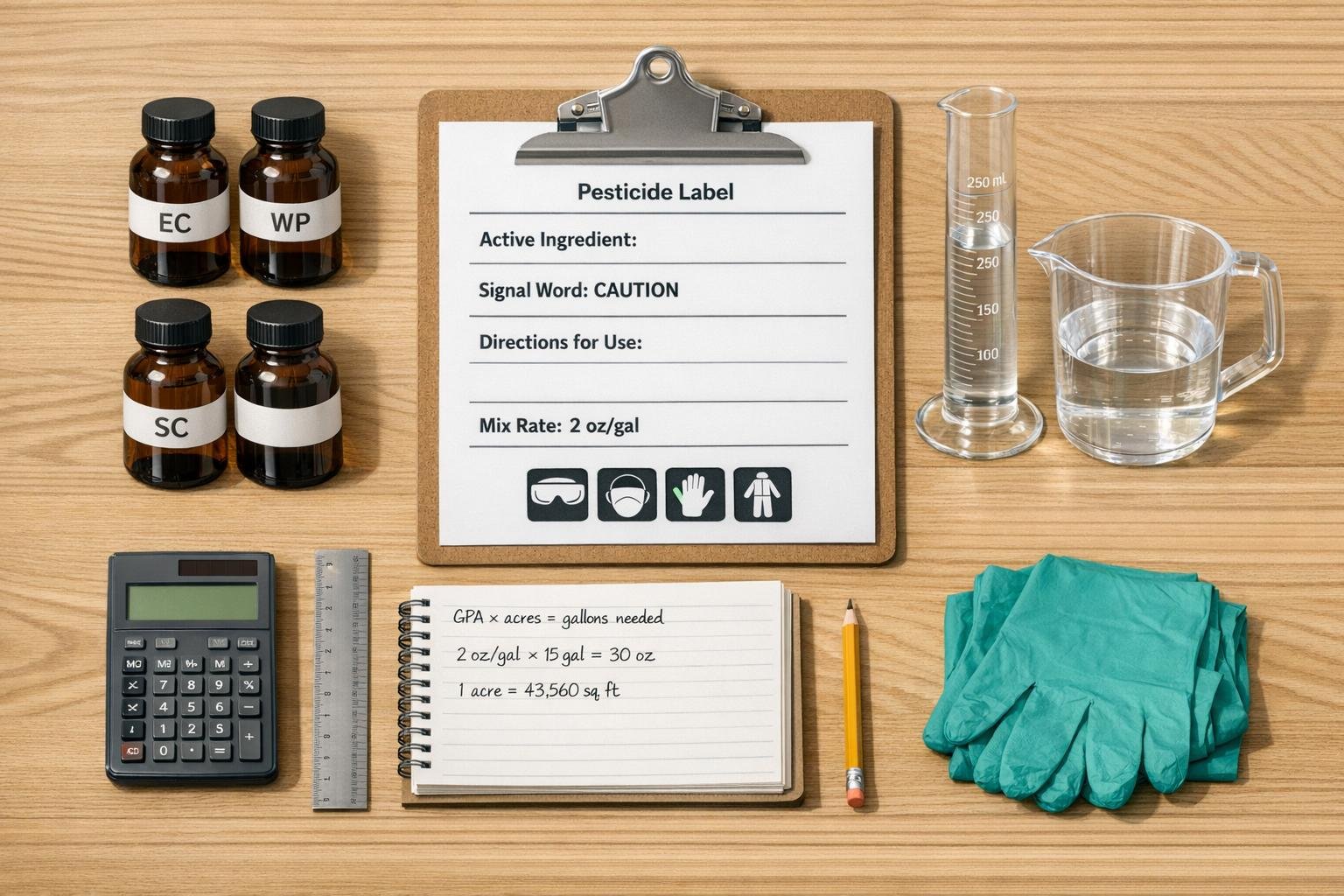
Take the time to carefully read pesticide labels – they are legal documents that explain how to properly mix, apply, store, and dispose of the product. As Penn State Extension points out, "using a pesticide in a manner inconsistent with its labeling is a violation of federal law". Many exam questions focus on your ability to find formulation details and interpret safety instructions, so knowing how to navigate a label can save you from mistakes and wasted time. This step builds on your knowledge of formulations by teaching you how to pull critical information directly from labels.
Label Sections and Formulation Details
Pesticide labels include key abbreviations that indicate formulation types. For example, "WP" stands for wettable powder. The ingredient statement outlines the percentages of active and inert ingredients. For instance, water-dispersible granules can contain up to 90% active ingredient by weight, while dust formulations typically have 10% or less.
The directions for use section provides essential details like mixing ratios, application rates, and equipment requirements. It also specifies whether the product needs to be diluted with water or oil or if it’s ready-to-use. Meanwhile, the physical and chemical hazards section highlights risks associated with the formulation – such as the flammability of petroleum-based emulsifiable concentrates – and lists the necessary personal protective equipment (PPE). These sections tie directly into the safety practices covered earlier.
Mixing Instructions and Compatibility
Once you’ve reviewed the label, follow its specific mixing instructions to ensure both safety and effectiveness. Labels often include warnings about incompatible products. For example, some indicate that wettable sulfur should not be combined with certain insecticides. Always check the container for instructions on mixing order and agitation needs. Products like wettable powders, flowables, and water-dispersible granules require constant agitation to avoid settling, gelling, or clogging.
Never mix undiluted liquid concentrates directly. Instead, dilute each one separately according to the label. Be alert for signs of incompatibility, such as clumping or separation in the spray tank. If you’re unsure about mixing two products, the label might include a compatibility chart or warnings about antagonism, where mixing could reduce the effectiveness of one or both chemicals.
Step 4: Use Practice Questions and Study Materials
Once you’ve got a handle on the pesticide label and mixing instructions, it’s time to put your knowledge to the test. Practicing with targeted questions and reviewing quality study materials can help you pinpoint weak spots and boost your confidence as you prepare for the exam.
Practice Test Questions
Start with exercises that challenge you to identify formulation abbreviations like WP (Wettable Powder), EC (Emulsifiable Concentrate), and WDG (Water-Dispersible Granule). These questions often require you to match the right formulation to specific application needs. You’ll also need to distinguish between active ingredients, inert ingredients, and synergists while working through scenarios that test your ability to select a formulation based on factors like application surface, equipment, and pest behavior.
Some practice exams feature 67 one-point questions, offering immediate feedback to help you identify areas that need extra attention. Be prepared for math and calibration problems, including application area calculations, unit conversions, and determining proper concentrate-to-diluent ratios. These quizzes are especially useful for highlighting specific topics that may require additional review.
Pair these exercises with high-quality study materials for a well-rounded preparation strategy.
Study Materials and Resources
The National Pesticide Applicator Certification Core Manual is the go-to resource for most state certification exams. Additionally, university extension guides, such as the UF/IFAS "PI231: Pesticide Formulations", provide detailed breakdowns of different formulation types, including their pros and cons.
Interactive online courses from institutions like Penn State, Utah State, and Oregon State are another excellent option. These courses often include videos, readings, and self-test questions specifically designed to deepen your understanding of pesticide formulations.
For a more structured approach, platforms like Online Pest Control Courses (https://onlinepestcontrolcourses.com) offer state-approved modules focusing on key topics like formulation abbreviations, compatibility, and strengths and weaknesses of various formulations. Many of these professional courses can be completed in about an hour and even count toward recertification credits. Before committing to a course, check for free sample modules to evaluate the quality, and always confirm that the course meets your state’s requirements.
Conclusion
Passing the Pesticide Formulations Exam requires a solid grasp of a few key topics. You’ll need to understand the distinctions between formulation types like WP (wettable powders), EC (emulsifiable concentrates), and WDG (water-dispersible granules). Being able to weigh the advantages and disadvantages of each and interpret pesticide labels for mixing instructions and safety guidelines is critical. Recognizing abbreviations and knowing which formulations need constant agitation – and why – will give you a clear edge.
Math tends to be the biggest challenge for most test-takers. Make sure you dedicate extra time to practicing unit conversions, working with fractions, and calculating how much pesticide to mix based on label rates and the application area. These questions are designed to test your ability to apply theoretical knowledge in practical scenarios.
"As you make your way through the course, be sure to take notes on each section, as there will be a comprehensive exam at the end." – Tyler Pettis, Director of Training, Online Pest Control Courses
If you’re completing an online certification course, stay on top of the required steps. Be sure to finish your final quiz at least 24 hours before any state reporting deadlines – like December 30 for calendar year credits – to avoid processing delays. For example, in Pennsylvania, applicators need six core and six category-specific credits within a three-year recertification period.
With steady preparation, detailed note-taking, and plenty of practice problems, you’ll head into the exam feeling ready and confident.
FAQs
What formulation should I use for porous surfaces like concrete?
For porous surfaces like concrete, emulsifiable concentrate (EC) formulations work best. These formulations seep into the surface, embedding the residual insecticide within the material to provide long-lasting pest control.
How do I know if two pesticides are compatible to tank-mix?
To determine if two pesticides can be safely tank-mixed, follow these steps for a jar test:
- Review the labels: Confirm that both pesticides are approved for your specific crop and that mixing them is permitted. Labels often include crucial instructions or restrictions.
- Conduct a jar test: Combine small amounts of both pesticides in water, adhering to the recommended mixing order. Look for any signs of incompatibility, such as clumping, separation, or excessive foaming.
- Follow the proper mixing sequence: Adding products in the correct order is key to avoiding potential issues.
This simple test can help you avoid problems during application and protect your equipment from damage.
What math should I practice most for the formulations exam?
To ace the pesticide formulations exam, it’s crucial to sharpen your math skills in a few specific areas. Start by focusing on dilutions, area conversions, and equipment calibration – these are the foundation of many exam questions.
Key areas to practice include:
- Percentages: Understand how to calculate and apply percentages, especially when working with active ingredient concentrations in formulations.
- Converting square feet to acres: Familiarize yourself with area measurements and how to convert between units, as this is often needed for determining application rates.
- Ratios and proportions: These are essential for mixing solutions accurately and scaling up or down for different tank sizes.
Additionally, work through problems that involve mixing liquid formulations and calculating the correct amount of pesticide for various tank capacities. Equipment calibration is another critical skill – learn the formulas for ensuring your equipment applies the right amount of product per unit area.
By practicing these topics, you’ll build the confidence and precision needed to handle the math challenges on the exam.