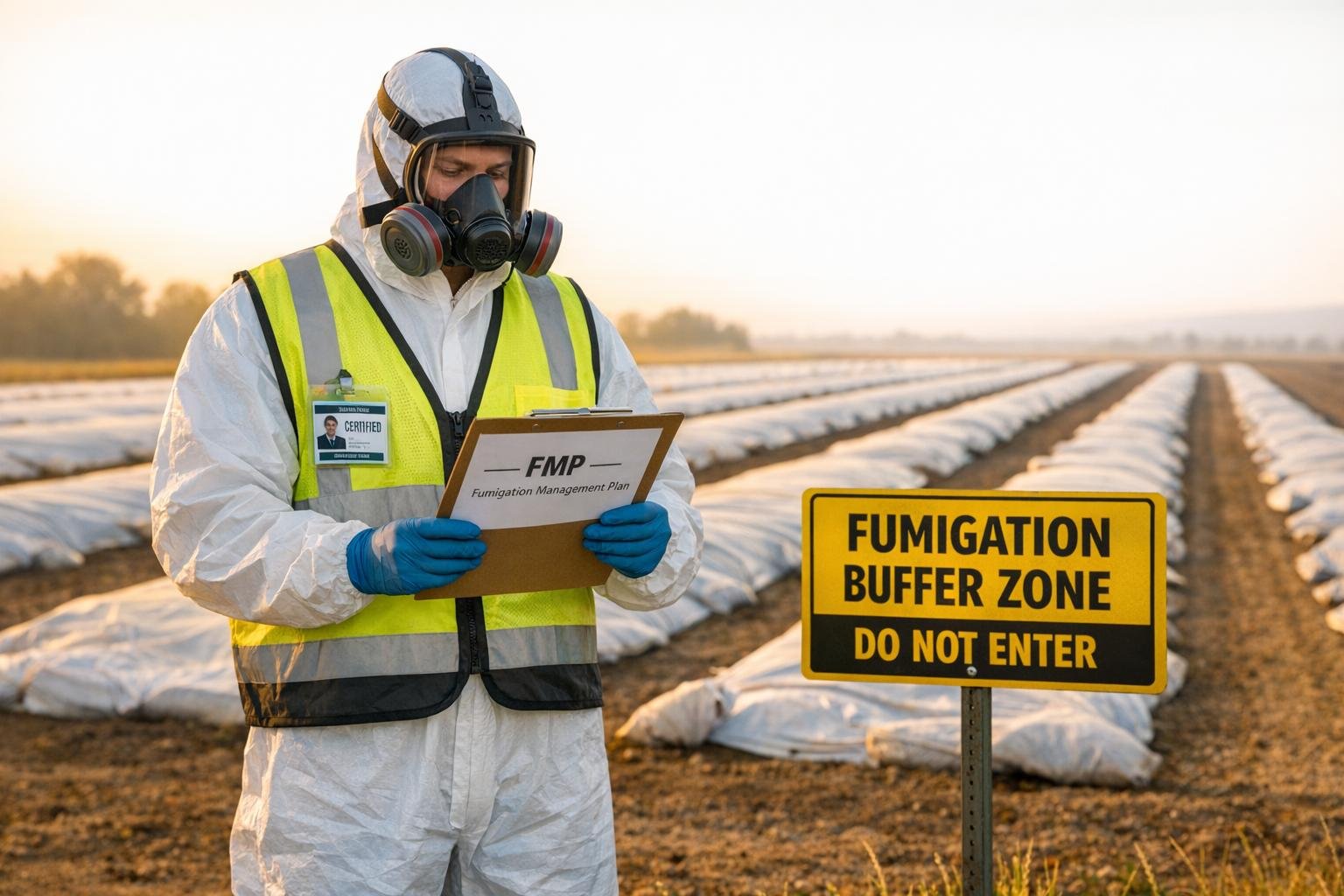
Soil fumigation certification is mandatory for anyone using restricted-use fumigants like chloropicrin, dazomet, and methyl bromide. This certification ensures applicators follow strict safety protocols, comply with EPA and state regulations, and renew their certification every three years. Key training topics include:
- Safety Measures: Use of protective gear, respirators, and gas detection tools, along with maintaining buffer zones (minimum 25 feet).
- Application Techniques: Site assessments, soil preparation, and proper use of shank injection methods.
- Regulatory Compliance: Adherence to federal and state laws, creation of Fumigant Management Plans (FMPs), and submission of post-application summaries.
- Buffer Zones: Calculation and marking of buffer distances to protect bystanders and reduce fumigant exposure.
- Chemical Properties: Understanding fumigant behavior, such as volatility and soil interactions, to ensure safe and effective use.
- Online Training: Flexible, EPA-approved programs for initial certification and recertification.
To stay compliant, always check your state’s specific requirements and use certified training platforms for recertification every 36 months.
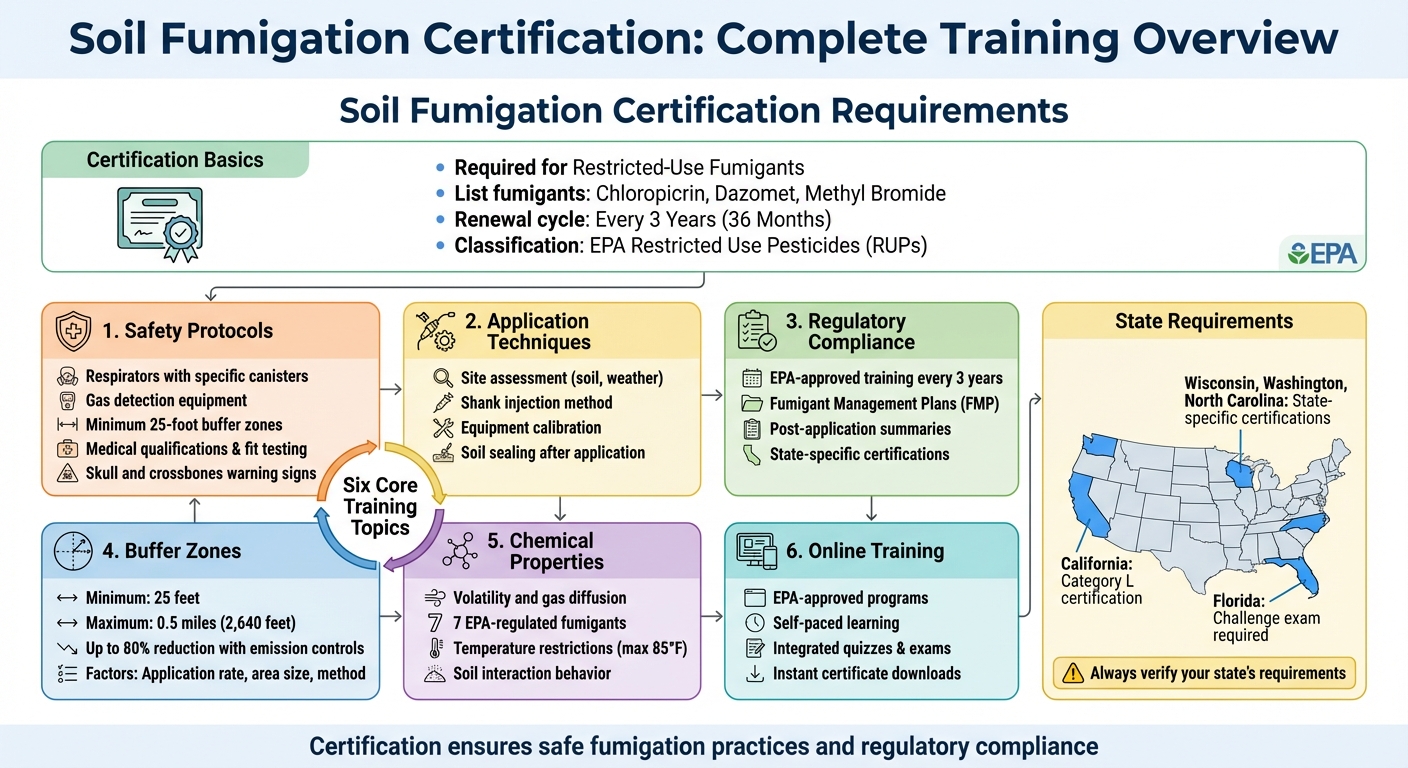
Soil Fumigation Certification Requirements and Training Process
National Pesticide Applicator Certification Core Manual – Ch 2: Federal Pesticide Laws & Regulations
sbb-itb-c4006de
1. Safety Protocols
This section dives into the essential personal protective measures and monitoring procedures required to ensure safe fumigation practices.
Personal Protective Equipment and Handler Requirements
When working with soil fumigants like chloropicrin, dazomet, and metam sodium, respirators with specific canisters or cartridges are the most critical pieces of protective gear. Handlers – including tractor drivers, shovelers, irrigators, crop advisors, and tarp workers – must adhere to strict safety guidelines to minimize risks.
Before using respiratory protective equipment, handlers are required to complete medical qualifications, fit testing, and specialized training. These steps are documented in the Fumigation Management Plan (FMP), which outlines all necessary safety procedures. This ensures that handlers are properly prepared and equipped for their tasks.
Product labels play a vital role in specifying the required protective clothing and respirator canisters. For example, products like Telone, Vapam, and K-Pam clearly state the protective gear needed. The FMP must confirm the availability of these items on-site, ensure that treated areas are clearly marked with "Skull and Crossbones" symbols, and maintain a mandatory 25-foot buffer zone.
Additionally, gas detection equipment is essential for monitoring fumigant levels. Strict aeration and reentry protocols must remain in place until fumigant concentrations are confirmed to be at safe levels [[5]](https://extension.psu.edu/Pennsylvania applicator recertification workbook for grain and rodent burrow fumigation).
2. Application Techniques
Pre-Application Planning and Equipment Setup
Before starting any fumigation process, it’s critical to perform a thorough site assessment. This involves checking soil conditions such as texture, moisture levels, and temperature to ensure they align with the product’s label requirements. Don’t overlook weather conditions either – factors like wind speed, humidity, and expected rainfall can significantly influence both the effectiveness of the fumigant and safety during application.
Safety protocols are the backbone of any successful application. Start by preparing a site-specific Fumigation Management Plan (FMP) tailored to the treatment area. This document provides a clear roadmap for the application process, helping protect both workers and surrounding communities. Proper calibration of application equipment is also crucial – this ensures the fumigant is applied at the correct dosage, preventing under- or over-application.
The actual application involves a precise sequence of steps. Fumigants are usually applied using shank injection, which places the chemical directly into the soil at the recommended depth. Right after the injection, the soil must be sealed to maintain the fumigant’s concentration and effectiveness.
Once the application is done, follow up with essential safety measures. Establish buffer zones around the treated area and post warning signs as outlined in the FMP. Finally, complete a post-application summary to document the process. For detailed guidance, refer to the National Soil Fumigation Manual, which provides standardized procedures to ensure both effective pest control and compliance with regulations.
3. Regulatory Compliance
Federal and State Regulatory Requirements
Regulatory compliance plays a critical role in ensuring soil fumigation practices adhere to both federal and state laws. The EPA classifies soil fumigants as Restricted Use Pesticides (RUPs), meaning only certified applicators – or those under their direct supervision – are authorized to purchase and apply these products.
"Compliance with the training required by the label is a condition of product use." – US EPA
To maintain certification, applicators must complete EPA-approved soil fumigant training every three years. While federal guidelines set the baseline, states have their own certification requirements. For example, Wisconsin, Washington, and North Carolina accept state-specific certifications, while California requires commercial certification in Category L.
Before any fumigation begins, a written, site-specific Fumigant Management Plan (FMP) must be prepared. The certified applicator overseeing the work is responsible for confirming in writing that the FMP is accurate and up-to-date. Additionally, post-application summaries must be retained to meet regulatory standards.
Some states and tribal authorities have notification requirements that must be followed. In certain areas, applicators are required to provide advance notice before fumigation takes place. To ensure compliance, consult the EPA’s state notice list to verify if your location has specific notification rules.
4. Buffer Zones and Environmental Protection
Calculating and Implementing Buffer Distances
When it comes to protecting both people and the environment, accurately calculating buffer zones is a must. These zones act as safety buffers around treatment areas, allowing fumigant residues to disperse and lowering the risk of inhalation exposure. They’re a critical part of fumigation safety protocols and application techniques.
"Buffer zones provide distance between the application block (i.e., edge of the treated field) and bystanders. Buffer zones: Allow airborne residues to disperse before reaching bystanders, reducing the potential for fumigant exposure." – US EPA
The size of these buffer zones depends on several factors, such as the broadcast equivalent application rate, the total area being treated, and the method of application. According to the Fumigation Management Plan (FMP), the minimum buffer zone is set at 25 feet, while the maximum can stretch up to 0.5 miles (2,640 feet).
Certain emission-control measures can significantly reduce the size of these zones – by as much as 80%. For example, using high-barrier tarps, applying water seals, or working in soils with specific characteristics (like over 27% clay, more than 2.5% organic matter, or temperatures below 50°F) can all help minimize the required buffer distance. To assist with these calculations, the EPA Buffer Zone Calculator offers tailored estimates for different products, though the product label remains the ultimate legal guideline if there’s any conflict.
To ensure safety, buffer zones must be clearly marked at all entry points. Signs should warn against entry, display the product name, and provide the applicator’s contact information. These postings must remain in place until the buffer period concludes. Together, these measures form a comprehensive system designed to uphold both safety and compliance in Michigan soil fumigation practices.
5. Soil Fumigant Characteristics
Understanding Chemical Properties and Behavior
Knowing how soil fumigants work is essential for ensuring safety, applying them correctly, and following regulations.
When applied, soil fumigants turn into gas, allowing them to move through soil pores and target pests like nematodes, fungi, and weeds. A critical property to understand is volatility – how easily these substances shift from liquid or solid forms into gases.
Careful monitoring of gas diffusion is key to safe fumigation. These gases can escape from the soil into the air at the application site and even pesticide drift off-site, sometimes causing health issues for hours or days. Health risks can range from mild eye irritation to severe and lasting damage.
Different active ingredients behave in unique ways. The EPA regulates several major fumigants, including chloropicrin, dazomet, metam sodium, metam potassium, methyl bromide, dimethyl disulfide (DMDS), and 1,3-dichloropropene. For example, dimethyl disulfide has distinct chemical properties that require a separate EPA-approved training program, setting it apart from fumigants like methyl bromide or chloropicrin. Understanding these differences is essential for adjusting application methods based on specific environmental conditions.
Environmental factors also play a big role in how fumigants behave. For instance, some product labels restrict use when air temperatures exceed 85°F to avoid excessive volatility and unintended drift. Applicators are encouraged to refer to the National Soil Fumigation Manual to understand how soil and pest conditions affect fumigant performance before pursuing certification. Always check the product label for the active ingredient, as each chemical has unique safety and handling protocols. Understanding these properties is critical for aligning fumigation practices with safety standards and regulatory requirements.
6. Online Training Integration
Flexible, Self-Paced Learning for Busy Applicators
Online training, including courses on the pesticide label, has transformed the way applicators approach soil fumigation certification. By focusing on safety and compliance, these programs offer a convenient, flexible solution for meeting certification requirements. Now, registrants of soil fumigant products provide EPA-approved online training programs that include integrated quizzes and exams. These platforms allow applicators to complete training at their own pace, making it easier to stay compliant while balancing busy schedules. This shift builds on traditional methods, simplifying both the learning and recertification processes.
Starting January 2026, the University of Missouri Extension will offer a course titled "Private Pesticide Applicator Category 21 Supplemental Training: Soil Fumigation." Directed by Sam Polly and Rusty Lee, this free, self-paced program takes about 50 minutes to complete and covers 13 critical topics, such as buffer zones, pesticide formulations, and fumigant management plans. Delivered through the Canvas platform, the course also provides a certificate upon completion, ensuring compliance with Missouri Pesticide Use Act standards.
Digital study materials further enhance accessibility. For instance, Penn State Extension offers its training materials for $30.00, which are immediately available through the "My Educational Content" dashboard.
However, while online options are expanding, applicators must confirm their state’s specific certification requirements. The EPA’s soil fumigation training page outlines whether a state accepts these registrant-developed online courses. Some states, such as California, Florida, and Washington, require additional EPA-approved challenge exams. In states without extra requirements, the registrant-developed training serves as the default compliance method.
For added convenience, platforms like Online Pest Control Courses (https://onlinepestcontrolcourses.com) offer state-approved training accessible across devices. These courses include instant certificate downloads, streamlining the process for maintaining the three-year recertification cycle.
Conclusion
Earning soil fumigation certification requires a solid understanding of several critical components. Following safety protocols – like establishing buffer zones, using proper respiratory protection, and preparing for emergencies – helps safeguard workers and bystanders. Mastering application techniques, such as assessing soil conditions, utilizing tarping methods, and understanding fumigant properties, minimizes risks like off-site movement. To comply with EPA regulations, certified applicators must complete approved training every three years (36 months) as part of the legal requirements for using these restricted-use fumigants. Tasks like creating Fumigant Management Plans (FMPs), calculating buffer zone credits, and maintaining detailed records are key responsibilities that set certified professionals apart.
State-specific rules add another layer of complexity. For example, California requires a Category L certification, while Florida mandates passing a challenge exam, emphasizing the need to meet both federal and local standards. Applicators should always confirm their state’s specific requirements to ensure they remain eligible to purchase and apply soil fumigants.
To address these demands, certification processes have become more accessible. State-approved online platforms now provide convenient training options. Online Pest Control Courses (https://onlinepestcontrolcourses.com) offers mobile-friendly courses with instant certificate downloads, simplifying compliance for busy professionals. Whether through registrant programs, university extensions, or specialized online resources, staying certified ensures both legal adherence and the highest safety practices in soil fumigation.
FAQs
Which soil fumigants require certification?
Certification is mandatory for applicators handling soil fumigants such as chloropicrin, dazomet, metam sodium/potassium, and methyl bromide. This requirement, enforced by EPA regulations and product labels, ensures these substances are used safely and in compliance with established guidelines.
What does a Fumigant Management Plan (FMP) need to include?
A Fumigant Management Plan (FMP) outlines key components such as application procedures, safety protocols, buffer zones, weather considerations, and adherence to label instructions. Resources like the EPA provide templates and examples to help develop a thorough and effective plan.
How do I figure out the right buffer zone for my job?
To figure out the right buffer zone for soil fumigation, start by checking the product label. It typically includes look-up tables and instructions based on factors like your application rate and the size of your field. You can also use buffer zone calculators for more precision. If needed, you can adjust your application methods, rates, or block sizes to potentially reduce the buffer zone, but it’s crucial to ensure it meets the minimum requirements. Always double-check the specific guidelines on the label before proceeding.