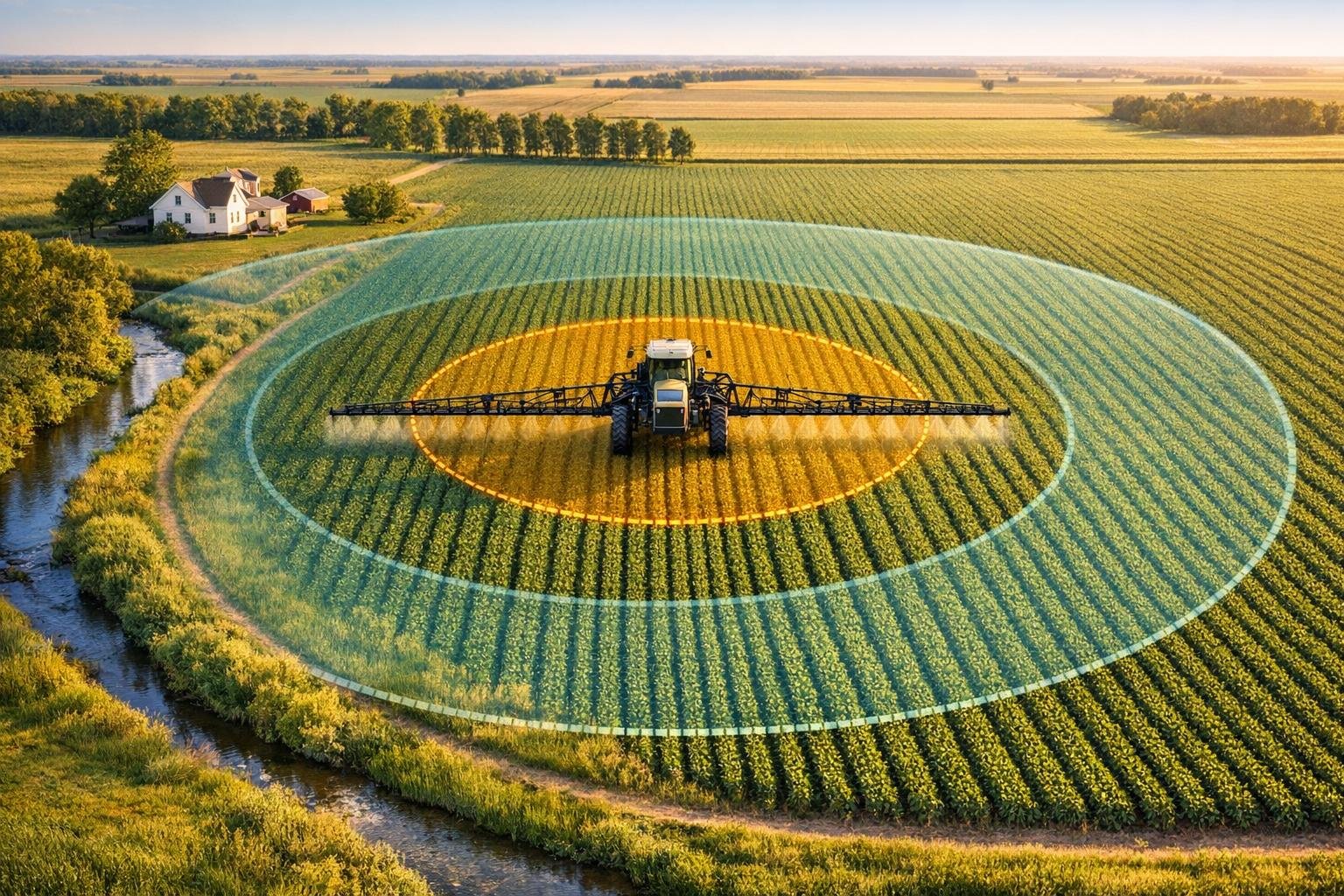
Buffer zones are mandatory safety buffers between treated fields and nearby people or sensitive areas to limit pesticide exposure. Here’s what you need to know:
- Minimum Buffer Zone: 25 feet for most applications, as per EPA guidelines.
- Maximum Buffer Zone: Applications are prohibited if the required buffer exceeds 2,640 feet (1/2 mile).
- Aerial Applications: Require a 100-foot exclusion zone during spraying.
- State-Specific Rules: Some states, like California and Arizona, enforce stricter regulations, including larger buffers near schools and residential areas.
- Key Factors: Buffer distances depend on pesticide type, application method, environmental conditions, and proximity to sensitive areas.
- Compliance: Applicators must follow the most restrictive rules (federal, state, or local) and maintain detailed records of calculations and notifications.
Understanding and following these rules is critical for legal compliance, protecting public health, and minimizing risks. Always prioritize pesticide label instructions and stay updated with state regulations.
Buffer Zones for Aerial Pesticide Applications
Buffer Zone Definition and Purpose
Aerial pesticide applications, whether carried out by fixed-wing aircraft or helicopters, pose unique challenges due to the risk of pesticide drift vs. buffer zones. To address this, specific measures are required to minimize exposure risks.
The Application Exclusion Zone (AEZ) acts as a moving buffer during spraying. According to the EPA, aerial pesticide applications must maintain a minimum AEZ of 100 feet – regardless of the type of pesticide or spray quality being used. Operations must stop immediately if anyone other than trained handlers enters this zone. The updated 2024 AEZ rule strengthens these protections by extending the exclusion zone beyond farm boundaries, ensuring the safety of bystanders on neighboring properties and public spaces.
Spray quality is another critical factor in determining AEZ requirements. A fine spray quality necessitates the full 100-foot AEZ, while ground applications using larger droplets may require just a 25-foot zone.
For added protection, vegetative buffers can be strategically implemented. These barriers are most effective when they feature plants with fine or needle-like leaves and stand at least twice as tall as the target crop. To work effectively, the buffer should maintain a density of 40% to 50%, allowing airflow while capturing pesticide drift. Mixing various plant types ensures a continuous, gap-free barrier.
While these federal guidelines provide a baseline, state regulations often impose stricter standards for aerial pesticide applications.
Federal EPA Guidelines vs. State Requirements
Federal EPA guidelines establish minimum requirements for buffer zones, but individual states often enforce stricter measures to enhance public safety. Applicators must comply with the most restrictive rules, whether federal, state, or local.
Some states go beyond federal guidelines by implementing "no-drift" standards, which prohibit any off-target pesticide movement. Unlike federal rules that allow wind-directional buffers, these state regulations may require uniform buffer zones regardless of wind conditions. Checking your state’s specific requirements is crucial before starting any aerial application.
In certain cases, the EPA’s Mitigation Menu allows for reduced buffer distances to address ecological spray drift, but these adjustments don’t apply to areas where people are present. Tools like the Pesticide App for Label Mitigations (PALM) can assist in documenting buffer calculations and ensuring compliance with all applicable rules. These resources are indispensable for maintaining accurate records and meeting site-specific requirements.
sbb-itb-c4006de
Adapting to ESA: Spray Drift
State-Specific Buffer Zone Requirements
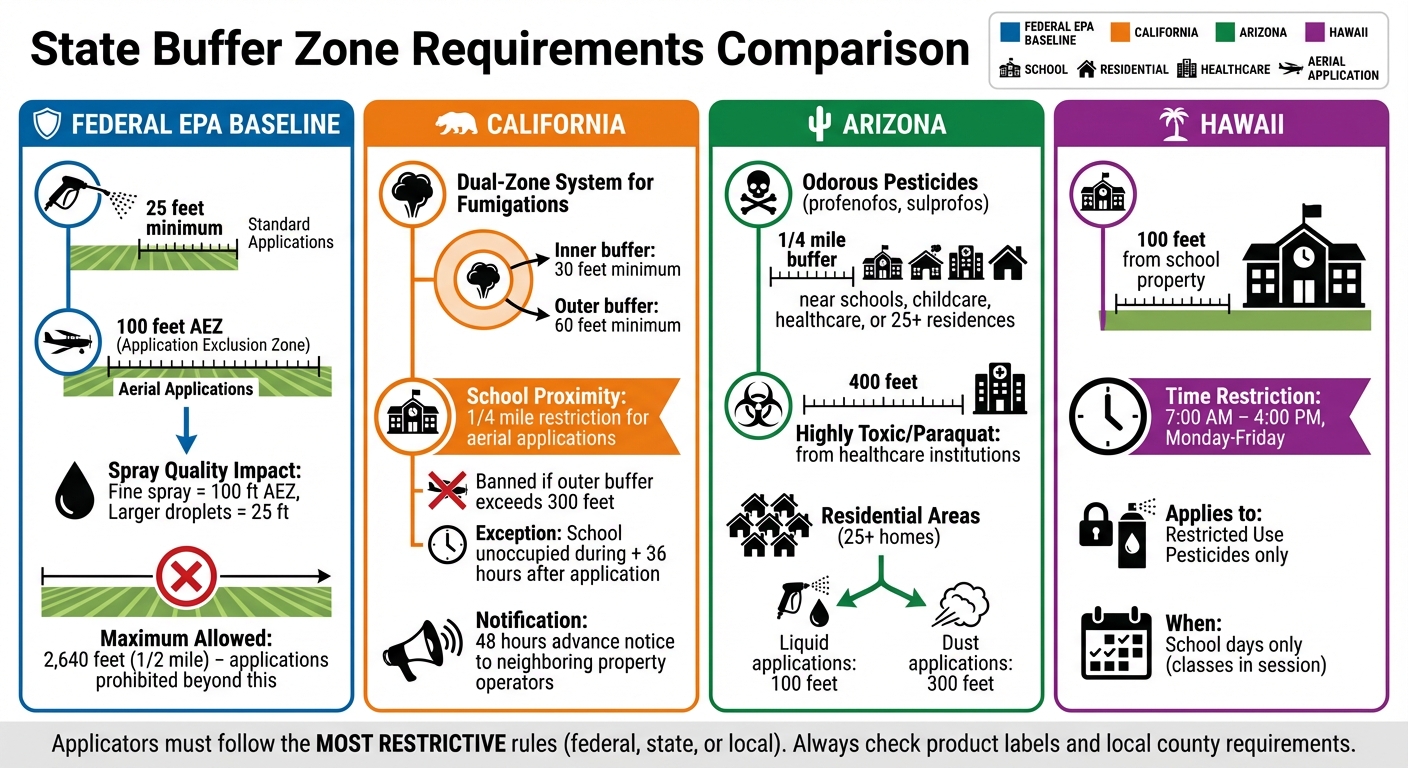
State Buffer Zone Requirements for Pesticide Applications: Federal vs State Rules
States with Stricter Buffer Zone Rules
Federal EPA guidelines set the baseline for buffer zones, but some states enforce stricter rules to safeguard public health and sensitive areas. Knowing these state-specific requirements is crucial for ensuring compliance during aerial pesticide applications.
California has one of the most detailed buffer systems in the country, especially for fumigations. The state uses a dual-zone system with an inner buffer zone of at least 30 feet and an outer buffer zone of at least 60 feet. If the outer buffer exceeds 300 feet, aerial applications near schools – within 1/4 mile – are banned unless the school is unoccupied during and for 36 hours after the application. Additionally, California requires applicators to notify neighboring property operators 48 hours in advance if the buffer zone extends onto their land.
Arizona sets strict proximity limits based on pesticide type and surrounding facilities. For pesticides with strong odors, such as profenofos and sulprofos, applicators must maintain a 1/4-mile buffer near schools, child care facilities, health care institutions, or areas with 25 or more adjoining residences. For highly toxic pesticides or paraquat, applications are banned within 400 feet of any health care institution. Residential areas have specific rules too: a 100-foot buffer is required for liquid applications and a 300-foot buffer for dust applications when 25 or more homes are nearby.
Hawaii takes a time-sensitive approach to protect schools. The state prohibits the use of Restricted Use Pesticides within 100 feet of school property during school hours, defined as 7:00 AM to 4:00 PM, Monday through Friday. This restriction applies only on days when classes are in session, giving applicators clear guidance for scheduling.
These examples highlight the importance of adapting your application strategy to meet specific state rules. Beyond these mandates, other factors can also influence buffer zone distances.
Factors That Affect Buffer Zone Distances
Buffer zones are not static; they vary depending on several environmental and operational factors. Applicators need to assess these conditions carefully before proceeding.
Application parameters are a key consideration. Higher application rates typically require larger buffer zones. For soil fumigants, the size of the treatment area also plays a role – larger areas demand wider buffers.
Environmental conditions can either increase or reduce buffer requirements. For example, soil properties can qualify for EPA-approved buffer credits. Soil with organic matter above 1.5% may allow for a 20% buffer reduction, while clay content exceeding 27% can add another 10% credit. Temperature also matters – soil temperatures below 50°F reduce off-gassing, which can lead to additional buffer reductions. In states like Arkansas or Mississippi, applicators must monitor for temperature inversions by tracking 3°F shifts in ambient temperatures from morning lows or afternoon highs, as inversions can increase drift risks.
Proximity to sensitive areas demands extra precautions. For example, water bodies require buffer zones based on water depth, and the use of vegetative filter strips – at least 33 feet wide – helps minimize pesticide runoff. Equipment settings also come into play. In Arkansas, aerial spray booms must be kept 15 feet or lower above the crop canopy, and aircraft speeds are capped at 145 mph to reduce drift.
To calculate precise buffer distances, applicators can rely on product-specific look-up tables and EPA calculators. However, these tools must always be cross-checked with the product label. In California, County Agricultural Commissioners can impose stricter buffer zones or longer durations based on local conditions, so verifying county-specific requirements is essential before any aerial application begins.
How to Comply with Buffer Zone Regulations
Planning Aerial Applications
Before you even take off, every detail of your aerial application needs to be carefully planned. Start with the pesticide label – it’s your legal roadmap. The label will tell you if a buffer zone is required and provide base distances based on the pesticide, application method, and crop. If your specific parameters aren’t listed in the label’s look-up tables, round up to determine the appropriate buffer distance.
Next, identify any sensitive areas near your application site. Sensitive areas include places like schools, playgrounds, apiaries, water bodies (streams, ponds), organic farms, and health care facilities. For instance, in Michigan, any occupied school building or grounds within 100 feet of your application site qualifies as a sensitive area.
Use approved digital tools to fine-tune your buffer calculations. These tools factor in site-specific conditions, such as soil organic matter, clay content, and temperature. For example, if your soil has more than 2% organic matter and over 27% clay content, you may qualify for buffer credits that reduce the required distance – but the minimum can never drop below 25 feet. If your calculation exceeds 1/2 mile (2,640 feet), the application is not allowed. Be sure to print and keep a summary of these calculations for at least one year as proof of compliance.
Weather monitoring is also key. In Arkansas, for example, you must record the ambient temperature at the airstrip and confirm that pre-noon readings rise by at least 3°F or that post-noon readings drop by no more than 3°F to rule out temperature inversions. Additionally, ensure aerial spray booms stay 15 feet or lower above the crop canopy, and keep aircraft speeds under 145 mph to maintain proper spray classification.
Once all calculations and plans are in place, document everything thoroughly to safeguard compliance.
Maintaining Compliance Records
Keeping detailed records is essential – not just for compliance but also to back up your pre-application planning. Start by preparing a written Fumigation Management Plan (FMP) and keep it on file for two years after the application. This plan should include details like your buffer distances, any credits applied, and site-specific conditions.
Record key details such as the application date, time, weather conditions, equipment settings, and buffer calculations. If you used credits to reduce buffer distances – like high-barrier tarps, potassium thiosulfate, or specific soil characteristics – make sure to document the supporting data. Previous records can also be a helpful reference for equipment setup and environmental conditions.
For soil fumigant applications, post buffer zone signs 24 hours before the application and leave them in place until the buffer period ends. Use the EPA Buffer Zone Sign Template to meet all posting requirements. In Michigan, applicators must notify individuals on a voluntary registry at least 24 hours in advance, either by phone or by leaving written notice at the main entrance. Keep copies of all notifications and confirmations for your records.
Finally, cross-check your documentation against both federal and state regulations to ensure you’re following the strictest requirements. Proper recordkeeping not only ensures compliance but also protects you in the event of an audit or inspection.
Staying Current Through Online Training
State-Approved Training from Online Pest Control Courses
Keeping up with changing buffer zone regulations is just as important as thorough planning and accurate recordkeeping. These rules are constantly updated, and staying informed isn’t optional – it’s required by law. A good example is the 2024 Application Exclusion Zone (AEZ) Rule, which reinstated the 2015 protections and reversed the 2020 provisions that had reduced bystander safety measures. Missing key updates – like the Immediate Family Exemption, which allows family members to be present in the AEZ under specific notification requirements – could lead to compliance issues.
Online Pest Control Courses offers state-approved training to help you stay ahead of these changes. Their courses provide CEUs and CCUs that align with federal standards under 40 CFR Part 171, ensuring you grasp essential topics like drift prevention, label interpretation, and pesticide laws at both state and federal levels. They also make complex concepts, such as buffer calculations, easier to understand by incorporating practical tools like look-up tables and credit assessments into the lessons.
The training also dives into technical standards like ASABE S572, which determines whether your AEZ needs to be 25 or 100 feet. But this isn’t just about passing a test – it’s about safeguarding yourself, your team, and the communities where you operate. These detailed modules are designed to prepare you for real-world challenges, ensuring you’re equipped to handle the scenarios discussed earlier.
Convenient Learning Options for Applicators
To meet the demands of changing regulations, applicators need training that’s both effective and flexible. For aerial applicators and others with tight schedules, sitting through long in-person sessions isn’t practical. That’s why Online Pest Control Courses is designed to work around your day. The platform is mobile-friendly, so you can access courses on your phone, tablet, or computer – whether you’re at the airstrip, on the road, or relaxing at home. This flexibility also makes it easy to use tools like the EPA’s Buffer Zone Calculator while you’re on-site.
Once you complete a course, you can immediately download the certificates required for state reporting and recertification, which is mandatory every three years. The platform also offers a 30-day money-back guarantee and secure checkout, giving you peace of mind when you enroll. This training isn’t just a box to check – it’s a key part of staying compliant and protecting your livelihood.
Conclusion
Following state buffer zone rules is crucial for protecting agricultural workers and their families, who rely on these regulations to ensure their safety. Buffer zones help airborne pesticide residues dissipate before reaching bystanders, significantly reducing exposure risks. When applicators follow these guidelines, the benefits ripple outward: fewer lost wages, lower medical expenses, and reduced absences from work and school for those affected.
The regulatory framework continues to evolve, with the October 2024 AEZ Final Rule reinstating stricter protections for nearby communities and school grounds. These updates highlight a commitment to safety standards rooted in science, such as the adoption of ASABE Standard 572 for determining spray quality and buffer distances. Staying informed about these changes isn’t just a best practice – it’s a legal obligation that safeguards your operation and your license.
These standards emphasize the importance of careful compliance during every application. Keep in mind that the pesticide product label is the ultimate authority. If the required buffer zone exceeds 2,640 feet, the application is prohibited. While credits may reduce buffer distances, the absolute minimum remains 25 feet. These limits are in place because proper adherence directly impacts the health of workers and the safety of surrounding communities. Your detailed planning, accurate recordkeeping, and commitment to ongoing education all contribute to a safer industry.
FAQs
How do I figure out my required buffer distance for a specific job?
To figure out the buffer distance you need, check the EPA’s guidelines. They offer tools like lookup tables and calculators to make the process easier. Start by identifying your application type – like soil fumigation – and note any mitigation measures you’re using, such as tarps. Then, use the EPA’s resources to calculate the correct distance while staying compliant with regulations and product label instructions. For extra tips and adjustments, take a look at the EPA fact sheets, which provide helpful advice and best practices.
What qualifies as a ‘sensitive area’ when establishing a buffer zone?
A sensitive area is any location where people, animals, or plants that are particularly vulnerable are found. These can include places like schools, hospitals, neighborhoods, parks, wildlife refuges, and areas that support pollinators. In such zones, it’s crucial to take extra precautions to limit pesticide exposure and safeguard the surrounding ecosystems.
What records should I keep to prove buffer zone compliance?
To ensure compliance with buffer zone regulations, it’s important to keep detailed records. These should include the pesticide product name, EPA registration number, amount applied, application date, exact location (including address and specific site), application method, target organisms, and any steps taken to minimize buffer zones, such as using tarps or applying credits. Keeping this information organized is crucial for meeting regulatory standards.