When it comes to pesticide recordkeeping, federal and state rules often differ, and understanding these differences is crucial for compliance. Here’s a quick breakdown:
- Federal Rules: Apply to Restricted Use Pesticides (RUPs) only. Records must be completed within 14 days and kept for 2 years. Required data includes product name, EPA registration number, application details, and applicator information.
- State Rules: Often stricter, covering both RUPs and General Use pesticides. States like Florida require records within 2 working days, while others like New York mandate 3-year retention. Additional details, such as weather conditions, are often required.
Quick Comparison
| Factor | Federal | State |
|---|---|---|
| Scope | RUPs only | Often includes General Use |
| Retention Period | 2 years | 2-3 years (varies by state) |
| Timeline to Record | 14 days | As short as 2 days (e.g., FL) |
| Additional Data | None | Weather, timing, equipment info |
State rules may go beyond federal standards, and if they do, you must follow the stricter requirements. Proper recordkeeping protects your license, avoids penalties, and ensures operational compliance.
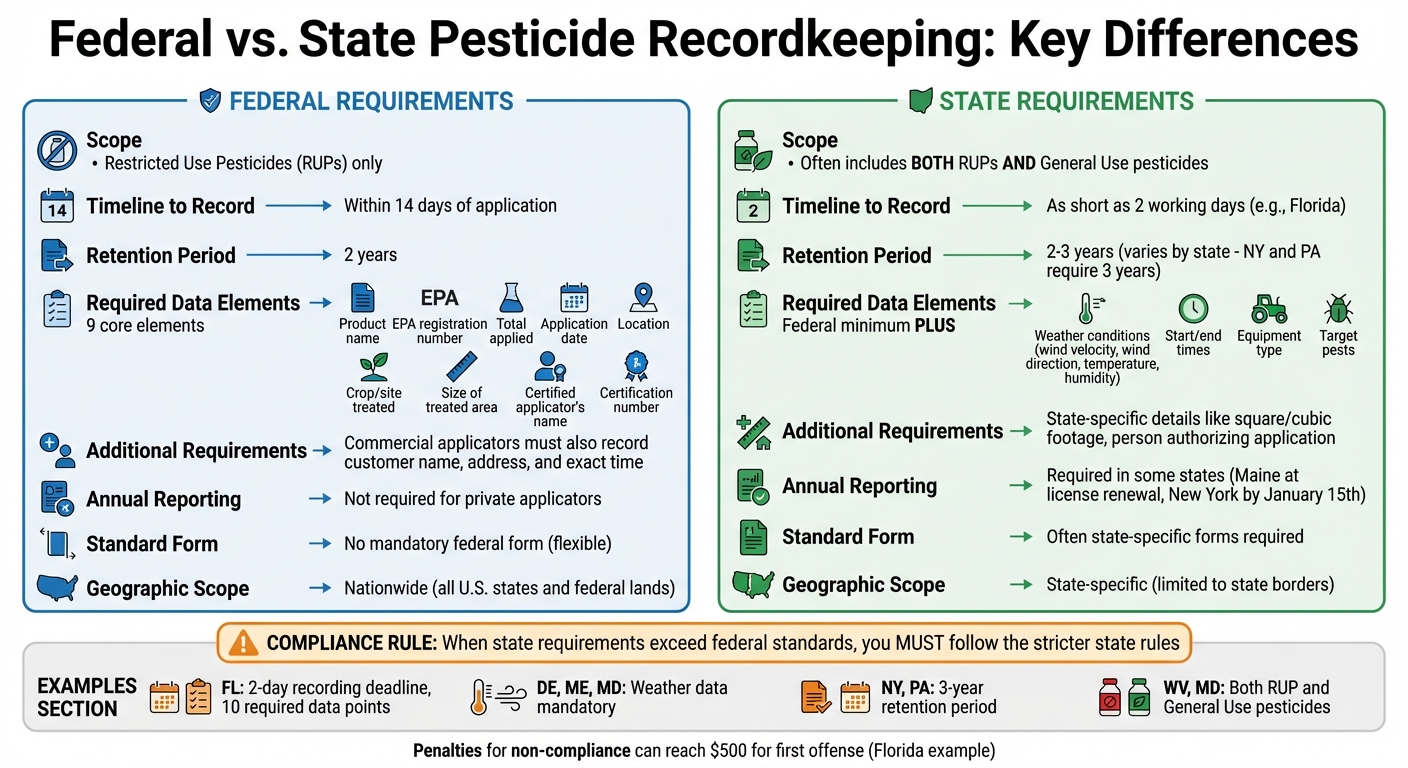
Federal vs State Pesticide Recordkeeping Requirements Comparison Chart
1. Federal Recordkeeping Rules
Retention Periods
Federal law requires that records for restricted use pesticide (RUP) applications be kept for at least two years from the application date for both private and commercial applicators. However, pesticide producers are held to a much longer timeline, needing to retain records related to disposal and human testing for 20 years. Below, we break down the specific data elements that must be recorded for each application.
Required Data Elements
For every RUP application, the following nine pieces of information must be documented:
- Product (brand) name
- EPA registration number
- Total amount applied
- Application date (month/day/year)
- Location
- Crop or site treated
- Size of the treated area
- Certified applicator’s name
- Certification number
Commercial applicators have additional requirements. They must also record the customer’s name, address, and the exact time of application. For private applicators handling spot treatments (less than 1/10 of an acre in a single day), a simplified process is allowed. In these cases, they only need to document the date, product name, EPA registration number, total amount applied, and mark the location as "Spot application".
Beyond recording specifics, federal rules also categorize applicators differently.
Applicator Types
Federal regulations divide applicators into two main categories:
- Private applicators: Certified individuals applying RUPs to grow agricultural commodities on property they own or lease.
- Commercial applicators: Those who apply pesticides as a service or on properties that don’t meet the private applicator criteria.
If a certified applicator supervises noncertified workers, their training – such as WPS (Worker Protection Standard) agricultural handler training – must also be documented separately.
Compliance Strategies
Federal guidelines stipulate that records must be completed within 14 days of the application. While there is no mandatory federal form, applicators can incorporate these requirements into their existing recordkeeping systems, whether digital or paper-based. Commercial applicators are also required to provide customers with a copy of the application details within 30 days. For multiple applications by the same certified applicator, their name and certification number only need to be recorded once.
According to the Agricultural Marketing Service, "No standard Federal form is required for recording RUP applications, which allows certified private applicators the flexibility to integrate RUP applications into any recordkeeping system".
In emergencies, records must be made immediately available to licensed health care professionals. Additionally, authorized representatives from the EPA, USDA, or state regulatory agencies have the right to inspect these records upon request.
sbb-itb-c4006de
2. State Recordkeeping Rules
Retention Periods
The length of time you need to keep records varies by state, typically falling between two to three years. For example, Delaware, Maine, Maryland, and West Virginia require a two-year retention period, while New York and Pennsylvania extend this to three years. It’s important to check the specific rules for your state before discarding records after two years. Additionally, state regulations often include requirements for recording more detailed information than federal standards.
Required Data Elements
Many states require applicators to document more than the federal minimum, especially when it comes to weather conditions and timing specifics. For instance:
- Delaware, Maine, and Maryland mandate recording wind velocity, wind direction, temperature, and relative humidity at the time of application.
- Florida has a list of 10 required data points, including start and end times of treatments and the name of the person authorizing the application.
- Maryland also requires applicators to note the square or cubic footage treated and the type of equipment used.
- Pennsylvania specifies recording the hour of completion for pesticides with reentry periods.
Many states, including Delaware, Maine, Maryland, New York, Pennsylvania, and West Virginia, require recordkeeping for both Restricted Use and General Use pesticides. This broader scope means more applications need to be documented.
Compliance Strategies
State-specific rules often add stricter timelines for recordkeeping. For example, Florida requires records to be completed within two working days of an application, compared to the federal allowance of 14 days. Florida also mandates providing a copy of the records to the client within 30 days for commercial applications. To avoid errors, it’s a good idea to record details immediately, especially for weather conditions and exact timing.
Some states, like Maine and New York, also require annual summary reports in addition to on-site records. Maine applicators submit these reports when renewing their licenses, while New York requires submission by January 15th of the following year. Non-compliance can be costly – Florida imposes civil penalties of up to $500 for a first offense. To identify treatment sites, many states accept GPS coordinates or USDA field numbering systems.
Managing Pesticide Drift in Vineyards & Pesticide Recordkeeping
Comparing Federal and State Requirements
Understanding the differences between federal and state rules for pesticide application documentation can help streamline your compliance process. Here’s a closer look at how these two systems align and differ, offering insight into how to approach your recordkeeping.
Federal regulations are straightforward and allow flexibility. There’s no required standard form, so you can incorporate the nine mandated data elements into your existing system. These rules apply nationwide, providing a consistent baseline for all certified applicators. However, while federal rules set a foundation, state regulations often add layers of detail to address local concerns.
State requirements are more specific and often demand additional information. For instance, states like Delaware, Maine, Maryland, and Mississippi require weather-related data – such as wind speed, direction, temperature, and humidity – to manage pesticide drift in their regions. Additionally, state rules frequently extend beyond Restricted Use Pesticides (RUPs) to include General Use pesticides, broadening their scope.
Federal rules apply universally across the U.S., including federal lands, while state rules are confined to their respective borders, focusing on local agricultural and environmental needs. If a state’s regulations meet or exceed federal standards, complying with state rules typically satisfies both sets of requirements. This makes it practical to base your recordkeeping on the stricter state standards.
| Factor | Federal Requirements | State Requirements |
|---|---|---|
| Ease of Use | High; no standard form required, allowing integration into existing systems | Lower; often requires more detailed data points like weather and target pests |
| Adaptability | Moderate; provides a general framework for RUPs nationwide | High; tailored to local environmental conditions and specific crop metrics |
| Geographic Scope | National; applies to all certified private applicators using RUPs | Limited to state borders; varies by jurisdiction |
| Pesticide Scope | Restricted Use Pesticides only | Often includes both RUP and General Use pesticides |
| Retention Period | 2 years | 2 to 3 years (e.g., 3 years in NY and PA) |
| Reporting | No private annual summary required | Some states (ME, NY, SC) require annual summary reports |
Conclusion
Federal regulations set the groundwork for pesticide recordkeeping by requiring certified applicators to log Restricted Use Pesticides (RUP) within 14 days of application and retain those records for two years. However, many states go beyond these federal standards, mandating shorter documentation timelines, longer retention periods, and additional details like weather conditions or the inclusion of General Use pesticides. If your state’s requirements surpass federal rules, you are obligated to follow the stricter state guidelines. Keeping precise records not only ensures compliance but also provides critical protection against potential liability.
Pesticide records serve purposes far beyond meeting legal requirements. As highlighted by UF/IFAS Extension:
Records are the best safeguard if a producer is accused of an improper application that causes drift, personal injury, or potential water-quality impairment.
In addition, maintaining detailed records helps with Integrated Pest Management (IPM) planning and ensures vital information is accessible to healthcare professionals during emergencies.
With regulations constantly evolving, staying informed is essential. Online Pest Control Courses offer state-approved training designed to keep applicators up-to-date on both federal pesticide laws and state compliance rules. Their courses cover pesticide laws, recordkeeping requirements, and management strategies. Plus, they provide CEU and CCU credits, with certificates available for download immediately after completion.
Whether you’re managing a single property or a larger operation, understanding and adhering to both federal and state recordkeeping standards is essential to protecting your business and maintaining operational stability.
FAQs
How can I tell if my state’s recordkeeping rules are stricter than federal rules?
Federal regulations, as enforced by the EPA, mandate that private applicators document restricted-use pesticide (RUP) applications within 14 days. These records must be kept for at least 2 years. However, individual states often impose stricter guidelines.
For example, some states may require records for all pesticide applications, not just RUPs. Others might extend the retention period beyond two years or demand additional details, such as weather conditions during application. These variations mean state-level rules can differ significantly from federal standards.
To ensure compliance, it’s essential to review your state’s specific requirements. Federal rules set the baseline, but your state may have additional recordkeeping obligations that go beyond EPA regulations. Always double-check to avoid potential penalties or issues.
What’s the easiest way to capture required weather and timing details during an application?
To monitor air temperature effectively, measure it in Fahrenheit directly at the application site. Take readings at specific times and repeat them multiple times to ensure accuracy. Alongside temperature, make sure to document other relevant factors like cloud cover and wind conditions. Use a digital or manual log to record these details consistently at regular intervals, ensuring your records are thorough and meet compliance requirements.
What should I do if an inspector or healthcare professional requests my pesticide records?
If an inspector or healthcare professional asks for your pesticide records, make sure to provide them without delay – this is especially critical during medical emergencies. Before handing over any records, confirm that they have valid credentials from the USDA, EPA, or appropriate state or tribal authorities.