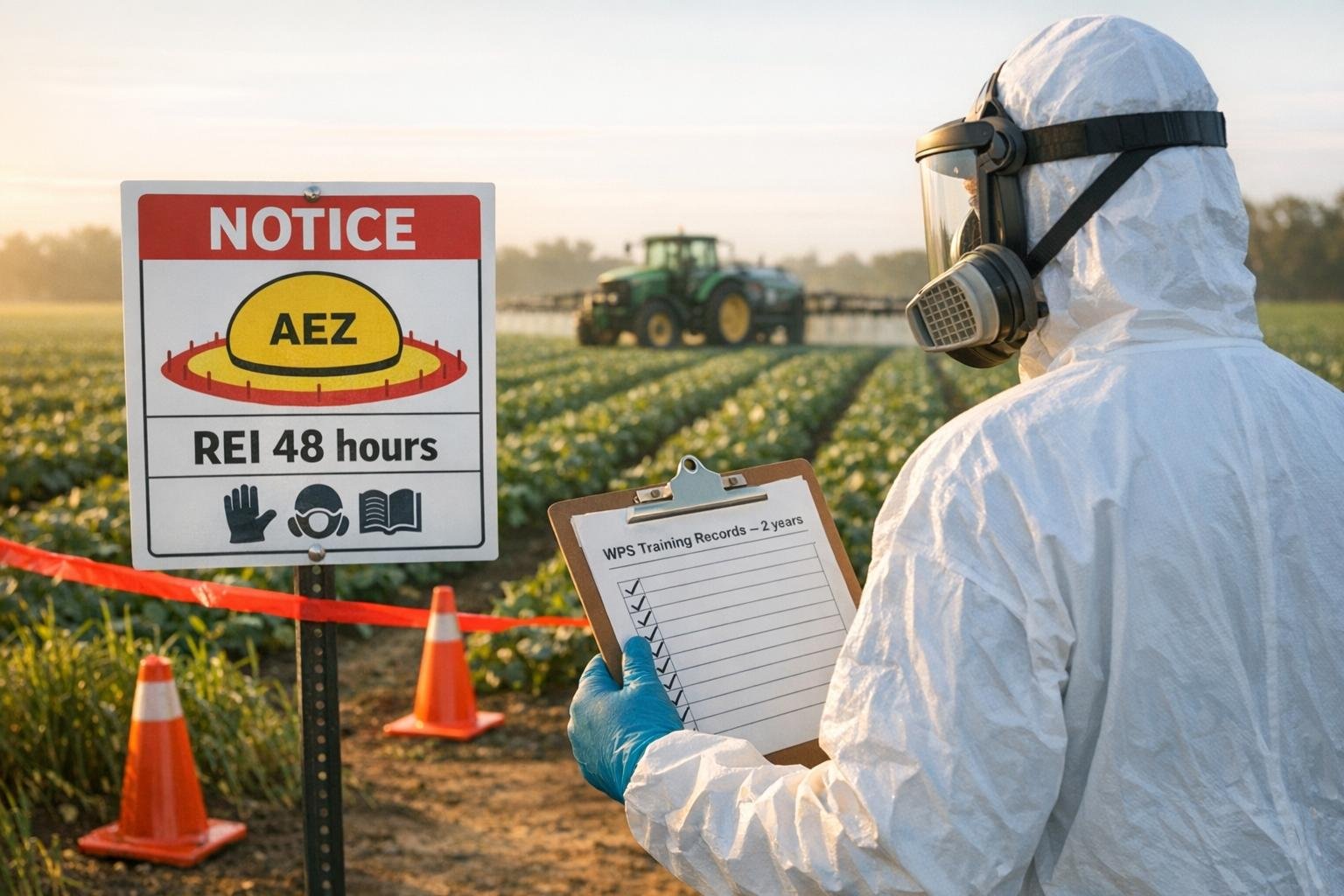
The Worker Protection Standard (WPS), enforced by the EPA, is a legal framework designed to protect over 2 million agricultural workers and pesticide handlers across the U.S. Here’s what you need to know:
- Who Must Comply: Farms, nurseries, greenhouses, and forests involved in commercial plant production, along with their employers, workers, and pesticide handlers. Some exemptions apply for family-owned operations.
- Key Employer Duties: Provide safety training, decontamination supplies, emergency assistance, and personal protective equipment (PPE). Maintain detailed records for at least two years.
- Recent Updates: As of December 2024, stricter Application Exclusion Zone (AEZ) rules require pesticide handlers to halt spraying if anyone enters the zone, even beyond farm boundaries.
- Training Requirements: Annual, EPA-approved training is mandatory for workers and handlers before they perform tasks involving pesticides.
- Record-Keeping: Employers must track training, pesticide applications, and respirator use, ensuring compliance with federal pesticide laws and state-specific rules.
WPS compliance isn’t optional – it’s a legal obligation to safeguard health and reduce pesticide-related risks. Following these guidelines ensures a safer working environment while meeting regulatory standards.
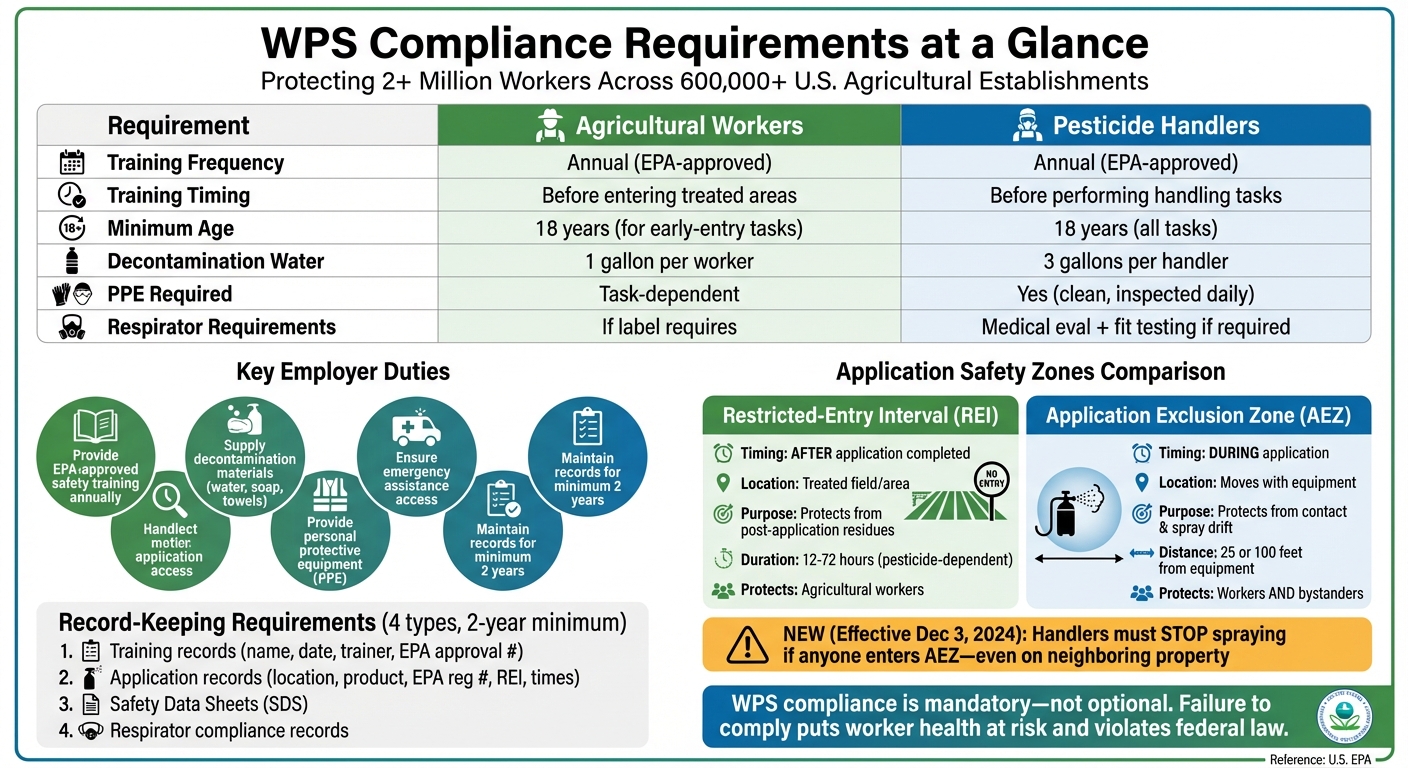
WPS Compliance Requirements Comparison Chart for Agricultural Workers and Pesticide Handlers
Worker Protection Standard (WPS) for Pesticide Handlers (Closed Captioned)
sbb-itb-c4006de
Who Must Comply with WPS
Understanding who falls under the Worker Protection Standard (WPS) is crucial for meeting compliance requirements. WPS primarily applies to three groups: agricultural employers, pesticide handlers, and agricultural workers.
Agricultural employers include those who own or manage farms, forests, nurseries, or greenhouses where agricultural plants are grown commercially. This category also extends to employers of researchers and commercial pesticide handling establishments. Even self-employed individuals who work for compensation are covered under this definition.
Pesticide handlers are individuals involved in tasks like mixing, loading, applying, or transferring pesticides. They also include those handling open containers, flagging during applications, or maintaining pesticide-related equipment. Handlers must be at least 18 years old. Certified applicators are required to follow handler protections but may be exempt from certain pesticide safety training requirements. However, transporting unopened pesticide containers does not classify someone as a handler.
Agricultural workers perform tasks such as harvesting, weeding, watering, and repotting. Workers engaged in early-entry tasks must also meet the minimum age requirement of 18. Crop advisors are a unique case: they are considered handlers if they work during an application or within a Restricted-Entry Interval (REI). Once the REI ends, they are classified as workers.
It’s essential to check pesticide labels for WPS applicability. Look for language in the "Directions for Use" section that specifies "Worker Protection Standard". Certain applications, such as those for livestock, pasture, rangeland, or mosquito abatement, are generally not subject to WPS regulations.
Now that it’s clear who must comply, the next sections will outline the specific responsibilities and obligations for each group.
Employer Responsibilities under WPS
The Worker Protection Standard (WPS) places clear responsibilities on employers to safeguard agricultural workers and pesticide handlers. These rules cover over 600,000 agricultural establishments across the U.S., protecting more than 2 million individuals involved in these industries. Meeting these obligations means prioritizing safety, proper training, and emergency readiness.
Employers need to ensure their workplaces are safe by providing training, necessary safety resources, and detailed emergency plans. A central and easily accessible location must display key information, including a pesticide safety poster, Safety Data Sheets (SDS), and application specifics like location, product name, EPA registration number, and Restricted-Entry Interval (REI). This setup acts as a vital resource for workers during their shifts.
In cases of suspected pesticide exposure, employers must act without delay. Immediate transportation to a medical facility – via ambulance, personal vehicle, or alternative arrangements – is required. Employers must also supply medical personnel with the SDS and product details. Preparing a "medical info pack" with EPA registration numbers for all pesticide formulations in use can save crucial time during emergencies. Additionally, thorough documentation is crucial to demonstrate compliance with WPS standards.
Training Requirements for Workers and Handlers
Training is a critical component of WPS compliance. Employers are required to provide annual pesticide safety training for both workers and handlers. Workers must complete training before entering pesticide-treated areas, while handlers need it before performing tasks involving pesticides.
The training must be led by a certified pesticide applicator or someone who has completed an EPA-approved "Train the Trainer" program. The trainer must be present throughout the session. Only materials approved by the EPA, which include updates from the 2015 WPS revisions, are acceptable for use.
Training records must be kept for at least two years. These records, along with verified trainer credentials, help avoid compliance issues. Certain individuals, like certified pesticide applicators, crop advisors, and immediate family members on family-owned farms, are exempt from these requirements.
| Requirement | Agricultural Workers | Pesticide Handlers |
|---|---|---|
| Training Frequency | Annual | Annual |
| Training Timing | Before entering treated areas | Before performing handling tasks |
| Minimum Age | 18 (for early-entry tasks) | 18 |
| Decontamination Water | 1 gallon per worker | 3 gallons per handler |
Providing Personal Protective Equipment (PPE)
Employers are responsible for supplying handlers with appropriate PPE that is clean and in working condition. PPE must be inspected daily for damage such as leaks, tears, or worn areas, with any faulty equipment either repaired or discarded immediately.
A clean, designated space for PPE storage and changing is required. Contaminated PPE must be kept separate, washed with detergent and hot water, and fully dried before reuse. Heavily contaminated items, such as coveralls soaked with undiluted pesticides labeled "DANGER" or "WARNING", should be discarded immediately.
If a respirator is required, employers must provide a medical evaluation, fit testing, and respirator training before use. Filtering facepiece respirators must be replaced after a maximum of 8 hours of use unless the manufacturer specifies otherwise. Handlers are prohibited from wearing or taking home pesticide-contaminated PPE. Additionally, individuals responsible for laundering PPE must be informed of the contamination risks and instructed on proper cleaning methods.
These measures are essential to ensure PPE remains effective and safe for use.
Decontamination and Emergency Assistance
Decontamination supplies must be readily available and strategically placed. Employers are required to provide water for routine washing and emergency eye flushing, along with soap and single-use towels, for all workers and handlers. Handlers also need access to enough water for full-body washing and a clean change of clothes, such as coveralls, for emergencies.
Supplies must be located within one-quarter mile of work areas. They should also be available at mixing sites and locations where handlers remove PPE. If protective eyewear is required, at least 1 pint of emergency eye flush water must be immediately accessible. In cases where pressurized closed mixing systems are used, or if specified by the pesticide label, a 15-minute eyewash system capable of delivering at least 0.4 gallons per minute is mandatory. The water provided should be safe, cool, and not repurposed from tank-stored mixing water.
Decontamination supplies must remain available for a specific period after the REI ends: 7 days if the REI is 4 hours or less, and 30 days if it is longer. For pesticides with no REI, supplies must be available for 30 days after application ends.
Emergency contact information, including the name, address, and phone number of the nearest medical facility, must be posted in a central, accessible location. In an emergency, employers must promptly provide medical personnel with the SDS, product name, EPA registration number, active ingredients, and details about the exposure.
| Pesticide REI Length | Duration to Provide Supplies |
|---|---|
| 4 hours or less | 7 days after REI expires |
| Greater than 4 hours | 30 days after REI expires |
| No REI | 30 days after application ends |
Application Restrictions and Exclusion Zones
The Restricted-Entry Interval (REI) is the time period after a pesticide has been applied during which workers must stay out of the treated area. This interval helps ensure that pesticide residues on plants, soil, water, or in the air decrease to levels deemed safe for human exposure. Depending on the pesticide’s toxicity, REIs can range from 12 to 72 hours. If multiple pesticides are applied at once, the longest REI among those products must be observed.
The Application Exclusion Zone (AEZ) refers to the area surrounding pesticide application equipment during spraying. Its purpose is to protect individuals from pesticide contact and drift. The size of the AEZ depends on the application method and the droplet size – typically 25 feet or 100 feet. For instance, ground-based applications using fine sprays require a 100-foot radius, while medium or larger droplet applications need a 25-foot radius. These distances are based on ASABE standards.
"Pesticide handlers must temporarily suspend the application if workers or other people are in the AEZ, whether those people are on or off the establishment." – US EPA
The updated 2024 AEZ rule, effective December 3, 2024, mandates that pesticide handlers stop spraying if anyone enters the exclusion zone, even if that person is on neighboring property, a public sidewalk, or within an easement area.
Workers may only enter a treated area during an REI under specific conditions, such as for "no-contact" tasks (e.g., working in an enclosed cab), short-term activities lasting less than one hour, or during agricultural emergencies. Before allowing early "no-contact" entry, all ventilation requirements and inhalation limits specified on the pesticide label must be met. Additionally, workers performing early-entry tasks must complete full pesticide safety training; the usual five-day grace period for training does not apply in these cases.
| Feature | Restricted-Entry Interval (REI) | Application Exclusion Zone (AEZ) |
|---|---|---|
| Timing | After application is completed | During the application process |
| Location | The treated field or area | Moves with the application equipment |
| Purpose | Protects from post-application residues | Protects from contact and spray drift |
| Distance | Defined by treated area boundaries | 25 or 100 feet from equipment |
| Scope | Primarily protects agricultural workers | Protects workers and bystanders |
Clear REI and AEZ protocols are essential, and maintaining accurate records is critical for demonstrating compliance.
Record-Keeping and Documentation Requirements
Keeping accurate records is a cornerstone of WPS compliance. Federal rules mandate that employers maintain four main types of documentation for at least two years: pesticide safety training records, pesticide application details, Safety Data Sheets (SDS), and respirator compliance records. These records not only demonstrate compliance but must also be made available upon written request. In fact, maintaining proper documentation is just as essential as training and protective measures in proving full compliance.
Required Documentation
Training records need to include specific details: the trainee’s name and signature, the training date, the trainer’s name and qualifications, the employer’s name, and the EPA approval number for the training materials. For application records, even more detail is required: the location and description of the treated area, product name, EPA registration number, active ingredients, Restricted Entry Interval (REI), and the exact start and end times and dates for the application. To ensure accuracy, these application records should be completed within 24 hours.
| Record Type | Details | Retention Period |
|---|---|---|
| Training Records | Name, signature, date, trainer name, trainer qualifications, EPA number | 2 years |
| Application Records | Location, product name, EPA Reg. #, active ingredients, REI, times | 2 years |
| Respirator Records | Medical evaluation, annual fit test results, training documentation | 2 years |
| Hazard Information | SDS for each pesticide applied | 2 years |
Employers are also required to display application information and SDS at a central location for 30 days after the REI expires. If a worker or their representative submits a written request, employers have 15 days to provide the requested application and hazard information. Additionally, warning signs must be removed or covered within three days after the REI ends to ensure accuracy regarding restricted areas.
Keep in mind that state regulations might add extra record-keeping obligations.
State-Specific Reporting Guidelines
Federal WPS rules set the minimum standards, but many states enforce stricter requirements. For instance, Pennsylvania requires pesticide application records to be kept for three years, exceeding the federal two-year rule. Similarly, Florida, under the Florida Agricultural Worker Safety Act (FAWSA), California, through 3 CCR 6761, and Texas, under the Texas Agricultural Hazard Communication Law, all have their own additional regulations that may go beyond federal guidelines.
Before setting up your record-keeping system, it’s crucial to check your state’s specific requirements with your state pesticide regulatory agency. Some states may require extra documentation, such as equipment calibration logs, to confirm that pesticide applications were done at the correct dosage and rate. To avoid compliance issues, aim to standardize your records to meet the strictest applicable standards, whether federal or state-level.
Exemptions for Owners and Immediate Family Members
The Worker Protection Standard (WPS) offers specific exemptions for family-owned agricultural operations, but these come with conditions. To qualify, the agricultural establishment must be majority-owned (over 50%) by one or more members of the same immediate family. If your operation doesn’t meet this ownership threshold, full WPS compliance applies to everyone involved. These exemptions are designed to separate family-run operations from standard WPS requirements.
Immediate family includes a wide range of relatives, such as spouses, parents (including step, foster, and in-laws), children (including step, foster, and in-laws), siblings (including in-laws), grandparents, grandchildren, aunts, uncles, nieces, nephews, and first cousins. For qualifying family members, certain WPS requirements are waived:
- Mandatory training
- Provision of decontamination supplies and first aid
- Emergency assistance
- Formal application notifications
- Minimum age requirements for handlers
- Centralized safety information display
However, these exemptions don’t mean family members can disregard safety measures. Owners and family members must still comply with pesticide label instructions, including wearing the specified personal protective equipment (PPE) and adhering to Restricted-Entry Intervals (REI). For pesticides that require a respirator, family members must complete a medical evaluation, fit testing, and respirator training, with records kept for two years. Additionally, pesticide applications must be stopped if anyone enters the Application Exclusion Zone (AEZ).
Here’s a quick breakdown of what’s exempt and what’s still mandatory:
| Exempted WPS Requirements | WPS Requirements That STILL Apply |
|---|---|
| Pesticide safety training | Following pesticide label instructions |
| Decontamination supplies | Wearing label-required PPE |
| Emergency assistance | Respirator medical evaluation and fit testing |
| Application records and SDS | Respecting Restricted-Entry Intervals (REI) |
| Minimum age for handlers | Application Exclusion Zone (AEZ) restrictions |
| Application notifications | Employer information exchange |
It’s also crucial to remember that non-family employees are not covered by these exemptions. Non-family workers must receive full WPS protections, regardless of the exemptions that apply to your family. Before relying on these exemptions, confirm your ownership structure and make sure you’re clear on the safety requirements that still apply to family members.
Using Online Pest Control Courses for WPS Compliance
Once you’ve established solid recordkeeping practices, the next critical step for Worker Protection Standard (WPS) compliance is effective training. The good news? Training doesn’t have to interrupt your operations. Online Pest Control Courses provides EPA-approved training that satisfies federal WPS requirements while allowing you to train workers and handlers on a schedule that works for you. Their materials come with official EPA approval numbers (like EPA approval W/H PST 00001), ensuring compliance across all 50 states and U.S. territories.
Platform Features and Advantages
The platform is designed for flexibility, accessible via computers, tablets, and smartphones. Workers can complete their training within a 60-day window, with automatic progress-saving to make the process seamless. Once a course is finished, certificates are immediately available for download, so employees can get back to work right away. Each course takes at least 2 hours, including the final exam, and covers the expanded WPS topics introduced in the 2015 updates. These include pesticide exposure risks, health hazards, proper use of personal protective equipment (PPE), and early-entry safety measures.
Another standout feature is the automated recordkeeping system, which securely stores training records for two years to meet federal requirements. This eliminates the need for messy paper trails and ensures you can quickly provide documentation to employees whenever needed.
These features make it easy to customize training to meet your specific WPS compliance needs.
Available Course Options for WPS Training
Online Pest Control Courses offers both individual classes and bundled packages to cover a range of certification needs. Individual courses focus on topics like pesticide laws, formulations, environmental considerations, and pest management strategies. For those needing broader coverage, bundled packages provide multiple credits in one purchase. Employers can also take advantage of Train-the-Trainer courses, which certify trainers to conduct in-house training across the continental U.S., Alaska, Hawaii, Puerto Rico, and Guam. These Train-the-Trainer courses, developed by the Pesticide Educational Resources Collaborative (PERC), are available online for $35.
All courses are state-approved and include the Continuing Education Units (CEUs) and Continuing Certification Units (CCUs) required for recertification. The platform also offers a 30-day money-back guarantee for added peace of mind. Since WPS training must be completed before workers enter treated areas – with no grace period – 24/7 access to the courses ensures you can onboard new employees immediately, without waiting for scheduled sessions.
Conclusion
The Worker Protection Standard (WPS) isn’t just a guideline – it’s a legal safeguard designed to protect the health and safety of over 2 million agricultural workers and pesticide handlers across more than 600,000 establishments in the U.S.. The rules are clear: provide annual EPA-approved training, ensure workers have access to proper personal protective equipment (PPE) and application exclusion zones, and reduce risks by supplying decontamination materials and preparing for emergencies.
Key compliance measures include maintaining decontamination supplies, keeping training records and pesticide application logs for at least two years, and monitoring handlers of highly toxic pesticides every two hours. Workers must also complete their certification before entering treated areas – there’s no grace period.
"EPA’s Agricultural Worker Protection Standard (WPS) aims to reduce pesticide poisonings and injuries among agricultural workers and pesticide handlers. Fewer incidents means a healthier workforce and fewer lost wages, medical bills and absences from work and school." – US EPA
This rigorous regulatory framework highlights the importance of reliable training programs. Online Pest Control Courses simplify compliance with EPA-approved materials (e.g., EPA approval W/H PST 00001), available nationwide, including U.S. territories. The platform also automates recordkeeping to meet the two-year documentation requirement. With 24/7 access and immediate certificate downloads, onboarding new employees has never been easier.
FAQs
How do I know if a pesticide application is covered by WPS?
If a pesticide is applied to an agricultural plant at locations like farms, forests, nurseries, or greenhouses, and its label includes WPS (Worker Protection Standard) instructions, it falls under WPS regulations. However, pesticides used for non-agricultural purposes, such as maintaining right-of-way areas or treating livestock, are not included under WPS.
What should I do to comply with the new 2024 AEZ rule near roads or neighbors?
To meet the 2024 AEZ rule requirements near roads or neighboring areas, make sure the application exclusion zone (AEZ) is well-defined and upheld during outdoor pesticide applications. Finalized by the EPA in October 2024, this rule aims to protect nearby communities while streamlining guidelines to make them easier for applicators to follow.
What’s the simplest way to organize WPS training and application records for audits?
To make WPS recordkeeping easier during audits, focus on keeping your documentation well-organized and accessible. This includes items like training certificates, attendance logs, and pesticide application records.
Here are some helpful tips:
- Use a centralized system – whether digital or physical – to sort records by date, worker, and activity for quick access.
- Hold onto records for at least 2 years and make sure they’re readily available for inspections or reviews.
- Save copies of training materials and completed course proofs, such as certificates, to meet compliance requirements.
Staying on top of these details can save you a lot of hassle when it’s time for an audit.