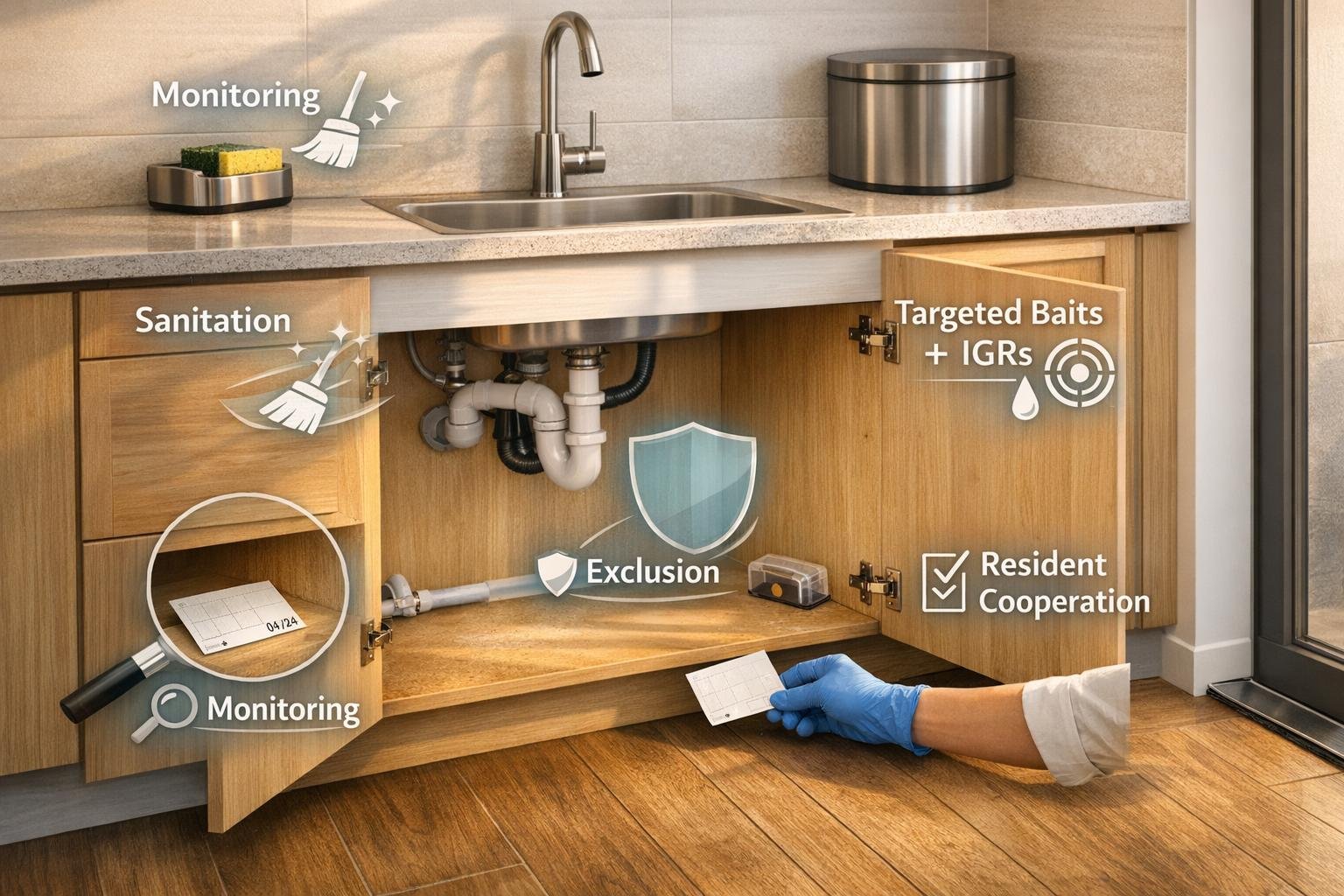
German cockroaches reproduce quickly, making infestations hard to control. A single female can produce up to 320 offspring, with 3–6 generations annually. Traditional sprays often fail, as they repel cockroaches into hidden areas or neighboring units. Integrated Pest Management (IPM) offers a better approach, focusing on removing food, water, and shelter while using targeted treatments.
Key Points:
- Monitoring: Sticky traps identify infestation areas and population trends.
- Sanitation: Remove food sources, fix leaks, and clean thoroughly to disrupt habitats.
- Exclusion: Seal gaps and repair structures to block entry and hideouts.
- Chemical Control: Use baits and insect growth regulators (IGRs) strategically; rotate active ingredients to avoid resistance.
- Resident Education: Teach proper sanitation and early reporting to prevent reinfestation.
IPM has shown over 90% success in reducing cockroach populations in studies, proving it’s a smarter, long-term solution compared to spray-only methods.
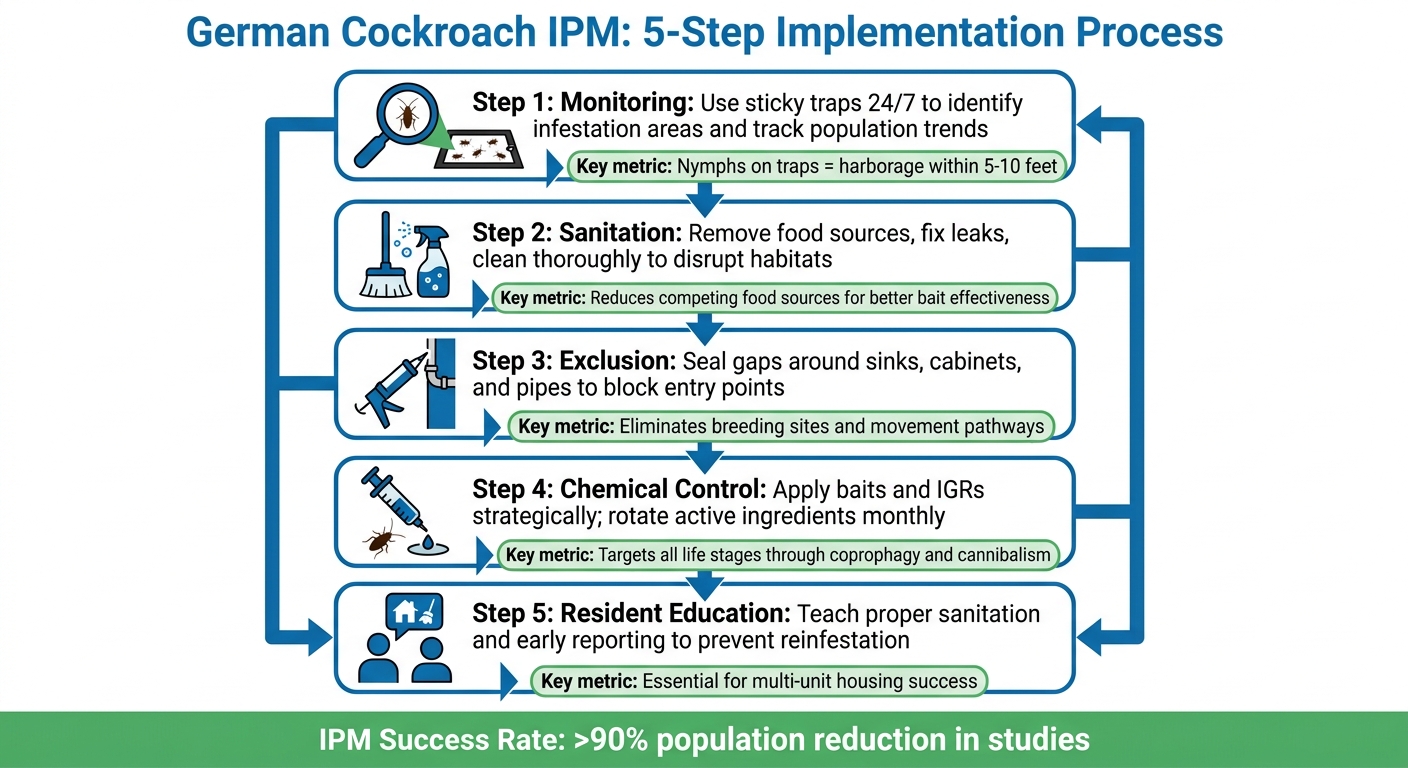
5-Step German Cockroach IPM Implementation Process
Tips for German Cockroach Control with Scott Baldwin
sbb-itb-c4006de
Core Elements of German Cockroach IPM
Managing German cockroaches effectively requires a combination of strategies that address their survival cycle. Each method targets a specific aspect of the infestation, ensuring a comprehensive approach.
Monitoring and Inspection Methods
Sticky traps are central to any Integrated Pest Management (IPM) program. According to researchers at the University of Florida, "Sticky traps… are your ‘eyes’ in the property and are working for you 24/7". These traps should be labeled with dates and numbers and mapped out to track population trends over time. Proper placement is key – position them along wall-floor junctions and in corners where cockroaches naturally travel, not in open areas.
Thorough inspections require tools like a high-intensity flashlight and a telescoping mirror to check dark, hard-to-reach spots. Focus on areas that combine food, water, and warmth, such as behind refrigerators, ovens, and under sinks. Both visual cues and odors can reveal hidden infestations.
Interpreting trap data is just as important. For example:
- Nymphs on traps suggest a harborage within 5–10 feet.
- All life stages present indicate an established infestation.
- Adults only point to a recent introduction rather than a breeding population.
| Monitoring Sign | What It Indicates |
|---|---|
| Fecal Spots | High activity near food and water sources. |
| Nymphs on Trap | Harborage within 5–10 feet of the trap. |
| Adults Only | Likely a new introduction, not yet established. |
| Daytime Activity | Severe infestation with overcrowded harborages. |
| Oothecae (Egg Cases) | Active breeding that requires immediate action. |
Once monitoring identifies problem areas, targeted sanitation can help disrupt cockroach habitats.
Sanitation and Environmental Controls
Sanitation plays a crucial role in IPM by removing the resources cockroaches need to survive – food, water, and shelter. As NC State Extension explains, "The less competing food sources there are, the more likely the cockroaches will feed on bait".
To limit food sources:
- Store all food, including items like corn and macaroni used in crafts, in sealed plastic containers.
- Use durable trash liners and dispose of food waste daily.
- Address plumbing leaks and empty refrigerator condensation pans to eliminate water sources.
A HEPA-filtered vacuum can be used to remove heavy infestations and allergens before applying chemical treatments. When cleaning, use soapy water followed by a rinse – cleaners that don’t require rinsing may spread allergens instead of removing them.
Reducing clutter and eliminating cardboard can simplify inspections and remove breeding grounds. Enzyme-based cleaners are effective for clearing grease and organic buildup in drains and cracks.
Exclusion and Structural Repairs
Sealing entry points is another critical step in IPM. Use silicone caulk to close gaps around sinks, cabinets, and backsplashes. Focus on areas like unsealed pipe escutcheons, loose sink edges, and wall-mounted electrical panels, as these are common cockroach hideouts.
Structural repairs not only block cockroach movement but also remove potential breeding sites.
Chemical Control Options
After addressing physical and environmental factors, chemical treatments can help control remaining cockroach populations. Monitoring data should guide the precise application of these treatments. Insecticide baits (gels, liquids, and dry-flowables) and Insect Growth Regulators (IGRs) are the preferred choices.
Baits work by exploiting cockroach behaviors like coprophagy (eating feces), emetophagy (eating vomit), and cannibalism, allowing secondary transfer to nymphs hidden in harborages. IGRs, on the other hand, stop immature cockroaches from reproducing and force gravid females to forage, increasing their exposure to baits.
Rotating bait ingredients monthly (based on IRAC classes) helps delay resistance and reduce bait aversion. Resistance genes in just 1% of a population can cause noticeable declines in bait effectiveness within a single generation (about 100 days).
| Active Ingredient | IRAC Class | Example Products |
|---|---|---|
| Indoxacarb | 22 | Advion Gel, Advion Evolution. |
| Dinotefuran | 4 | Alpine Cockroach Gel Bait. |
| Abamectin B1 | 6 | Avert Dry Flowable, Vendetta. |
| Boric Acid | 8 | InTice Roach Bait, Magnetic Roach Bait. |
| Fipronil | 2 | Maxforce FC, Maxforce Magnum. |
| Clothianidin | 4 | Maxforce Impact, Vendetta Nitro. |
Bait placement should be precise, targeting specific "hot spots" identified during monitoring. Avoid applying repellent sprays or foggers near bait, as they can contaminate it and reduce its appeal. Replace baits every 30 days if they’re not effective, as different brands use unique formulations to counter flavor aversion.
Some cockroach populations have developed glucose aversion, where sugar tastes bitter to them. In such cases, switching to protein-based baits or alternative bait matrices is necessary.
Resident Education and Participation
In multi-unit housing, resident involvement is essential for IPM success. Tenants should be educated on:
- Proper sanitation practices.
- Reporting infestations early.
- Checking items like backpacks, purses, and groceries for cockroaches before bringing them inside.
They should also learn about food storage, waste management, and promptly reporting leaks or structural damage. Since cockroaches can move between units through shared walls, plumbing, and electrical conduits, cooperation among residents is crucial.
For professionals looking to expand their IPM knowledge, Online Pest Control Courses (https://onlinepestcontrolcourses.com) offers state-approved training on these strategies and more.
IPM Implementation Steps
Initial Population Assessment
Start by evaluating the extent of the infestation. Use a high-powered flashlight and inspection mirror to check dark, hard-to-reach spots like behind refrigerators, under sinks, and inside electrical junction boxes. Since German cockroaches are nocturnal, daytime sightings usually point to a severe infestation.
To get a clearer picture, place sticky traps along wall-floor junctions near suspected hiding spots. Experts like Miller, Black, and Wang recommend, "For apartment buildings, a building-wide inspection, using sticky traps, should be conducted every six to 12 months".
Analyze the traps carefully. If you see all life stages – nymphs, adults, and egg cases – it suggests a breeding population. A few adults may indicate a recent introduction. Early instar nymphs near traps often mean the harborage is within 5 to 10 feet. Even a single gravid female can lead to rapid population growth since one egg case can produce 30 to 40 nymphs.
A real-world example: In 2012, entomologist Herb Field tackled a severe German cockroach infestation in a 64-unit apartment complex in Concord, CA. Sticky traps were used to categorize units into "severe" (over 100 cockroaches), "moderate" (50 to 100), and "light" (fewer than 50). Treatment intervals were based on these findings, with severe cases treated weekly and lighter infestations addressed monthly. Combining this approach with structural sealing, the team eliminated the infestation in all 64 units within eight weeks.
| Assessment Level | Observation/Data Point | Likely Population Status |
|---|---|---|
| New Introduction | 1 to 3 adults only on traps | Recent entry; not yet established |
| Established Infestation | Presence of all life stages (nymphs and adults) | Breeding population present |
| Severe Infestation | Daytime sightings; >100 cockroaches per trap | High density; requires intensive treatment |
| Directional Data | Higher counts on one side of a trap | Indicates the direction of the primary harborage |
Use these findings to guide targeted treatments. Professional pest managers can further refine these skills through exterminator training courses focused on integrated pest management.
Treatment Application
Select a treatment strategy based on the infestation’s severity and characteristics. The key to effective IPM is cutting off cockroaches’ access to food, water, and shelter.
For high-density infestations – where cockroaches are visible during the day – start with immediate population reduction using HEPA vacuums or high-volume gel bait applications. As UF/IFAS Extension explains, "If cockroaches are seen in the open during the daytime, there is a high probability that the population is large and will require multiple control tactics".
Focus treatments on identified hot spots. If traps in a particular area show no activity, chemical application is unnecessary.
A case study from North Carolina A&T State University highlights the impact of targeted IPM. From October 2011 to March 2014, researchers tackled cockroach infestations in manufactured homes in Franklin County, NC. After assessing the situation and testing insecticide susceptibility, they used Combat Source Kill MaxR1 (0.03% fipronil) combined with resident education. The program achieved an 86% reduction in cockroach populations, with trap counts dropping from 20.5 to 3.9 per participant.
Address the "survival triangle" – food, water, and harborage – by sealing cracks with silicone caulk, fixing plumbing leaks, and tailoring resident education to reduce competing food and water sources.
| Infestation Finding | Recommended Tailored Action |
|---|---|
| Visible during daytime | Use multiple tactics: HEPA vacuuming + high-volume baiting |
| Early instar nymphs only | Focus inspection/treatment within 5–10 feet of the trap |
| Bait ignored for 30 days | Change bait brand/active ingredient to address aversion |
| High sanitation ranking | Prioritize resident education and removal of competing food |
| Dry environment/Sensitive areas | Use dry-flowable bait instead of gel to prevent drying |
Follow-Up Monitoring and Program Adjustments
Sticky traps remain essential after treatment, acting as constant monitors for pest activity and population size. Keep baiting until trap counts drop to zero and no nymphs or egg cases are observed. Replace any compromised traps promptly.
Reapply bait every 1 to 2 weeks during active treatment to ensure fresh, effective bait is available. Adjust service frequency based on trap counts – weekly for severe infestations, bi-weekly for moderate, and monthly for light cases. Programs that use trap data to guide baiting have achieved over 90% population reductions, with complete elimination in 75% of units.
If control efforts stall despite proper baiting, reassess sanitation and exclusion measures, and switch to a different insecticide class immediately. Resistance can develop quickly if even a small percentage of the population carries resistance genes. Once the area is cleared, increase monitoring and conduct inspections for six months to prevent reinfestation.
| Infestation Level | Trap Count (Example) | Recommended Service Interval |
|---|---|---|
| Severe | >100 cockroaches | Weekly |
| Moderate | 50 – 100 cockroaches | Every two weeks |
| Light | <50 cockroaches | Monthly |
| Eliminated | 0 cockroaches | Quarterly/Bi-annual monitoring |
IPM in Multi-Unit Housing
Integrated Pest Management (IPM) in multi-unit housing requires a well-coordinated approach to address unique challenges effectively.
Multi-Unit Coordination
In apartment complexes, cockroach infestations often highlight structural vulnerabilities. Shared walls, plumbing systems, and electrical conduits provide easy pathways for pests, allowing an issue in one unit to spread quickly throughout the building.
To combat this, collaboration among property managers, pest control experts, and residents is essential. Routine, building-wide inspections using sticky traps can uncover low-level infestations that might otherwise go unnoticed or unreported by tenants.
A notable example comes from a 12-month IPM program led by Dr. Changlu Wang at Rutgers University. Conducted between 2018 and 2019 in a 188-unit high-rise in Paterson, NJ, the program initially found infestations heavily linked between neighboring units. Through resident education and the application of targeted gel baits and boric acid dust in 172 apartments, the team broke these correlations and significantly reduced the cockroach population across the building.
"Implementation of a building-wide cockroach IPM program for a 12-month period eliminated the correlations among infestations across the hallway as well as those sharing common walls." – Changlu Wang, Ph.D., Rutgers University
Structural improvements are just as important as treatments. Property managers need to seal gaps and fix leaking pipes, while residents should focus on reducing clutter and eliminating food sources. Educational efforts can also discourage the use of over-the-counter pesticides, as demonstrated by a study where such applications dropped from 91% to 19% in a low-income housing setting.
Without this level of coordination, reliance on traditional spray methods often undermines pest control efforts.
Why Spray-Only Methods Fail
Spray-only pest control programs fall short in multi-unit housing for several reasons. Sprays can repel cockroaches into hidden areas, leaving first-stage nymphs safe in their harborages, where they feed on feces instead of crossing treated surfaces. Additionally, sprays used near bait placements can contaminate the bait, making it less effective.
Another issue with spray-based methods is their focus on complaint-driven treatments, which often overlook "silent" infestations. For instance, a study in Santa Clara County revealed that over 20% of units were infested during initial inspections, many of which showed no visible signs and would have been missed in a complaint-only system. Repeated use of the same type of insecticide also increases the risk of resistance.
The financial inefficiency of spray programs is another drawback. A 75-unit property in Contra Costa County spent US$42,365 annually on reactive spray treatments. By switching to a proactive IPM program using sticky traps for monitoring and gel baits for treatment, the annual cost dropped to US$31,244, saving US$11,121 per year. Beyond the cost savings, the IPM approach achieved better pest control outcomes.
| Site | Annual Reactive Cost | Annual IPM Cost | Annual Savings |
|---|---|---|---|
| Santa Clara County (59 units) | US$22,765 (US$385/unit) | US$21,444 (US$363/unit) | US$1,321 |
| Contra Costa County (75 units) | US$42,365 (US$565/unit) | US$31,244 (US$417/unit) | US$11,121 |
These findings highlight that IPM not only delivers better results but also proves to be a more cost-effective solution in multi-unit housing.
Long-Term Advantages of IPM
Cost and Environmental Benefits
Integrated Pest Management (IPM) shifts the focus from reactive treatments to proactive prevention, leading to considerable cost savings. For example, a study conducted in Gary, Indiana, revealed how costs decreased significantly once pest populations were brought under control. Cockroach management costs averaged just $7.50 per apartment per month. The real financial benefit, however, came from the reduced need for chemical interventions over time.
In a 2008–2009 study involving 442 low-income apartment units, Purdue researchers observed an 88.5–92.7% reduction in bait usage between the first and fourth quarters as pest populations declined. Infested apartments dropped by 74%, and trap counts saw a staggering reduction of 98.3% to 99.6%. This steep decline in chemical usage not only cuts material costs but also reduces environmental harm.
"The cost for subsequent years service is expected to be lower due to reduced cockroach infestations." – Changlu Wang and Gary W. Bennett, Journal of Economic Entomology
Another financial advantage of IPM lies in its strategy of rotating bait products. By switching insecticide classes quarterly, IPM prevents pesticide resistance, which is a common issue with spray-only methods. Resistant pest populations often require increasingly toxic and expensive treatments, a problem IPM effectively avoids.
Beyond the financial and environmental benefits, IPM also contributes to better health outcomes for residents.
Health Benefits
IPM doesn’t just save money – it also reduces health risks. German cockroaches, for instance, are known to produce 12 allergens that can trigger asthma, particularly in children. IPM employs methods like HEPA vacuuming, targeted baiting, and moisture control to physically remove these allergens while addressing the root cause of infestations.
In the Gary, Indiana study, researchers tracked Bla g 1, a primary cockroach allergen found in kitchen dust. Over 12 months, allergen levels dropped dramatically from 27.8 U/g to 2.2 U/g. This significant reduction improves indoor air quality without relying on broadcast sprays or foggers, which can exacerbate respiratory issues. Such improvements are especially critical in urban settings, where reducing allergens has far-reaching benefits beyond just pest control.
Additionally, IPM’s targeted approach – using gel baits and insect growth regulators – minimizes airborne toxins compared to traditional surface sprays. This method not only addresses immediate health concerns like allergen exposure but also reduces long-term risks from repeated pesticide use. This makes IPM particularly effective in multi-unit housing, where children, elderly residents, and other vulnerable populations are often at higher risk.
Conclusion
Integrated Pest Management (IPM) for German cockroaches offers something traditional spray programs simply can’t: long-term, effective control that tackles infestations at their source instead of just masking the problem. The results speak for themselves. Take Herb Field’s 2012 program in Concord, CA, which eradicated 100% of infestations across 64 heavily affected units within just eight weeks. Or consider the North Carolina study, where an 86% population reduction was achieved over 27 months. These outcomes are consistently linked to IPM strategies like monitoring, sanitation, exclusion, and targeted chemical applications.
Transitioning from reactive spraying to proactive IPM takes specialized knowledge. Technicians need to master skills such as interpreting sticky trap data, rotating baits according to IRAC guidelines, and detecting leaks with moisture meters. Understanding the biology of cockroaches is equally crucial – like knowing that first-stage nymphs rarely leave their hiding spots, making surface sprays ineffective, while baits leverage behaviors like coprophagy to target all life stages. This technical expertise underpins the success of IPM.
Beyond these skills, ongoing education plays a vital role.
"Continuing education is necessary for changing residents’ attitudes about the presence of arthropods and implementing an urban pest management program." – Beatrice N. Dingha, North Carolina A&T State University
For professionals aiming to refine their IPM techniques, Online Pest Control Courses (https://onlinepestcontrolcourses.com) offers state-approved training that covers everything from pesticide regulations to advanced pest management methods. The platform provides CEUs and CCUs, accessible on any device, with instant certificate downloads. This flexibility makes it easier for pest management professionals to stay updated on IPM best practices without disrupting their busy schedules. These programs help build the expertise and knowledge needed for effective IPM implementation.
While German cockroach infestations remain a challenge, IPM offers a proven path to lasting control. The real question isn’t whether IPM works – it’s whether you have the tools and training to make it work for you. With the right preparation, you can transform persistent infestations into manageable solutions in your service area.
FAQs
How many sticky traps do I need, and where should I place them?
The number of sticky traps you’ll need depends on the size of the area you’re dealing with and how severe the infestation is. Focus on placing traps in areas where pests are most active or likely to hide. Good spots include along walls, behind appliances, under sinks, and near food storage. Use several traps to get a clear picture of the activity, check them often, and move them around if needed to improve their effectiveness.
What should I do if cockroaches ignore the bait?
If cockroaches start avoiding bait, switch to baits with active ingredients from different IRAC classes to help prevent resistance and aversion. Pair baiting with other Integrated Pest Management (IPM) techniques, like locating infestation sources and tweaking your control strategies. Opting for high-quality baits and incorporating extra control measures can also lead to better outcomes.
How do I keep German cockroaches from spreading between apartments?
To prevent German cockroaches from spreading between apartments, focus on sealing potential entry points. This includes filling cracks in walls, around doors, and inside cabinets. Maintain a clean living space by sweeping floors regularly, washing dishes right away, and removing any food or water sources they might find appealing. Implementing a building-wide integrated pest management (IPM) program is another effective strategy, as it tackles infestations across the entire property. Research supports these methods as reliable ways to limit cockroach movement.