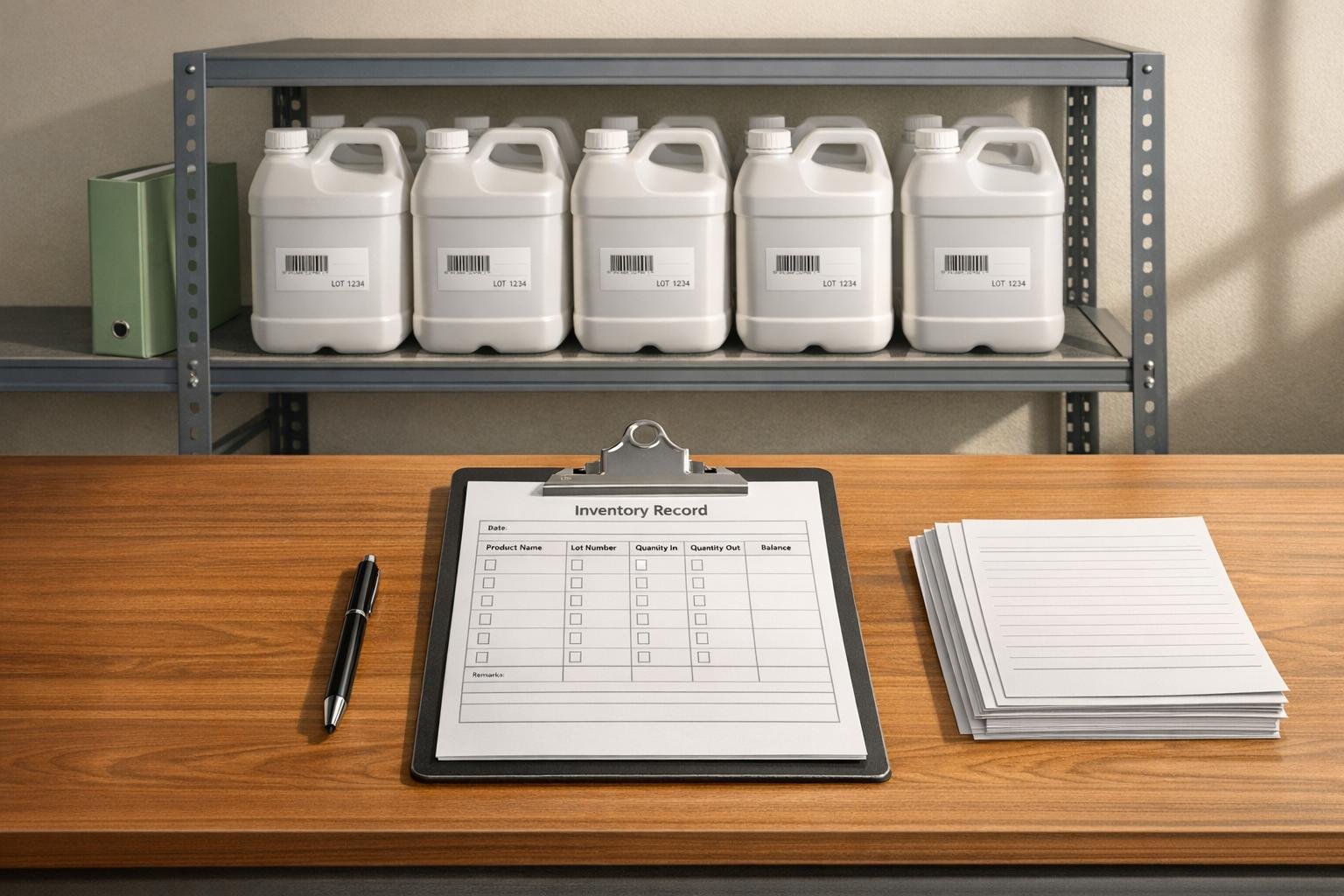
If you use pesticides in your work, keeping accurate records isn’t optional – it’s required by law. Federal rules mandate that certified applicators maintain detailed records for restricted-use pesticides (RUPs) for at least two years. However, individual states often impose stricter requirements. For instance, Washington requires records to be kept for seven years, while Florida mandates completion within two working days of application and client notification within 30 days.
Noncompliance can lead to fines, license suspensions, or legal disputes. To stay compliant:
- Follow federal and state-specific rules: Know your state’s retention periods and required data fields.
- Use approved forms: Ensure all records include mandatory details like EPA registration numbers and application dates.
- Conduct regular audits: Verify records are complete and align with state deadlines.
- Stay organized: Keep records accessible for inspections or emergencies.
Accurate recordkeeping protects your business, ensures public safety, and avoids penalties.
Pesticide Record Keeping
sbb-itb-c4006de
Federal Requirements for Pesticide Stock Records
Federal regulations establish the groundwork for pesticide recordkeeping, which states can build upon with their own rules. These federal standards serve as the basis for the additional state-specific requirements discussed later.
Certified applicators are required by federal law to maintain records for two years following the date of pesticide application:
"If there is no State requirement for the maintenance of records, such applicator shall maintain records that contain the product name, amount, approximate date of application, and location of application of each such pesticide used for a 2-year period after such use."
Each record must include nine specific details: the EPA registration number, brand or product name, total amount applied, location of application, size of the treated area, crop or site treated, date of application, applicator name, and certification number. Among these, the EPA registration number is especially important, as it allows healthcare professionals to identify the exact chemical in emergencies.
Commercial applicators are required to provide a copy of the record to their clients within 30 days, while private applicators must complete their records within 14 days. In urgent situations, these records must be made available immediately:
"In the case of an emergency, such record information shall be provided immediately."
Noncompliance can result in fines – up to $550 for a first offense and at least $1,100 for repeat violations. However, penalties may be reduced if the Secretary of Agriculture determines there was a good faith effort to comply. That said, following the regulations closely is the safest way to avoid penalties.
Familiarity with these federal guidelines will help you better navigate the additional recordkeeping requirements imposed by individual states.
State-Specific Recordkeeping Rules
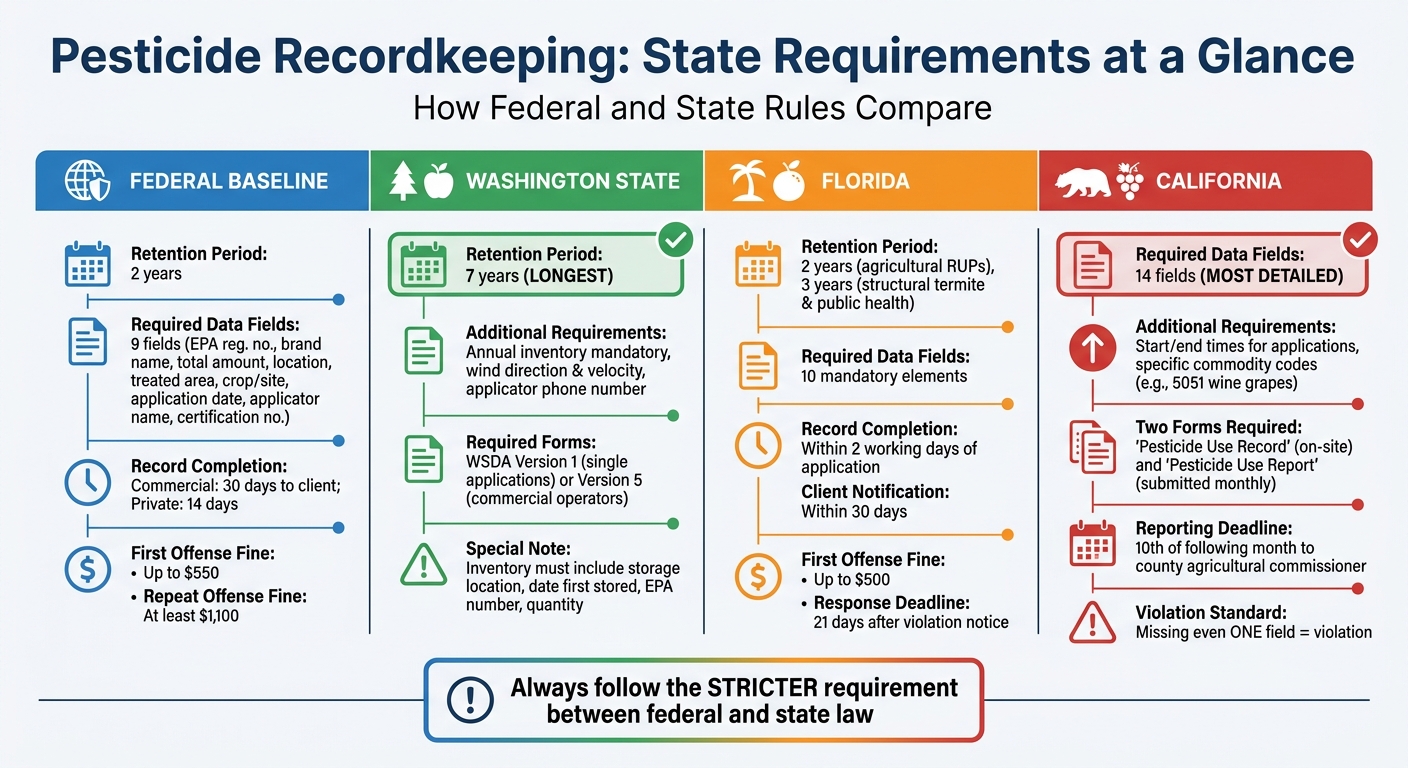
State-by-State Pesticide Recordkeeping Requirements Comparison
Federal recordkeeping laws set the foundation, but state-specific rules often add extra layers of requirements. These state rules can include stricter standards, meaning applicators must follow the more stringent of the two – federal or state. Understanding your state’s regulations is essential to avoid penalties.
States may extend federal rules by requiring longer record retention periods, additional data fields, or specific forms and reporting protocols. For example, Washington mandates that pesticide application records be kept for seven years, compared to the federal standard of two years. In Florida, the Florida Pesticide Law requires records to be completed within two working days of application and specifies ten mandatory data elements for every restricted-use pesticide application.
State requirements often go beyond just retention periods. Washington, for instance, requires an annual inventory of all stored pesticides, with details like the storage location, date first stored, EPA registration number, and quantity. Meanwhile, California enforces a 14-field requirement for commercial pesticide application records, where missing even one field constitutes a violation.
Retention periods can also differ within the same state based on the type of application. In Florida, agricultural restricted-use pesticide records must be kept for two years, but this extends to three years for structural termite treatments and public health pest control. This makes it crucial for applicators to not only know the rules of the state they’re operating in but also the specific requirements tied to the type of work they perform.
State Variations in Retention Periods
Retention requirements vary widely between states. While federal law requires records to be kept for two years, Washington’s seven-year requirement for pesticide application records demands a more robust system for long-term record storage, whether digital or physical.
Florida aligns with the federal two-year standard for agricultural restricted-use pesticides but increases the retention period to three years for structural termite treatments and public health pest control. This variation based on application type underscores the importance of accurately classifying your work and applying the correct retention period.
Additional Required Elements by State
States frequently demand specific data points that federal regulations don’t cover. In California, applicators must include 14 data fields, such as start and end times for applications, which are essential for calculating Restricted Entry Intervals. The state also requires the use of specific commodity codes, like code 5051 for wine grapes, instead of generic crop names.
Washington adds its own unique requirements, such as documenting wind direction and estimated velocity during outdoor applications (excluding indoor or bait station use). Applicators must also record their phone numbers and maintain an annual inventory detailing pesticide storage locations and the exact time each product was first stored.
Form requirements also differ by state. Florida allows any form that includes the ten required data elements, while Washington may require official WSDA forms, such as Version 1 for single applications or Version 5 for commercial operators, when requested. California distinguishes between two forms: the "Pesticide Use Record", which stays on-site, and the "Pesticide Use Report", which must be submitted monthly to the county agricultural commissioner by the 10th of the following month.
Best Practices for Maintaining Pesticide Stock Records
Using Approved Forms and Tools
To stay compliant, it’s essential to use state-approved forms tailored to your specific needs. For instance, the Washington State Department of Agriculture (WSDA) provides five distinct form versions. These include options like Version 1, designed for single applications with one applicator at one location, and Version 5, intended for commercial pest control operators. Choosing the correct form ensures you capture all required details, such as EPA registration numbers.
If you prefer digital recordkeeping, that’s allowed as long as your records include all necessary data. However, if the WSDA requests your records, you’ll need to transfer them to official WSDA forms. According to the WSDA:
Pesticide application recordkeeping can occur in any format as long as the required information is included. If the WSDA requests the submission of pesticide application records you must use an official WSDA form.
This flexibility means you can use tools like Excel or online tracking systems for daily operations, but ensure your format aligns with state requirements. To confirm compliance, submit a "WSDA Pesticide Recordkeeping Form Approval Request" to verify your custom format meets state standards. Accurate and approved forms not only help you meet legal requirements but also make inventory audits and record retention smoother.
Conducting Regular Inventory Audits
Beyond maintaining proper forms, regular inventory audits are a must to stay compliant. In states like Washington, annual inventory checks are mandatory. Employers must complete a full inventory of all stored pesticides at least once a year, ensuring it aligns with state deadlines, such as New York’s February 1st reporting date for commercial applicators. Scheduling your audit close to the deadline ensures your reported data accurately reflects your physical stock.
During audits, document these four critical details: the exact storage location address, the date and time the pesticide was first stored, the product name with its EPA registration number, and the current quantity in storage. Keeping purchase records is also key to maintaining full traceability of your inventory from acquisition to disposal. This approach simplifies audits and reduces the risk of errors.
You can make purchase tracking easier by obtaining a written agreement from your pesticide distributors to maintain purchase records on your behalf. Be aware of retention requirements, as these vary by state. For example, Washington mandates that records be kept for seven years, while New York and Ohio require a three-year retention period. Organize your storage and recordkeeping systems to meet these timelines effectively.
Consequences of Non-Compliance and Enforcement
Failing to maintain complete pesticide stock records can lead to serious penalties. State agriculture departments have the authority to inspect, copy, and photograph your records during routine audits. For example, in Florida, the Department of Agriculture and Consumer Services (FDACS) states: "A certified applicator who violates any provision of this program will, in the case of the first offense, be asked to correct their violation(s) and be subject to a civil penalty of not more than $500". This means that any recordkeeping errors must be corrected immediately in line with the regulations.
State agencies also impose stricter penalties for repeat violations. If noncompliance continues, fines can increase significantly, and licenses may be suspended. According to Utah Code Section 4-14-111, "the department may suspend a registration certificate if the pesticide applicator business violates this chapter or any rules authorized by it". To regain your license, you’ll need to prove full compliance with all state pesticide laws and regulations.
Violations typically come with a formal notice and a strict response deadline. In Florida, for instance, applicators have exactly 21 days to respond or request a hearing after being notified. Missing records can also lead to emergency inspections, especially if healthcare professionals need immediate access to pesticide application records while treating exposure cases. Some states may reduce penalties if you can show a genuine effort to comply with the law. Keeping track of internal audits and training sessions can help demonstrate your commitment to meeting regulatory requirements.
To avoid these escalating consequences, ensure your records are always well-organized and accessible to authorized representatives. Florida’s Administrative Code, for example, specifies that "upon written request by an authorized department representative, a licensed applicator shall make available the records required to be maintained under this rule and shall permit the authorized representative to copy or photograph any of the records". Adhering to your state’s record retention requirements – whether two years in Florida or seven years in Washington – can reduce inspection risks and show that your operations comply with the law.
Conclusion and Next Steps
Keeping accurate pesticide stock records does more than just help you avoid fines – it safeguards public health and protects your business against legal disputes. In situations where healthcare providers need quick access to information for treating pesticide exposure, having detailed and accurate records can make all the difference. Beyond compliance, these records also play a crucial role in evaluating treatment outcomes, determining safe crop replant intervals, and improving pest management strategies, which can ultimately boost profitability.
State regulations on record retention can vary significantly. While some states require records to be kept for as little as two years, others extend this to seven years or more, especially in areas with additional sensitive-location rules. To stay compliant, it’s essential to understand the specific requirements in your state.
Here’s how to ensure your records meet compliance standards:
- Record promptly and accurately: Use state-approved forms to document application data as soon as possible. For example, Washington’s WSDA offers multiple form options tailored to different application scenarios.
- Conduct regular audits: Periodically review your records to confirm they include all required details, such as EPA registration numbers and application methods.
- Keep records accessible: Store your records in an organized and easy-to-access format to simplify retrieval for inspections or emergency situations.
For additional support, platforms like Online Pest Control Courses (https://onlinepestcontrolcourses.com) offer state-approved training and recertification programs. These courses cover pesticide laws, application techniques, and compliance strategies, helping you and your team stay up-to-date on evolving standards. Plus, they provide CEUs and CCUs, with instant certificate downloads upon course completion. Staying informed through professional training ensures your team understands the latest regulations and knows how to maintain proper documentation.
FAQs
Which state’s pesticide recordkeeping rules do I follow if I work across state lines?
If your work involves crossing state lines, make sure to adhere to the pesticide recordkeeping rules of the state where the application is performed or where your license is issued. Since each state may have its own set of requirements, it’s essential to stay informed and comply with the regulations specific to those areas.
What should I do if my state requires more record fields than federal law?
If your state requires additional record fields beyond federal law, make sure to include them in your pesticide stock records. Staying compliant with state-specific regulations is crucial to avoid penalties and keep your documentation in order.
Can I keep pesticide records digitally and still pass a state inspection?
Yes, you can use digital pesticide recordkeeping for state inspections, provided the records are securely stored and properly maintained. Just make sure your digital system complies with all state guidelines for accuracy and accessibility during inspections.