
New pesticide certification deadlines are here for 2026. If you’re a pesticide applicator, you’ll need to meet stricter requirements set by the EPA’s updated Certification and Training Rule. These changes impact private and commercial applicators, as well as supervised noncertified workers, across the U.S. Missing deadlines could mean losing your license or facing penalties.
Key Updates You Need to Know:
- New age requirement: Minimum of 18 years old (16-17 allowed on family farms).
- Tighter supervision rules: Noncertified applicators must complete mandatory training.
- Enhanced recordkeeping: Applies to pesticide dealers.
- State-specific deadlines: Vary by state, with certification renewal dates spanning early to late 2026.
Examples of State Deadlines:
- Tennessee: June 30, 2026 – CEUs required for commercial applicators.
- Minnesota: March 1, 2026 – Private applicators must complete recertification.
- North Carolina: June 30 (commercial) / September 30 (private) – Mandatory one-hour training video.
- Ohio: January 15, 2026 – Recertification conferences.
- Michigan: February-March 2026 – Core review and testing sessions.
What Happens if You Miss the Deadline?
- North Carolina: Must retake all certification exams.
- Iowa: Civil penalties up to $500 per violation.
To stay compliant, start early with state-approved courses, online exams, or in-person workshops. Plan ahead to avoid penalties or license loss.
State-Specific Deadline Changes
With the updated EPA standards in place, states are now enforcing their own certification timelines. Here’s a breakdown of what applicators in Tennessee, Minnesota, North Carolina, Ohio, and Michigan need to know.
Tennessee Certification Changes
In Tennessee, certification renewals will open on February 23, 2026, with the deadline for completing CEUs set for June 30, 2026.
Minnesota Recertification Changes
Minnesota’s private pesticide applicator certifications will expire on March 1, 2026. To meet the 2024 EPA certification rules, the state is introducing a proctored online exam system in 2026, using Honorlock software. According to the University of Minnesota Extension:
"This change is to maintain the security and integrity of the certification process and ensures that all exams are taken under the same fair conditions under the new EPA certification rules that took effect in 2024".
Applicators in Minnesota will have five recertification options: in-person workshops, online Zoom sessions, self-paced Canvas courses, proctored online exams, or mail-in exams – each costing $100. Important deadlines include:
- Self-paced Canvas course: Must be completed by February 28, 2026.
- Mail-in exams: Must be postmarked by October 31, 2026.
For the online exam, applicants will need both a webcam and microphone to use the Honorlock proctoring system.
North Carolina Training Requirements
North Carolina has introduced a mandatory one-hour EPA update video titled "NCDA&CS Required Pesticide Certification & Training Standards Update." This video is required for all applicators certified before July 1, 2025, as part of the state’s response to the 2024 EPA certification updates. Deadlines for compliance are:
- Commercial applicators: Must complete the requirement by June 30, 2026.
- Private applicators: Must complete the requirement by September 30, 2026.
Ohio and Michigan Recertification Dates
Ohio applicators must attend a recertification conference by January 15, 2026 to maintain their certification. Meanwhile, Michigan has planned core review and testing sessions throughout February and March 2026, offering multiple opportunities for applicators to complete their recertification. Both states are aligning their processes with the updated EPA standards to ensure federal compliance.
sbb-itb-c4006de
Deadline Comparison by State
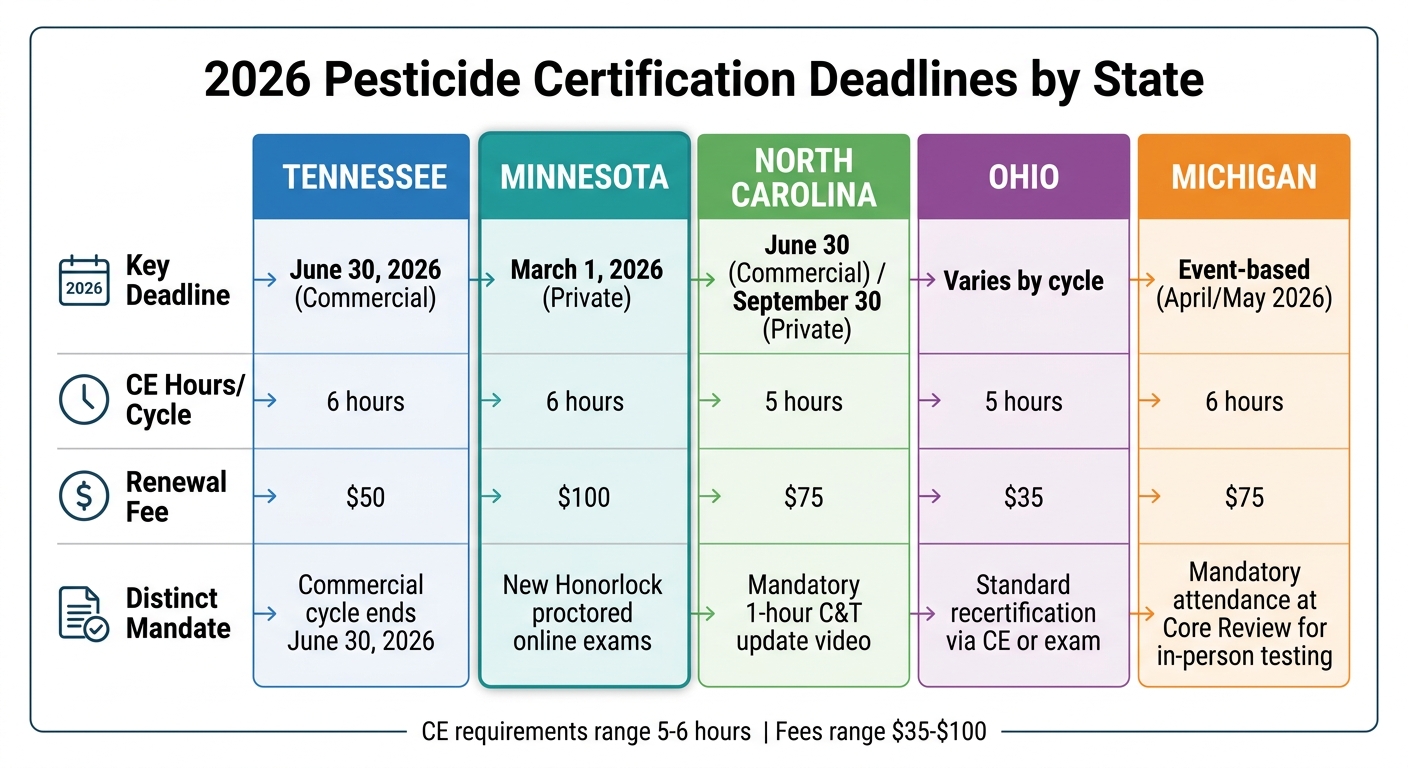
2026 Pesticide Certification Deadlines by State Comparison
Certification Deadline Comparison Table
The table below provides a clear snapshot of the key deadlines, continuing education (CE) requirements, and specific mandates for select states as they adapt to the revised EPA certification guidelines for 2026. This information is particularly useful for applicators working across state lines or considering relocation, as each state has its own approach.
| State | 2026 Key Deadline | CE Hours / Cycle | Renewal Fee | Distinct Mandates |
|---|---|---|---|---|
| Tennessee | June 30, 2026 (Commercial) | 6 hours | $50 | Commercial cycle ends June 30, 2026 |
| Minnesota | March 1, 2026 (Private) | 6 hours | $100 | New Honorlock proctored online exams |
| North Carolina | June 30 (Commercial) / September 30 (Private) | 5 hours | $75 | Mandatory 1-hour C&T update video |
| Ohio | Varies by cycle | 5 hours | $35 | Standard recertification via CE or exam |
| Michigan | Event-based (April/May 2026) | 6 hours | $75 | Mandatory attendance at Core Review for in-person testing |
Key Highlights by State
- North Carolina: Applicators must complete a one-hour training video on Certification & Training (C&T). Missing this requirement means retaking all exams.
- Minnesota: Introduced new proctored online exams through Honorlock, ensuring secure testing environments.
- Michigan: In-person Core Review sessions are scheduled for April and May 2026, with registration required at least a week in advance.
Continuing education requirements range between 5 and 6 hours, with renewal fees spanning $35 to $100 depending on the state . These variations emphasize the importance of staying informed about state-specific mandates to meet the 2026 certification standards effectively.
How to Meet the New Deadlines
Using Online Pest Control Courses for Certification

To stay on track for the 2026 certification deadlines, you can choose from in-person workshops, Zoom sessions, or self-paced online courses. In places like Minnesota, the cost for recertification is generally around $100, though the level of flexibility depends on the format you select.
State-approved self-paced courses provide Continuing Education Units (CEUs), instant certificate downloads, and cover vital topics like pesticide laws and pest management practices. Be sure your device has functional speakers, as mobile phones may not support all course features. These online options are a practical alternative to traditional methods, helping you adapt to evolving state requirements.
These updates align with the stricter EPA standards now in effect. Online proctored exams, such as those in Minnesota using Honorlock, require a working webcam, microphone, and stable internet connection. Testing your equipment beforehand can save you from last-minute technical headaches on exam day.
Tips for Managing Your Certification Schedule
Choosing the right training format is just the first step – staying organized with your schedule is equally important. Register as soon as possible, since state registration windows open early and often close several days before the event.
Make sure to track state-specific requirements alongside CE obligations. For example, in North Carolina, applicators certified before July 1, 2025, must watch a one-hour "NCDA&CS Required Pesticide Certification & Training Standards Update" video and submit a verification form. Watching the video alone isn’t enough – failing to submit the form will force you to retake the entire certification exam. If you’re attending an in-person workshop, plan to arrive at least 15 minutes early. Late arrivals or early departures can result in no credit being awarded.
Keep an eye on the different types of deadlines. In Minnesota, applicators using self-paced online courses must complete all materials by February 28, 2026, while those opting for mail-in exams have until October 31, 2026. Note that the mail-in deadline is based on the postmark date, not the date you finish the exam. In North Carolina, commercial applicators must meet a June 30, 2026 deadline, while private applicators have until September 30, 2026. Don’t forget to bring your current certification card and a photo ID to ensure your attendance is properly recorded.
Conclusion
The 2026 pesticide certification deadlines mark a period of change driven by stricter EPA standards introduced in 2024. Whether you’re a private applicator in Minnesota with a March 1, 2026 expiration date or a commercial applicator in North Carolina facing a June 30, 2026 deadline, planning ahead is essential. Missing these deadlines can result in serious setbacks. For instance, in North Carolina, failing to complete the required one-hour training video and verification form means you’ll need to retake the entire certification exam – even if you’ve already earned all other recertification credits .
The adoption of proctored online exams, using systems like Honorlock, reflects a shift toward tighter security while maintaining flexibility. Alongside these online options, applicators can choose from self-paced courses, in-person workshops, and mail-in exams, offering various routes to meet certification requirements.
For a streamlined way to tackle these changes, Online Pest Control Courses provides state-approved training on pesticide laws, formulations, pest management, and more. With mobile-friendly access and instant certificate downloads, this platform makes it easier to stay on track for your 2026 certification goals.
FAQs
Does the new EPA rule affect private and commercial applicators differently?
The new EPA rule creates different requirements for private and commercial applicators.
Private applicators need to recertify by set deadlines, such as February 28 or March 1, 2026. They can meet these requirements through options like attending workshops or completing online exams.
On the other hand, the available information does not specify the recertification details for commercial applicators.
What qualifies as ‘mandatory training’ for supervised noncertified applicators?
To meet the requirements for supervised noncertified applicators, individuals must complete an IDALS-approved noncertified applicator training program. Alternatively, holding a certification in another category or jurisdiction can also fulfill the criteria. Staying up to date with the latest guidelines is crucial to maintaining eligibility.
If I’m certified in one state, what do I need to do to stay compliant in another?
To ensure you remain compliant when operating in another state, start by verifying your current license. Some states may also require a letter of good standing from your existing licensing authority. Additionally, you’ll need to meet that state’s reciprocity requirements, which often involve submitting an application and paying any associated fees. Always review the specific regulations of the state where you intend to maintain compliance, as rules can vary significantly.