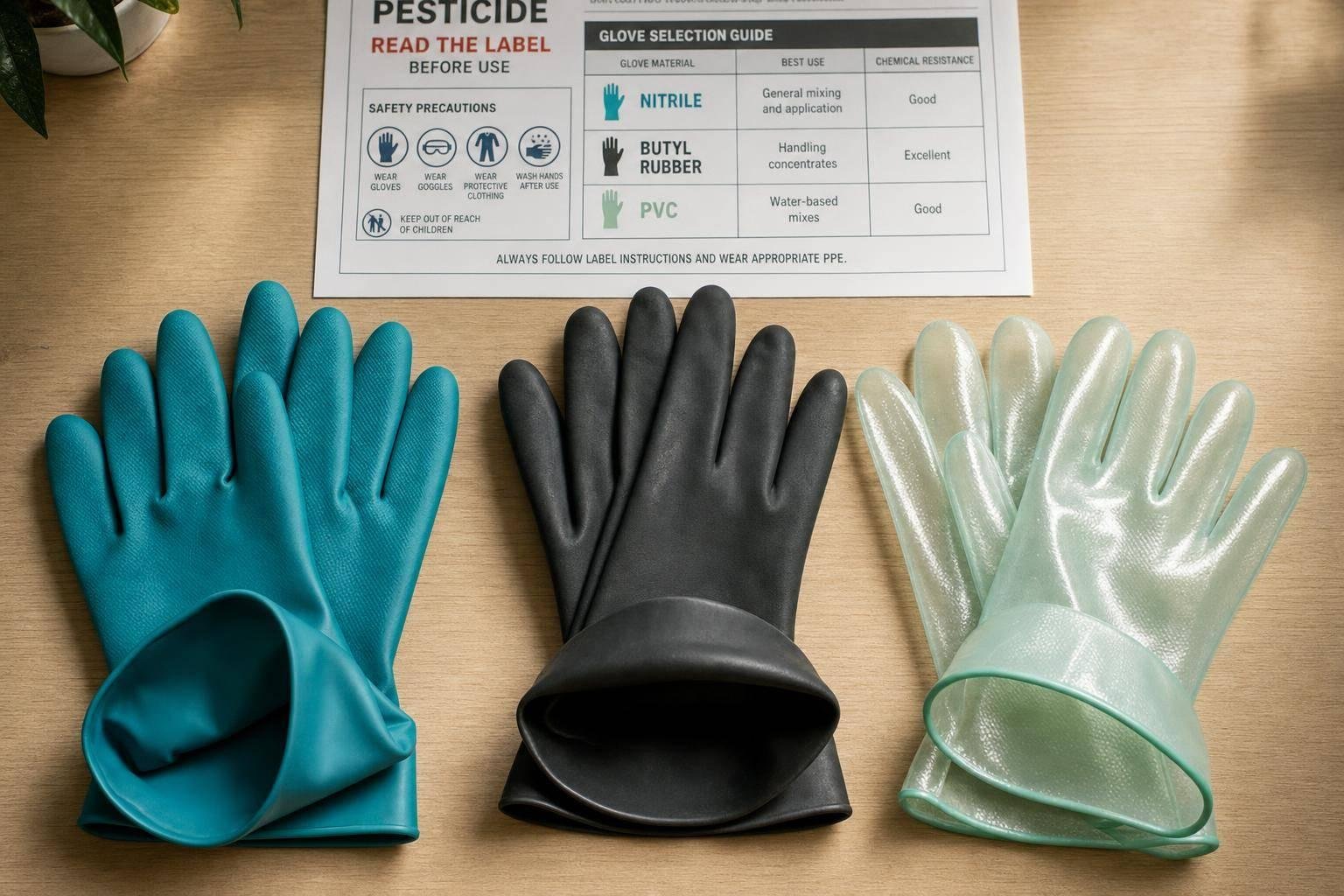
If you remember one thing, make it this: the pesticide label decides the glove. I’d start with barrier laminate for the highest chemical resistance, then look at butyl, nitrile, neoprene, PVC, Viton, natural rubber, and polyethylene based on the label, the task, and how much hand movement you need.
Here’s the short version:
- Barrier laminate: highest chemical resistance; often stiff and costs more
- Butyl rubber: strong chemical protection for mixing and loading
- Nitrile rubber: a common middle-ground for protection, hand movement, and price
- Neoprene rubber: another common label-listed option for routine pesticide handling
- PVC: lower-cost pick for some water-based products only
- Viton: used when the label calls for more solvent resistance
- Natural rubber: below nitrile, neoprene, and butyl for pesticide work
- Polyethylene: lowest protection in this group; use only if the label allows it
A few points matter most:
- Mixing and loading carry the highest exposure risk because the pesticide is most concentrated then
- Use unlined gloves; liners can hold residue against your skin
- Replace gloves at the first sign of wear, thinning, cracks, or tears
- Some gloves may last 1 day to 1 month, depending on the material, product, and use
- PVC is not for many solvent-based products, including most EC formulations
Gloves for Pesticide Application
sbb-itb-c4006de
Quick Comparison
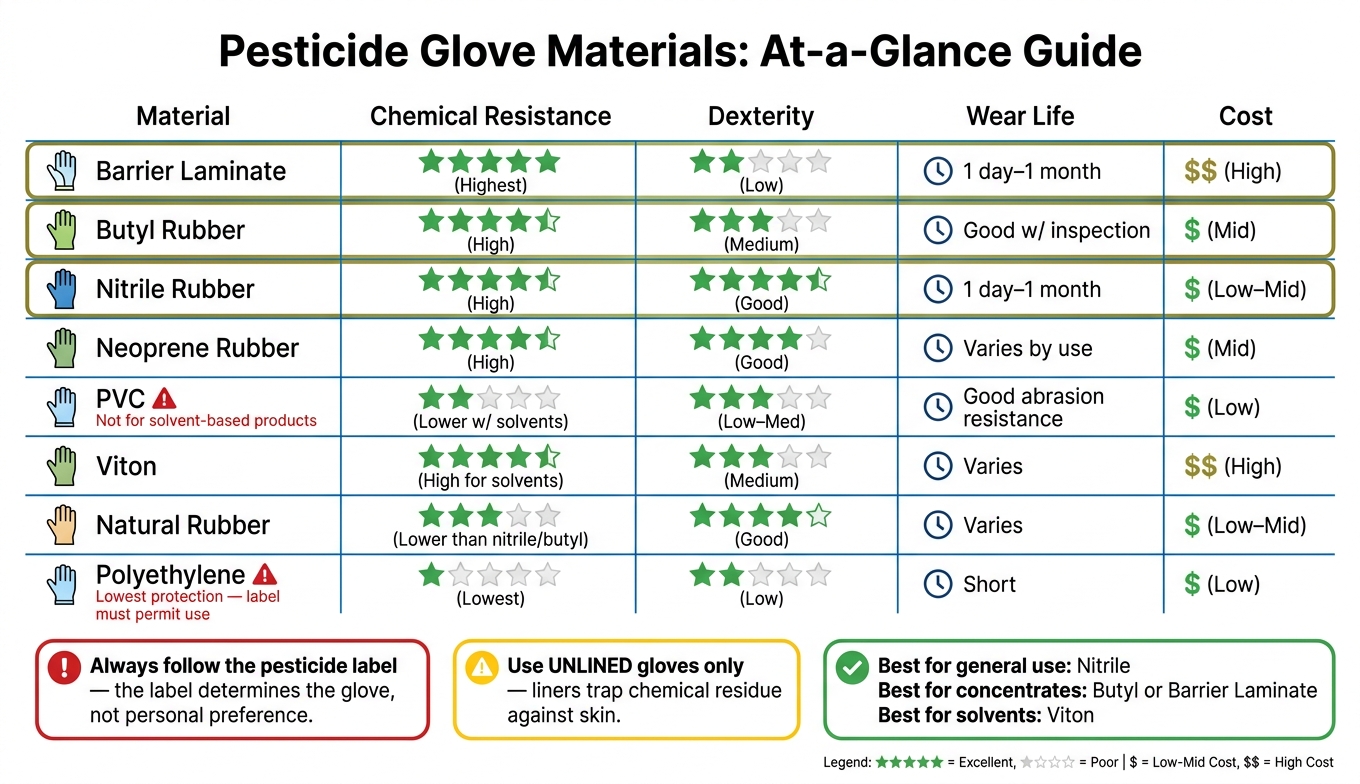
Pesticide Glove Materials Compared: Protection, Dexterity & Cost
| Material | Chemical Resistance | Hand Movement | Wear Life | Cost |
|---|---|---|---|---|
| Barrier laminate | Highest | Low | 1 day to 1 month | High |
| Butyl rubber | High | Medium | Good with inspection | Mid |
| Nitrile rubber | High | Good | 1 day to 1 month | Low to mid |
| Neoprene rubber | High | Good | Varies by use | Mid |
| PVC | Lower with solvents; better for water-based products | Low to medium | Good abrasion resistance | Low |
| Viton | High for label-called solvent tasks | Medium | Varies | High |
| Natural rubber | Lower than nitrile/neoprene/butyl | Good | Varies | Low to mid |
| Polyethylene | Lowest in this group | Low | Short | Low |
In plain English: if the label gives you a choice, I’d lean toward nitrile for general use, butyl or barrier laminate for concentrates, PVC only for label-approved water-based work, and Viton for high-solvent jobs that call for it.
1. Barrier Laminate Gloves
Barrier laminate gloves are the top benchmark for chemical resistance.
Chemical Resistance
Barrier laminate gloves provide the strongest chemical barrier for pesticide handling, helping protect hands and forearms during use. They make the most sense when you need the highest level of chemical resistance, especially during mixing and loading, when exposure risk is at its highest. Use them only when the label or the task calls for maximum chemical resistance.
Durability
How long they last depends on the product, the manufacturer, and how often you use them. Service life can range from one day to one month. Stick with unlined gloves. Lined or fabric gloves can absorb chemicals.
If barrier laminate gloves feel too expensive or too stiff, the next choices give up some resistance in exchange for a better fit or easier access.
2. Butyl Rubber Gloves
Butyl rubber is a solid pick when you need high chemical resistance but also want more give than barrier laminate. Barrier laminate can protect well, sure, but it often feels less practical on the hand. Butyl tends to strike a better balance for many applicators.
Chemical Resistance
Nitrile, neoprene, and butyl rubber are the standard unlined chemical-resistant choices. Butyl rubber offers strong protection for hand and forearm exposure.
Put simply: butyl sits near the top of the list for chemical-resistant glove materials. Still, the glove label matters less than the pesticide label. That label is what decides the final match.
Label Compatibility
Use only the glove material listed on the pesticide label. Use unlined gloves; lined gloves can trap residues.
That point is easy to miss, but it matters. A lined glove might seem more comfortable, yet it can hold onto pesticide residue like a sponge.
Durability
Butyl gloves are durable enough for repeated handling but still require routine inspection.
Even tough gloves wear down over time. Small cracks, thinning spots, or tears can turn a good glove into a weak link fast.
Cost
Butyl gloves are usually cost-effective for routine pesticide work.
If butyl feels too stiff for the task, nitrile and neoprene are the next most common options.
3. Nitrile Rubber Gloves
Nitrile rubber gloves offer a solid mix of chemical resistance, dexterity, and low cost, which is why they’re a common pick for pesticide work. They rank alongside neoprene and butyl as one of the top chemical-resistant glove options. In plain English, nitrile sits in the middle: more protective than basic gloves, but still comfortable enough for day-to-day use.
Chemical Resistance
Nitrile creates a chemical-resistant barrier for the hand and forearm. For mixing and loading, use unlined nitrile gloves when the label lists nitrile. That mix of protection and ease of use makes nitrile a good fit for more than one type of job.
Formulation Compatibility
Check the pesticide label before use. Nitrile gloves are suitable for mixing and loading when the label allows them.
Durability, Dexterity & Cost
Depending on the glove and how often you use it, nitrile gloves may last from a day to a month. Replace them at the first sign of wear. They’re usually affordable and easy to find.
If nitrile doesn’t match the label or the task, neoprene is the next common option.
4. Neoprene Rubber Gloves
Neoprene rubber gloves are a common chemical-resistant choice for pesticide handling when the label allows them. They sit in the same unlined chemical-resistant group as nitrile and butyl, but many labels still list neoprene as its own option. In plain terms, neoprene is often a solid middle-ground pick when a label calls for chemical-resistant gloves.
Chemical Resistance
Unlined nitrile, neoprene, and butyl rubber gloves are the standard chemical-resistant choices. Use unlined neoprene gloves that cover the hand and forearm.
Formulation Compatibility
Start with the pesticide label. Then confirm that neoprene meets the label rules before mixing or loading.
Durability
Check neoprene gloves often. Replace them at the first sign of wear or right after a spill.
If neoprene is not listed, move to the next label-approved option.
5. PVC Gloves
Use PVC gloves only when the label says you can and the product is water-based. They’re a budget-friendly pick for label-approved work with water-based mixes.
Chemical Resistance
PVC holds up well against water-based formulations, inorganic acids, and alkalis. But there’s a catch: many organic solvents can pass through it fast. So don’t use PVC with solvent-based pesticide products, including most ECs.
Durability & Dexterity
PVC stands up well to abrasion and snags. The downside is that it’s stiff, which can make fine hand movement tougher. That stiffness also makes cold-weather work more of a hassle.
Cost & Availability
PVC is usually the lowest-cost chemical-resistant glove material.
If the label calls for stronger solvent resistance or a glove that bends and moves more easily, move to the next approved material.
6. Viton Gloves
When you need more solvent resistance than PVC can give, Viton is the next step up, if the label calls for it. These gloves are a niche option for pesticide work, but they matter in the cases where the label-approved glove material has to go beyond the usual choices.
Put simply: Viton is for jobs where common glove materials may fall short.
Chemical Resistance
If the label lists Viton, use it for that task.
Cost & Availability
Viton gloves cost more and can be harder to find than nitrile, neoprene, or butyl. That means many applicators treat them as a specialized option rather than an everyday glove.
7. Natural Rubber Gloves
Natural rubber sits a step below the synthetic chemical-resistant gloves mentioned above. It does a better job than leather at resisting pesticide absorption, but it’s not a top choice for pesticide work. For mixing and loading, nitrile, neoprene, or butyl are stronger picks. After that, the label makes the call on whether natural rubber fits the job at all.
Formulation Compatibility
Use natural rubber only when the pesticide label lists it.
Durability
Durability depends on how the gloves are used and what chemicals they touch. Check gloves before each use, and replace them at the first sign of wear.
8. Polyethylene Gloves
Polyethylene is the lowest-protection option in this comparison. These gloves provide basic liquid protection and not much more. They also resist chemicals less than nitrile, neoprene, or butyl, so use them only when the pesticide label says they’re allowed.
And one thing is worth saying plainly: don’t swap in plastic bags or other makeshift items. Use gloves that are made for chemical handling.
Formulation Compatibility
Use polyethylene only when the pesticide label lists it. If you’re dealing with a higher-risk product, go with nitrile, neoprene, or butyl instead.
Cost & Durability
Polyethylene gloves are cheap and easy to find, which is why people often reach for them first. The catch is simple: they wear out faster than stronger chemical-resistant gloves.
Those trade-offs set up the pros-and-cons comparison below.
Pros and Cons of Each Glove Material
Use this summary to narrow your options before you check the label-approved glove material. It covers the glove materials most often used for pesticide work, not every glove type, and it does not overrule the pesticide label.
| Glove Material | Main Pros | Main Cons | Best-Fit Use Cases |
|---|---|---|---|
| Butyl Rubber | High chemical resistance | Use unlined gloves; liners can hold residues | Mixing and loading concentrates |
| Nitrile Rubber | High chemical resistance; low cost | Durability varies by product and use | Mixing, loading, and routine labeled pesticide work |
| Neoprene Rubber | Strong chemical resistance | Use unlined gloves; liners can hold residues | Routine labeled pesticide work |
| Natural Rubber | More protective than leather, but not a top pesticide glove | Not a first-choice glove for concentrates | Basic label-approved tasks only |
After that, match the label’s glove requirement to the task and the exposure level.
Swap out gloves at the first sign of wear, and check the label before each task.
How to Pick the Right Glove for Your Label and Task
Use the comparison above to narrow your choices. Then match the glove to the job in front of you.
Start by learning how to read the pesticide label. Check the "PPE" subsection under "Precautionary Statements." If it lists a glove material by name, such as nitrile or butyl rubber, use that exact material. No guesswork. If the label gives a chemical-resistance class instead of a material name, check an EPA or university extension chemical-resistance chart to see which glove materials fit that class.
Before you buy anything, confirm the glove thickness the label calls for. Gloves should reach up to the forearm, which helps guard against splashes during mixing and loading. Go with unlined gloves. Lined gloves can hold pesticide residue against your skin.
If the label is missing or too worn to read, pull up the latest version on the manufacturer’s website or in a database like Greenbook before handling the product.
Here’s a quick match guide for cases where the label allows more than one glove material:
| Scenario | Recommended Material |
|---|---|
| General use | Nitrile rubber |
| High-solvent concentrates | Barrier laminate or Viton |
| Water-based products | Use the label-listed material; PVC is common for some water-based formulations |
| Budget-conscious purchases | Nitrile rubber |
FAQs
How do I read a pesticide label for glove selection?
Check the Precautionary Statements section on the pesticide label. That’s where you’ll find the glove material you need, such as nitrile or butyl rubber. Some labels also list a minimum glove thickness in mils, with 1 mil = 0.001 inch.
You may also see EPA chemical resistance categories (A–H). These categories help you match the right gloves to the pesticide’s solvent.
When should I replace pesticide gloves?
Inspect gloves every day for leaks, tears, thin spots, or any other damage. If you spot a problem, repair the gloves or throw them out immediately. Don’t wait until the damage is obvious. Replace gloves as soon as you see the first signs of wear.
Glove lifespan can vary a lot. Based on how they’re used, who made them, and the exact product, a pair may last anywhere from one day to one month.
What glove thickness is best for pesticide work?
For pesticide work, glove thickness matters for safety. Chemical-resistant gloves are usually 12 to 22 mils thick, and many product labels call for at least 14 mils for materials like nitrile, neoprene, or butyl rubber.
Always check the specific pesticide label. It sets the exact glove requirement for the job you’re doing.