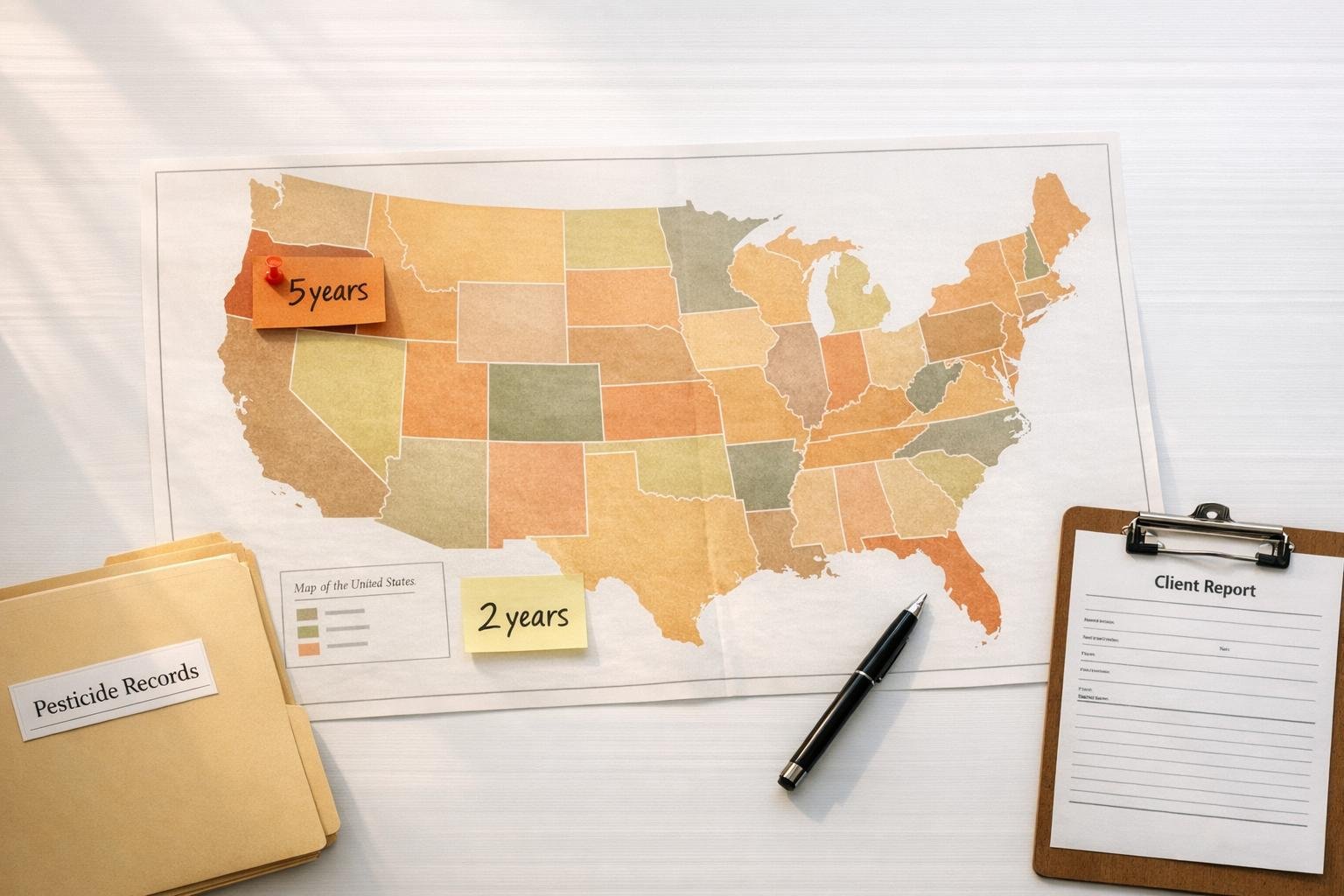
If you use pesticides, keeping accurate records isn’t optional – it’s required by law. Federal regulations mandate that certified applicators of restricted-use pesticides (RUPs) maintain records for at least two years. However, some states enforce stricter rules. For example, Oregon requires five years, while New York mandates three years.
Why does this matter? Accurate records protect you from fines, help during medical emergencies, and ensure compliance during inspections. They’re also essential for evaluating pesticide effectiveness and planning future applications. Failing to comply can lead to penalties, starting at $500 for a first offense.
Here’s the bottom line:
- Federal law: 2-year retention for RUP records.
- State rules: Vary – Oregon (5 years), New York (3 years), most others (2 years).
- Organic certification: USDA requires 5 years, regardless of state.
Commercial applicators must also provide clients with application records within 30 days. Staying organized – digitally or on paper – and reviewing records regularly ensures you’re always inspection-ready.
Federal Requirements for Pesticide Record Retention
The Federal Insecticide, Fungicide, and Rodenticide Act (FIFRA)
FIFRA lays out the rules for pesticide recordkeeping across the United States. Under this federal law, certified applicators using Restricted Use Pesticides (RUPs) must keep records for at least two years from the application date. This rule applies to all certified applicators nationwide.
These records must include four key details: product name, amount used, date, and location. While some states may require additional information – like EPA registration numbers, applicator certification numbers, or exact timing – these four elements are the baseline for federal compliance.
"If there is no State requirement for the maintenance of records, such applicator shall maintain records that contain the product name, amount, approximate date of application, and location of application of each such pesticide used for a 2-year period after such use." – 7 USC 136i-1
For commercial applicators, there’s an extra step: they must provide clients with a copy of the application records within 30 days of completing the work. These federal rules ensure that the EPA can effectively oversee pesticide use.
EPA‘s Role in Recordkeeping Standards
The Environmental Protection Agency plays a central role in enforcing these recordkeeping requirements. Through the "EPA Plan for the Federal Certification of Applicators of Restricted Use Pesticides", the agency oversees compliance in federal jurisdictions, including Indian country. The EPA has the authority to access, inspect, and copy records to confirm adherence to the rules.
When conducting inspections, the EPA reviews detailed documentation. This includes certification numbers, product registration numbers, precise application times, and the specific treatment area. If you supervise noncertified applicators, you’re also required to keep records of their training, including the trainer’s name and the EPA-approved materials used.
Penalties for non-compliance can be steep. First-time offenses may result in fines up to $500, with higher fines for repeated violations. In cases of intentional non-compliance, criminal charges may apply. These escalating penalties underscore the importance of meeting federal recordkeeping standards.
sbb-itb-c4006de
Pesticide Record Keeping
Pesticide Record Retention Periods by State
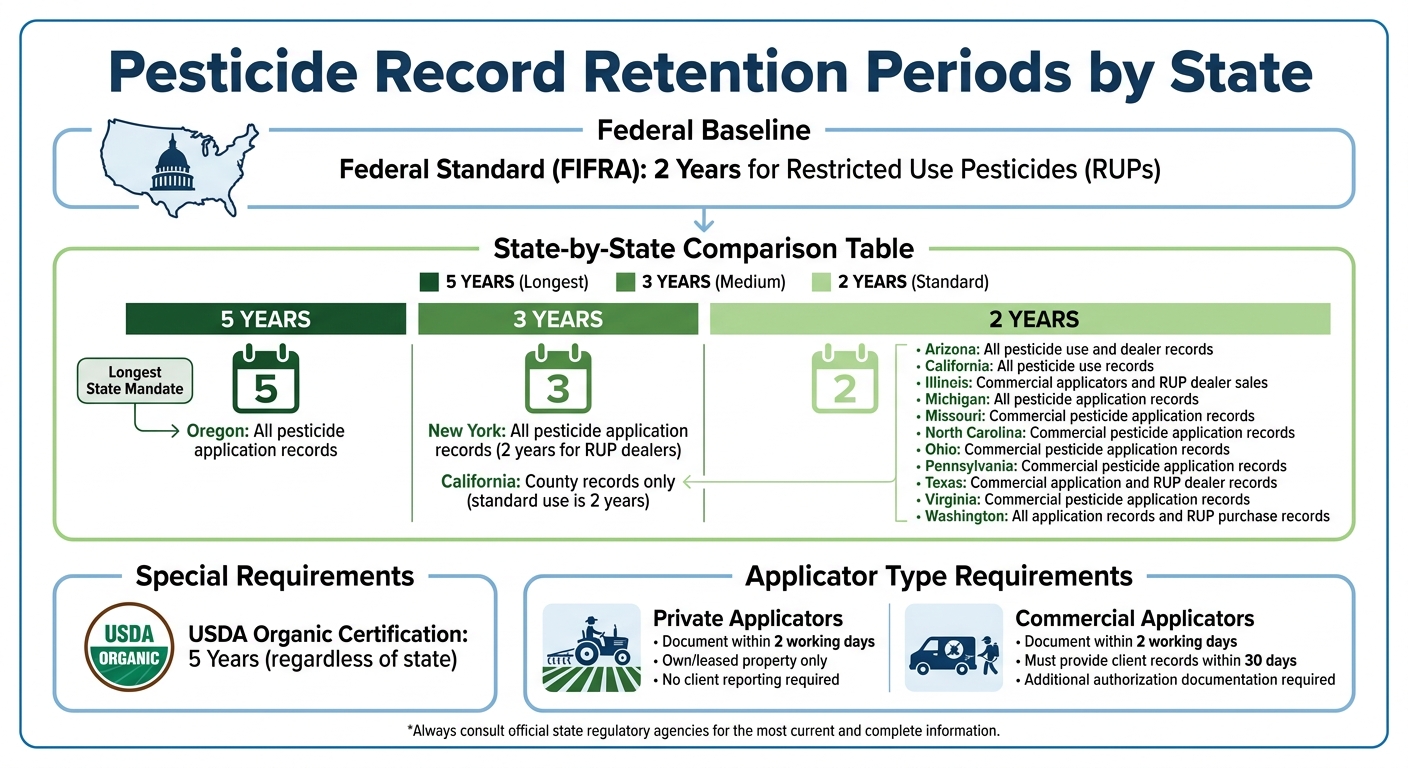
Pesticide Record Retention Requirements by State and Applicator Type
How to Use the State Retention Period Table
This table outlines the minimum record retention periods for pesticides, varying by state. While many states stick to the federal record keeping requirements, others have longer requirements. The Retention Period column shows the minimum number of years records must be kept, while the Applicator Type / Specifics column explains whether the rule applies to all applicators or just commercial ones.
For certified organic operations, the USDA requires records to be kept for five years.
| State | Retention Period | Applicator Type / Specifics |
|---|---|---|
| Arizona | 2 Years | All pesticide use and dealer records |
| California | 2 Years | All pesticide use records; 3 years for County records |
| Illinois | 2 Years | Commercial applicators and RUP dealer sales |
| Michigan | 2 Years | All pesticide application records |
| Missouri | 2 Years | Commercial pesticide application records |
| New York | 3 Years | All pesticide application records; 2 years for RUP dealers |
| North Carolina | 2 Years | Commercial pesticide application records |
| Ohio | 2 Years | Commercial pesticide application records |
| Oregon | 5 Years | All pesticide application records (Longest state requirement) |
| Pennsylvania | 2 Years | Commercial pesticide application records |
| Texas | 2 Years | Commercial application and RUP dealer records |
| Virginia | 2 Years | Commercial pesticide application records |
| Washington | 2 Years | All application records and RUP purchase records |
The table highlights states with different requirements, helping applicators stay compliant.
States with Different Retention Requirements
Some states go beyond federal standards, requiring longer record retention. Oregon stands out with a five-year minimum period, the longest in the country.
"Oregon has the longest mandatory retention requirement among major US wine states at 5 years; California and Washington require 2 years; New York requires 3 years; most other states require 2 years".
This extended five-year window in Oregon increases the timeframe for inspections. For example, an inspector in Oregon in 2026 could request records dating back to 2021. By contrast, in California, inspectors can only look at records from the last two years, though County Agricultural Commissioners hold their records for three years.
These retention periods directly affect how far back regulators can review records. Knowing your state’s requirements is crucial to ensure compliance and avoid issues during inspections.
Record Retention Requirements by Applicator Type
Private Applicators
Private applicators are farmers who apply pesticides on their own land, whether that’s a farm, forest, or nursery. They need to document all required Restricted Use Pesticide (RUP) details – like their license number, the date and time of application, the location, the product’s brand name, the EPA registration number, and the total amount used – within two working days of the application. It’s a good idea to record this information right after the application to avoid forgetting key details, such as exact start and end times or the specific quantities applied. Since private applicators are treating property they own or lease, they don’t need to record third-party authorizations or share their records with clients.
Commercial Applicators
Commercial applicators have more extensive documentation and reporting responsibilities. Along with documenting all required RUP details within two working days, they must keep these records for at least two years. When working on property they don’t own or lease, they also need to record the name of the person who authorized the application. Additionally, federal regulations mandate that they provide a copy of the pesticide application record to the client within 30 days of completing the work.
If commercial applicators supervise noncertified individuals, they must also maintain records of the trainee’s qualifications, including the dates of their training and the materials covered. These added requirements highlight the importance of staying organized to ensure compliance and avoid penalties.
For organic operations, both private and commercial applicators are required to follow the USDA National Organic Program‘s rule of keeping records for five years, even if state laws have shorter retention periods.
Best Practices for Pesticide Recordkeeping
How to Organize and Store Records
Keeping pesticide records well-organized is crucial for protecting your business and staying compliant with regulations. Opting for digital storage can be a game-changer, offering benefits like automatic timestamps that create a reliable audit trail and safeguarding records from potential loss. If you prefer paper records, make sure they are stored securely in a climate-controlled space, clearly labeled by date and treatment site. Regardless of the format, ensure your records are ready for immediate inspection by authorized state officials.
When documenting pesticide applications, include all the required details. For instance, record GPS coordinates or legal property descriptions to clearly identify each treatment site. Don’t just note the date – include both the start and end times of applications. As noted by Michael Aerts, O. Norman Nesheim, and Frederick M. Fishel, "Records are the best safeguard if a producer is accused of an improper application that causes drift, personal injury, or potential water-quality impairment". If you’re a commercial applicator, remember to provide clients with copies of these records within the mandated 30-day window. A well-organized system not only ensures compliance but also helps you integrate additional compliance tools more easily.
Using Online Training for Recordkeeping Compliance
Once you have an organized system in place, training is essential to reinforce compliance. It’s not just about recording information but understanding why certain data points are required. Online Pest Control Courses (https://onlinepestcontrolcourses.com) offers state-approved training programs that cover all the mandatory elements, such as EPA registration numbers, application methods, and specific site details. These courses can help applicators avoid civil penalties by ensuring every legal requirement is met.
Additionally, the training highlights how records can be used as part of Integrated Pest Management strategies. By analyzing past records, you can evaluate the effectiveness of treatments and even identify ways to cut costs.
Conducting Regular Record Reviews
Regularly auditing your records is another critical step. Make it a habit to review all entries to ensure they are completed within two working days and include precise details like location, timing, and product information. These periodic checks show a "good-faith effort" to comply with regulations, which can sometimes help reduce penalties if an issue arises.
For treatments conducted on third-party properties, double-check that the name of the person authorizing the application is properly recorded. Combining regular reviews with organized recordkeeping and proper training creates a solid defense against compliance violations. These internal audits not only keep your records audit-ready but also act as a legal safeguard in case of disputes.
Conclusion
Key Takeaways
Understanding pesticide record retention rules is crucial for safeguarding your business, ensuring client trust, and protecting the environment. Federal law requires keeping restricted-use pesticide records for at least two years, but many states enforce stricter guidelines. For instance, Ohio aligns with the federal standard of two years, while Oregon extends it to five years. If you operate across state lines or maintain organic certification, sticking to a five-year retention period can simplify compliance and help you meet the most stringent requirements.
Non-compliance carries serious risks. Beyond financial penalties, failing to produce records during inspections is a violation on its own – even if your pesticide applications were compliant. Additionally, records must be readily available to health professionals during medical emergencies involving pesticide exposure.
State-specific rules also dictate varying recordkeeping requirements for private and commercial applicators. For example, commercial applicators must provide clients with application records within 30 days of treatment. Meanwhile, recording timelines differ by state – Ohio requires private applicators to document usage on the same day, whereas Florida allows up to two working days. Always consult your state’s lead agency to stay informed about local requirements, as they often exceed federal standards.
Keeping detailed records isn’t just about compliance – it’s also a smart business practice. As noted by the Florida Department of Agriculture and Consumer Services:
"Agricultural producers who keep records of their pesticide use are smart managers. By using their pesticide records, they can make decisions that save time and money".
Reviewing past records helps fine-tune Integrated Pest Management strategies and evaluate the success of treatments over time.
To stay audit-ready, ensure your records include all mandatory details: applicator name, EPA registration number, product brand, amount used, application date, and exact location. Regular training, like the programs offered by Online Pest Control Courses (https://onlinepestcontrolcourses.com), is essential for maintaining compliance and understanding the importance of accurate recordkeeping. Pairing proper training with routine record reviews creates a strong foundation for protecting your operation well into the future.
FAQs
Which state’s retention rule applies if I work across state lines?
If your work involves crossing state lines, it’s important to follow the record retention rules of the state where the pesticide application occurs. Each state has its own requirements, so these rules can vary. Federal regulations typically mandate keeping records for a minimum of two years, but it’s always a good idea to double-check the specific regulations in each state to make sure you’re in compliance.
Do I need to keep records longer if I use only general-use (non-RUP) pesticides?
Federal regulations generally require records to be kept for two years. However, retention periods can vary by state. For instance, Ohio and Nebraska mandate holding records for at least three years. It’s always a good idea to review your state’s specific guidelines to ensure you’re meeting all legal requirements.
What should I do if I’m missing records during an inspection?
If records are missing during an inspection, it’s important to act fast. Start by documenting any available information, such as application logs or safety data sheets, and provide a clear explanation to the inspector about the missing records. Make sure to keep your own record of what’s missing and the reason behind it – this demonstrates your effort to comply. To avoid similar problems down the line, regularly review your recordkeeping practices and ensure they align with both state and federal regulations.