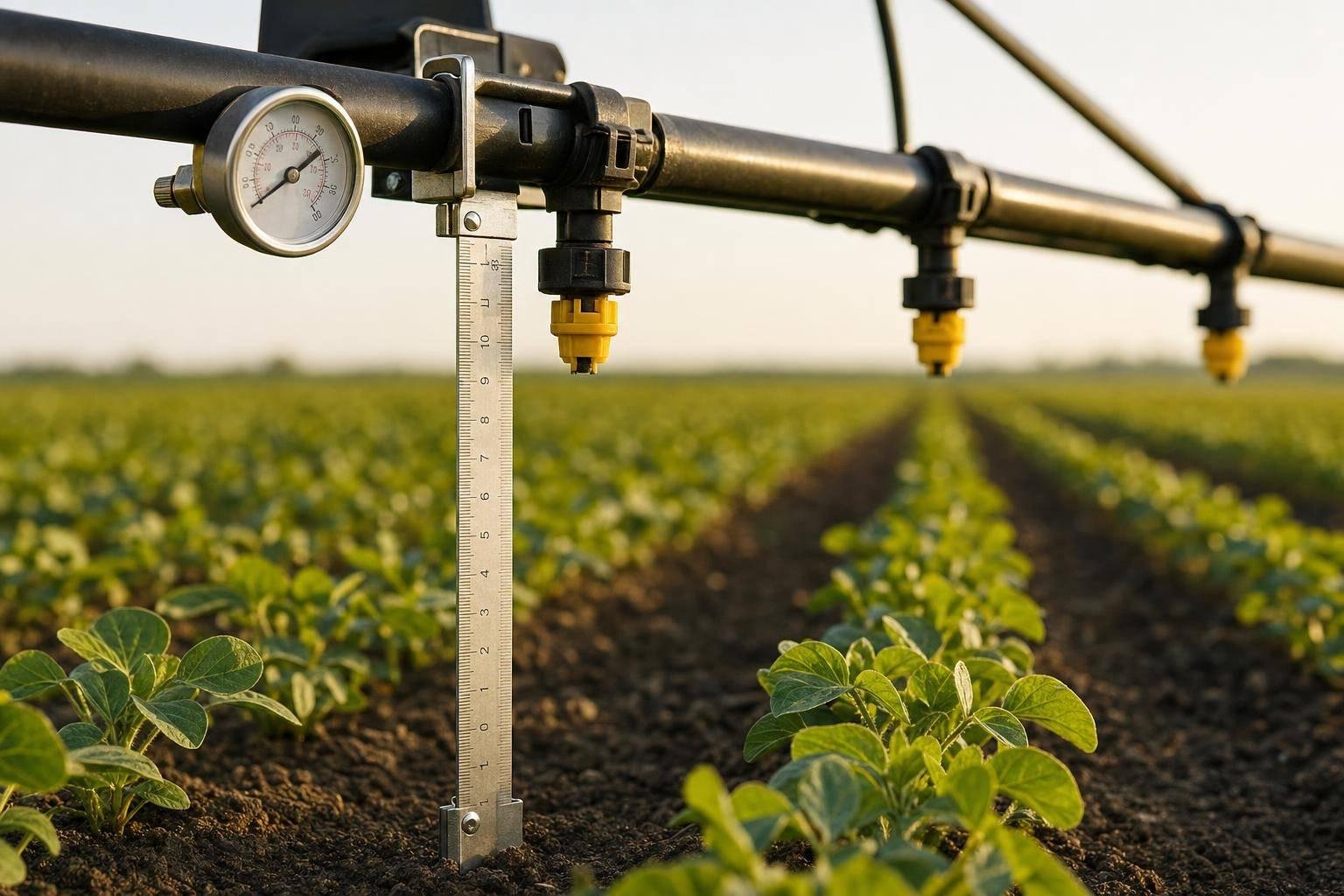
A small calibration miss can turn into a big field problem fast. If your sprayer is off by 10%, a product that costs $35 per acre can waste $3.50 per acre – or $560 on 160 acres.
I’d boil the whole article down to this: if your spray rate is wrong, the cause usually comes from one of five places:
- Travel speed is off
- Pressure is wrong or the gauge is lying
- Nozzles are worn, clogged, or mixed
- Math or units are wrong
- Field conditions, boom height, or overlap change the pattern
The big risk goes both ways. Too little product can leave streaks and weak control. Too much can waste money, injure the crop, and create label trouble. And some sprayers in field studies missed the target by 10% or more.
Here’s the simple fix: check speed, verify pressure, test nozzle output, confirm the math, and recheck in the field. If I’m more than 5% off target, I should stop and recalibrate.
Calibrating Sprayers with Rate Controllers – Focusing in on Accuracy
sbb-itb-c4006de
Quick Comparison
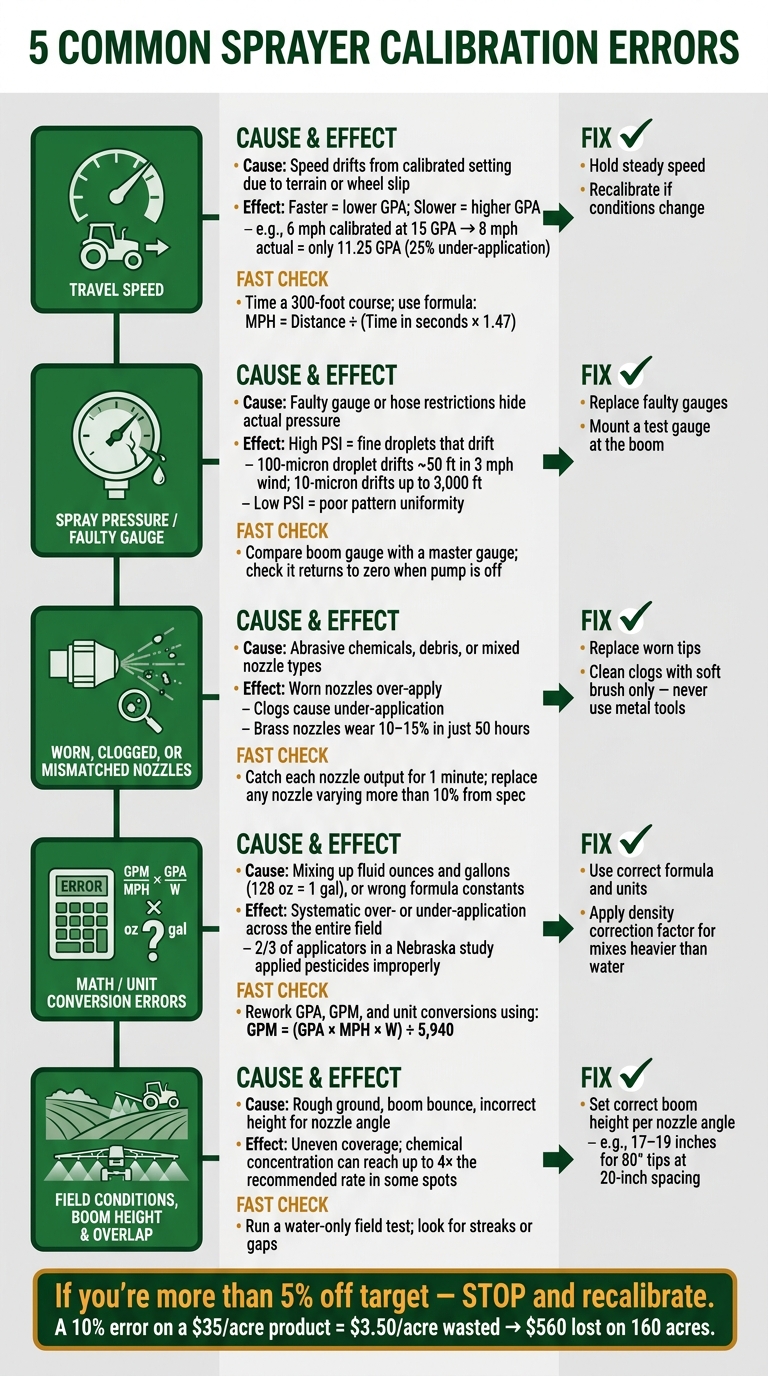
5 Common Sprayer Calibration Errors: Causes, Effects & Fixes
| Error | What happens | Fast check | Basic fix |
|---|---|---|---|
| Travel speed | Faster = lower GPA; slower = higher GPA | Time a 300-foot course | Hold steady speed and recalibrate if conditions change |
| Pressure / gauge | Drift risk or poor pattern | Compare with a test gauge | Fix or replace the gauge; reset pressure |
| Nozzles | Over- or under-application across the boom | Catch each nozzle for 1 minute | Replace worn tips; clean clogs with non-metal tools |
| Math / units | Whole-field rate error | Rework GPA, GPM, and pesticide formulations unit conversions | Use the correct formula and units |
| Boom height / overlap / field conditions | Streaks, gaps, stacked spray | Water-only field check | Set the right boom height and account for rough ground |
If I keep those five checks tight, I cut waste, hold coverage, and stay on rate.
How Small Calibration Errors Lead to Big Application Problems
Gallons per acre (GPA) comes down to how four things work together: nozzle flow rate (GPM), travel speed (MPH), operating pressure (PSI), and nozzle spacing or swath width (inches). Use this formula:
GPM = (GPA × MPH × W) ÷ 5,940
The problem usually isn’t the math. It’s changing one setting and acting like nothing else moved. If you change any one of those inputs without recalibrating the rest, your GPA changes too. Drive faster, and the rate drops. Increase pressure, and nozzle output goes up in a nonlinear way.
That may sound minor on paper, but it adds up fast in the field. If a pesticide costs $35 per acre, a 10% over-application error wastes $3.50 per acre. On a 160-acre field, that turns into $560 lost from one calibration mistake.
And that’s just product cost. It doesn’t count possible crop injury or the cost of coming back for a re-treatment after an under-application. As NDSU notes, inaccurate applications waste product, reduce pest control, increase carryover, and can damage crops.
That’s why small mistakes matter so much. They don’t stay small. They build pass after pass across the field. The next sections break down five common errors, how to spot them, and how to stop them before they affect rate, coverage, or cost.
1. Incorrect Travel Speed
Travel speed is one of the most direct ways to control how much product lands on the ground. The rule is simple: drive faster, apply less; drive slower, apply more. If a sprayer is set at 6 mph but you end up driving 8 mph, you’ll underapply. And in the field, speed can drift fast when the ground gets rough or conditions change.
The numbers make the problem plain. You can estimate your actual GPA when speed shifts from the speed you used during calibration with this formula:
Actual GPA = (Calibrated GPA × Calibrated Speed) ÷ Actual Speed
Here’s a clear example. If you calibrated at 6 mph for 15 GPA but run at 8 mph, your actual rate falls to 11.25 GPA. That’s a 25% under-application.
One catch: dashboard speed readings aren’t always right. Wheel slip, rough ground, and changes in tire pressure can throw them off. On top of that, rate controllers may change pressure, which can affect droplet size and increase drift risk.
That’s why it helps to measure speed in the field, not just trust the display. A 300-foot field test is the best check. Mark off a 300-foot course, time two passes at your target speed, and average the results. Then use this formula to find your actual MPH:
MPH = Distance (ft) ÷ (Time in seconds × 1.47)
For example, if your average pass takes 42.6 seconds, the math looks like this: 300 ÷ (1.47 × 42.6) = 4.8 mph.
Run this check:
- At the start of the season or when completing South Carolina applicator recertification
- After tire or equipment changes
- When field conditions shift
If speed checks out, move next to pressure and nozzle output.
2. Wrong Spray Pressure or Faulty Gauge Readings
Once travel speed is dialed in, the next thing to check is pressure.
Pressure affects droplet size and overall spray quality. Push the pressure too high, and you get fine droplets that drift off target. Run it too low, and you end up with coarse droplets, weak coverage, and uneven spray patterns. The drift risk can get big fast: a 100-micron droplet can travel about 50 feet in a 3 mph breeze, while a 10-micron droplet can drift as far as 3,000 feet.
There’s also a math piece here. Flow changes with the square root of pressure, so if you want to double GPM, you need four times the pressure. That’s why pressure alone isn’t the best lever for big rate changes. If you need a major change, adjust speed or switch nozzle size instead.
A faulty gauge can throw everything off because it hides the actual pressure. Check the gauge once a year against a master gauge, and make sure it returns to zero when the pump and boom are off. It also helps to mount a test gauge at the boom so you can read actual nozzle pressure. Pressure drops often happen between the pump and the boom, and that gap can mislead you if you only look at one reading point.
If pressure checks out, the next step is to look at nozzle wear and flow.
3. Worn, Clogged, or Mismatched Nozzles
Even if your pressure is right, your spray rate can still drift if the nozzles are worn, clogged, or mixed up.
A worn nozzle has a larger opening than it should. That means it puts out more product than planned, which can lead to overapplication. A clogged nozzle cuts flow instead, so some areas get less than they should.
The wear difference between materials can add up fast. Brass nozzles can wear 10%–15% in 50 hours, while hardened stainless steel usually wears only about 2%.
Mixing nozzle sizes, nozzle types, or spray angles is another common problem. It throws off swath output and can lead to striping and off-rate areas.
A simple catch test can help you spot trouble before it turns into a field-wide mess. Run the sprayer at field pressure, collect each nozzle’s output for one minute, and compare it with the manufacturer’s spec. Replace any nozzle that varies by 10% or more from spec.
If you find a clog, clean it with a soft-bristled toothbrush or a wooden toothpick. Never use metal. It can permanently damage the orifice.
For longer wear life, use:
- Ceramic tips
- Carbide tips
- Hardened stainless steel tips
Skip brass or plastic when you can.
After nozzle checks, confirm your math and units. A bad calculation can still give you the wrong rate. Reviewing a pesticide safety course can help reinforce these critical application standards.
4. Calibration Math and Unit Conversion Mistakes
Even when your nozzles are fine, bad math can still throw your GPA way off. A Nebraska study found that two-thirds of applicators were applying pesticides improperly , a common issue addressed in Oklahoma pest control CEU courses. The main reason? Unit mix-ups and formula mistakes.
One of the most common errors is treating fluid ounces like gallons. That sounds small, but it isn’t. There are 128 fluid ounces in 1 gallon, so if you skip that step, your calculated rate can end up 128 times higher than the actual GPA.
Another easy mistake is using 5,940 with the wrong units in the standard calibration formula:
GPM = (GPA × MPH × W) / 5,940
(where W = nozzle spacing in inches)
That 5,940 constant only works when GPA, MPH, and nozzle spacing are all in the standard units shown above. Change the units, and the formula has to change too. If not, the answer looks fine on paper but is wrong in the field.
Heavier mixes also need a correction factor. You can’t just eyeball it. When the liquid is heavier than water, it puts out less flow at the same setting, which means GPA drops unless you adjust for it.
| Solution Weight (per gallon) | Specific Gravity | Conversion Factor (Multiply GPM by) |
|---|---|---|
| 7.0 lbs | 0.84 | 0.92 |
| 8.34 lbs (Water) | 1.00 | 1.00 |
| 10.0 lbs | 1.20 | 1.10 |
| 12.0 lbs | 1.44 | 1.20 |
| 14.0 lbs | 1.68 | 1.30 |
Source: Colorado State University Extension
5. Ignoring Field Conditions, Boom Height, and Overlap
Getting the sprayer calibrated is a good start. But that doesn’t mean the rate stays right once you hit the field.
Field conditions can change what the sprayer puts out, even when the setup looked perfect in the yard. Rough ground, tillage, and slope all affect your actual travel speed. And when speed changes, your GPA changes too, just like it would with the wrong nozzle setup.
Boom height matters just as much. If one side of the boom drops over rough ground, spray can stack up on the low side. If the boom rides too high, you start to see coverage gaps. That’s when weed streaks or crop injury can show up. In some spots, uneven application can push chemical concentration up to 4 times the recommended rate.
The right boom height depends on nozzle spacing and spray angle:
| Spray Angle (Degrees) | 20-inch Nozzle Spacing (Height in Inches) | 30-inch Nozzle Spacing (Height in Inches) |
|---|---|---|
| 65 | 21–23 | 32–34 |
| 73 | 20–21 | 27–29 |
| 80 | 17–19 | 25–27 |
| 110 | 10–12 | 14–18 |
Source: Colorado State University Extension
And boom height isn’t the whole story. Bounce and overlap can throw things off too. When the boom bounces or rides unevenly, some strips get hit twice while others get missed. One pass looks fine from the cab, but the pattern on the ground tells a different story.
This is where a lot of applicators get tripped up. Monitors, rate controllers, and GPS are useful for record keeping, but they can’t fix boom bounce or wheel slip. If the controller is reading wheel speed, slip can throw the rate off.
Two simple field checks can help spot these problems early:
- Calibrate on the same kind of ground you’ll actually spray. Surface conditions affect your true speed.
- Run a stop-check. Spray a known distance of at least 3,000 feet, then measure exactly how much water it takes to refill the tank. From there, calculate actual GPA with this formula: GPA = (gallons sprayed × 43,560) / (boom width [ft] × distance [ft]).
If your result misses the target, the issue may not be the sprayer itself. It may be the field. In that case, fix boom height or travel speed before moving on.
Quick Reference Table: Spotting and Fixing Calibration Mistakes
This table helps you connect a field symptom with the calibration mistake most likely behind it. Each row lines up with one of the five mistakes covered above. If a pass looks off, use it to narrow down the cause fast.
| Error | Cause | Effect | Check | Corrective Action |
|---|---|---|---|---|
| Incorrect Travel Speed | Wrong gear/RPM or wheel slip | GPA changes inversely with speed | Time travel over a measured 300-ft course under actual field conditions | Maintain a steady gear and throttle; recalibrate if speed changes |
| Incorrect Spray Pressure | Faulty gauge or hose restrictions | High PSI causes drift; low PSI causes poor pattern uniformity | Compare the boom gauge with a master gauge | Replace faulty gauges; adjust the relief valve; check hose diameter |
| Worn or Clogged Nozzles | Abrasive chemicals or debris in the tank | Worn nozzles over-apply; clogs cause under-application | Catch output from every nozzle for 1 minute; flag any that vary more than 10% from the boom average output | Replace tips that exceed the 10% threshold; clean only with a soft brush; never use metal tools |
| Math or Unit Errors | Wrong tank volume or incorrect formula | Systematic over- or under-application across the entire field | Spray a known distance, then measure gallons needed to refill the tank | Recalculate using GPM = (GPA × MPH × nozzle spacing in inches) / 5,940; apply a density correction for heavier-than-water mixes |
| Field Conditions, Boom Height, and Overlap | Uneven terrain, boom bounce, or incorrect height for nozzle angle | Non-uniform coverage; concentration can reach up to 4 times the recommended rate in some spots | Run a water-only test and look for streaks | Adjust boom to the correct height for your nozzle angle – for example, 17–19 inches for 80° tips at 20-inch spacing |
Once you spot the error, the next move is simple: put habits and training in place so it doesn’t keep showing up.
Training and Continuing Education for Better Calibration
Most calibration mistakes don’t happen because people don’t care. They happen because small things get missed.
The five problems covered in this article – speed inconsistency, pressure issues, nozzle wear, math errors, and failing to account for field conditions – can all be prevented with steady training and regular refreshers. That’s where structured applicator training helps. It gives people a repeatable way to check their work before small errors turn into costly ones.
Field studies show calibration errors are common, which is exactly why hands-on, practical training matters.
Good training should cover the basics that affect spray accuracy every day, including:
- application math
- equipment checks
- nozzle selection
- drift control
- label compliance
That includes skills like checking travel speed, confirming pressure readings, spotting nozzle wear before it becomes a problem, converting units the right way, and adjusting for field conditions. In other words, it trains people to avoid the same mistakes covered in this article.
Exceeding the label rate is illegal.
For applicators who need a set path for recertification, online training can help keep these skills up to date. Online Pest Control Courses offers state-approved online training with CEUs and CCUs, device-friendly access, and instant certificate downloads.
Conclusion
All five errors lead to the same outcome: an off-rate application. Sprayer calibration comes down to five trouble spots – travel speed, pressure, nozzle condition, application math, and field conditions – and if even one is off, your application rate can drift enough to waste product or weaken control.
The fix is straightforward: recalibrate after any equipment change or field change.
Before you spray, inspect the machine and then check it again in the field. Confirm output, covered area, and ground speed before the first full pass.
Treat anything more than 5% off target as a recalibration issue. If you’re outside that range, stop and recalibrate before spraying. Accurate calibration protects coverage, cost, and compliance. For professionals, maintaining these standards is a key part of Mississippi applicator recertification and staying current with state regulations.
FAQs
How often should I recalibrate my sprayer?
Calibrate your sprayer carefully before the first use of each season.
Then calibrate it again any time you change:
- application rates
- products
- nozzle types
- travel speed
It’s also smart to check for nozzle wear and recalibrate from time to time as the equipment wears down with normal use. That matters even more when you use dry formulations, since they can wear parts out faster.
What is the fastest way to check if my sprayer is off-rate?
The fastest way to see if your sprayer is applying the wrong rate is with a bucket test.
Here’s the idea: catch the output from each nozzle for a set amount of time with a container and stopwatch. Then compare the amount you collected to the expected flow rate.
It’s simple, but it tells you what’s actually happening at the nozzle.
That matters because electronic controllers don’t always tell the whole story. They can drift or give bad readings over time. A bucket test cuts through that and gives you a direct check of field performance.
When should I replace sprayer nozzles instead of cleaning them?
Replace sprayer nozzles instead of cleaning them if the flow rate is more than 10% off compared with a new nozzle at the same pressure, or if the spray pattern looks irregular or off.
Even if you don’t see wear, replace nozzles at least once a year.