One treatment usually isn’t enough. If I want aquatic weeds under control in a U.S. pond, lake, or canal, I need a plan that starts with the right plant ID, sets action limits, cuts nutrient inputs, tracks growth, and uses more than one control method.
Here’s the short version:
- Identify the plant first. A wrong ID can lead to the wrong treatment.
- Set action thresholds. For example, a recreational lake may need action at more than 25% to 30% surface coverage.
- Fix site issues. Runoff, sediment, manure, fertilizer, and waterfowl can feed repeat weed and algae growth.
- Stop spread between sites. Clean boats, trailers, tools, and any shared equipment.
- Match the control to the weed and site. Options may include drawdown, hand removal, harvesting, suction removal, grass carp, or aquatic herbicides.
- Follow label and permit rules. In the U.S., aquatic pesticide use is controlled by federal and state law.
- Treat in sections when needed. Large die-offs can lower dissolved oxygen and lead to fish loss.
- Keep records and check results. Track dates, rates, weather, water conditions, and plant response so next season’s plan is better.
A few points stand out. Some weeds, like hydrilla, can regrow from tubers that stay alive for years. Grass carp may live 10+ years, which means their effects can last a long time too. And algae tools like barley straw only help if used before a bloom starts.
If I boil the article down to one idea, it’s this: aquatic weed IPM is a repeat process, not a one-time fix. I identify, monitor, act at the right time, mix methods, and review the results after each treatment.
That’s the framework the rest of the article explains in more detail.
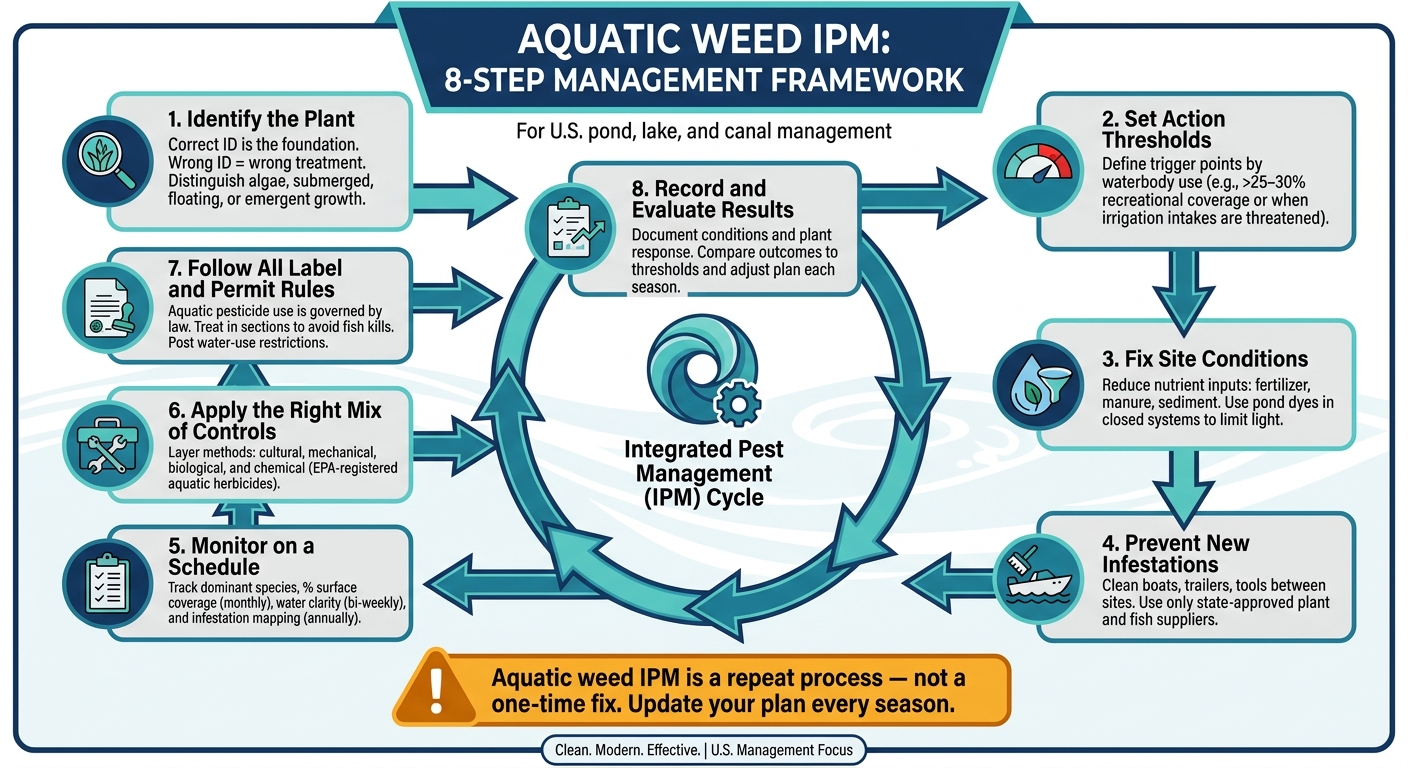
Aquatic Weed IPM: 8-Step Management Framework
Ask an Expert: Aquatic Plant Management
How to Build a Site-Specific Aquatic Weed Management Plan
Once your IPM framework is in place, the next step is the site itself. This is where the plan gets practical.
No two waterbodies behave the same way. Depth, flow, watershed inputs, and nearby land use all shape weed pressure and affect which treatments fit best. That’s why a site-specific plan matters. Start with a site inspection, then line up control choices with what the waterbody can handle.
Assess the Site and Identify the Weed Correctly
Begin by documenting the basics: surface area, average depth, inflows and outflows, sediment, water source, construction features, and nearby land use, especially farms and septic systems. Those details affect both treatment choice and permit needs.
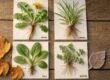
Next, identify what you’re dealing with. Is it algae, submerged growth, floating growth, or emergent growth? That distinction matters because each type calls for a different control method. If the problem is a submerged weed like hydrilla, check the sediment for tubers. They can stay viable for years and fuel regrowth long after the top growth is gone.
"Correctly identifying aquatic plants is the first step in choosing the right control method." – Texas A&M AgriLife Extension Service
Before any treatment starts, flag sensitive non-target species and note seasonal wildlife use of the area.
Set Management Goals, Action Thresholds, and Constraints
Set thresholds based on the waterbody’s main use – irrigation, swimming, fishing, or habitat. Then define the level of plant cover or obstruction that should trigger action.
A recreational lake, for instance, may need action when surface coverage goes past 25–30% or when foul odors show up. An irrigation pond may need treatment much sooner, as soon as plant growth starts clogging pump intakes. You’ll also need to check residue limits, downstream effects, wildlife timing, and permit rules before moving ahead.
Plan Priorities by Waterbody Type: Comparison Table
Once you’ve set thresholds, use the waterbody type to narrow your priorities. Think of the table below as a starting point, not a one-size-fits-all answer.
| Waterbody Type | Primary Goals | Common Threshold Triggers | Key Site Constraints |
|---|---|---|---|
| Irrigation Pond | Maintain water volume and flow; prevent pump clogging | Obstruction of intakes; high biomass | Herbicide residue restrictions for crops; consistent water levels |
| Recreational Lake | Access for swimming and fishing; maintain aesthetics | >25–30% surface coverage; foul odors | Safety for swimmers; protection of fish populations and sensitive non-target species |
| Canal / Ditch | Unobstructed drainage and transport | Reduced flow capacity; sediment buildup | Flow rate; downstream impacts |
| Stormwater Pond | Nutrient sequestration; flood control | Excessive sediment; invasive monocultures | High nutrient loading; frequent water fluctuations |
Early detection helps limit regrowth and can keep long-term control costs lower. It also gives you a baseline for monitoring and later treatment decisions.
Prevention and Monitoring: Stop Problems Before They Spread
Once your thresholds are in place, the next move is prevention and routine monitoring. Your site plan should steer both.
Reduce Nutrient Levels and Site Conditions That Favor Weed Growth
Chronic algae and weed trouble usually starts with excess nutrients. In plain terms, too many nutrients in the water feed repeat outbreaks. Cut those inputs, and you usually cut repeat weed pressure and how often you need to treat.
Watch the main sources: fertilizer and manure runoff, sediment washing in, and heavy waterfowl activity. Each of these adds nutrients, so the goal is simple – keep them out of the pond, lake, or canal. In ponds without an overflow, non-toxic surface dyes can limit light penetration and slow algae and submerged plant growth.
Prevent Weeds from Entering on Boats, Equipment, and Plant Material
Prevention also means keeping new infestations from getting in. Many aquatic weeds spread by fragmentation, so even a small piece stuck on a propeller, trailer, or tool can start a new patch.
Inspect and clean boats, trailers, and tools before moving between waterbodies. Remove plant material, mud, and stringy filaments before leaving a site.
When buying plants or fish, use only state-approved suppliers. It also helps to check your state’s approved species list before you buy anything. If a contractor or vendor brings equipment onto your site, hold them to the same biosecurity standard. Shared gear can move weeds from one property to another.
Use Seasonal Surveys and Tracking Data to Guide Action
Monitoring needs to continue through the growing season. The key is consistency. Track the same metrics each season so your decisions stay tied to thresholds, not guesswork.
| Monitoring Metric | Tracking Method | Frequency | IPM Decision Support |
|---|---|---|---|
| Dominant Species | Visual inspection and ID guides | Seasonal | Determines the correct control method |
| Percent Surface Coverage | Visual estimation or mapping | Monthly during growing season | Confirms if action thresholds have been met |
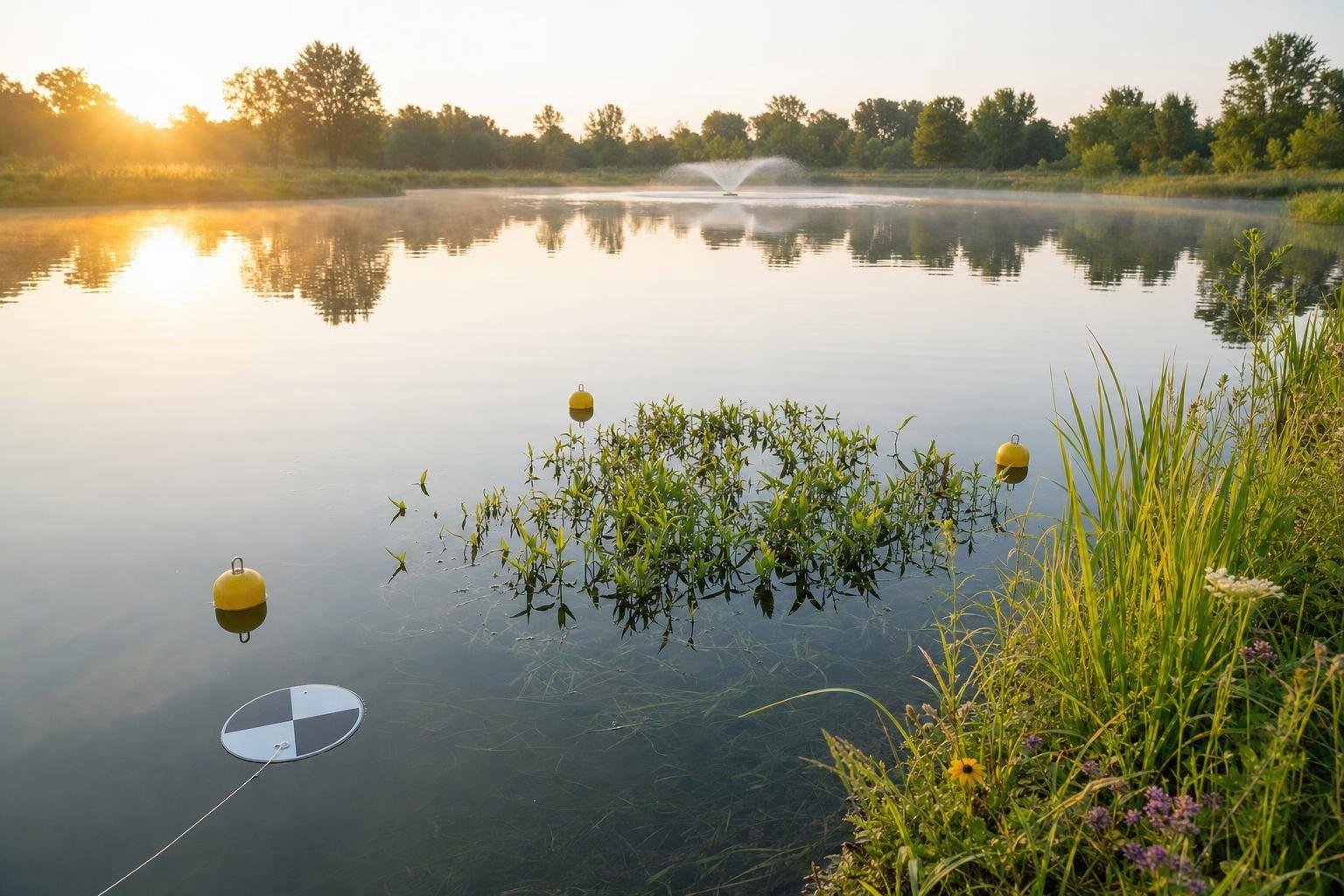
| Water Clarity | Secchi disk or visual tint assessment | Bi-weekly | Detects early planktonic algae blooms |
| Infestation Mapping | Field surveys and seasonal tracking | Annual | Identifies hotspots and year-to-year spread |
| Water Source/Runoff | Watershed and shoreline inspection | Seasonal (Spring/Fall) | Pinpoints external nutrient and sediment entry points |
Use the survey data to decide whether to hold, treat, or switch tactics. Year-to-year comparisons help show what’s working and where you need to adjust.
sbb-itb-c4006de
Combining Cultural, Mechanical, Biological, and Chemical Controls
Once monitoring shows you’ve hit a threshold, the next step is simple in theory and tricky in practice: pick the right mix of controls for the species, the site, and the time of year. The best plan usually layers tactics that work together, based on the target plant, how the waterbody is used, the weed’s growth stage, and any state rules that apply.
Cultural and Mechanical Controls for Immediate and Preventive Management
Cultural and mechanical tools help in two ways. They cut back existing weeds, and they also change the conditions that help weeds spread.
Water-level drawdowns are one of the best tools for rooted plants in northern climates. But the timing has to line up. If roots and tubers are exposed during freezing weather, the cold can kill plant material. In Pennsylvania, any waterbody larger than 1 acre needs a drawdown permit. In southern areas, drawdowns tend to work less well because hard freezes are less dependable.
Mechanical harvesting can open up large areas fast, which makes it useful when access or navigation is the main issue. The catch is fragmentation. Species such as hydrilla can regrow from tiny pieces, so every bit of cut material needs to be collected and removed before it drifts off and starts a new patch somewhere else. For small, isolated infestations, diver-assisted suction is often the better call because it removes the full root and tuber system, which matters if you want to stop regrowth.
| Method | Best Use Case | Key Considerations |
|---|---|---|
| Nutrient Reduction | Long-term prevention | Keep out manure and fertilizers, cut sediment runoff, and manage overabundant waterfowl. |
| Drawdown | Rooted plants in northern climates | Works best when paired with freezing weather; some states require permits. |
| Manual Removal | Small ponds or isolated areas | Labor-intensive; best for small patches. |
| Mechanical Harvesting | Large infestations or navigation channels | Short-term control; fragments must be contained. |
| Diver-Assisted Suction | Small, localized patches | Must remove the entire root and tuber system. |
| Pond Dyes | Algae prevention in closed ponds | Only works in waterbodies without overflow; dye disperses once water flows out. |
| Barley Straw | Supplemental algae control in small ponds | Apply before a bloom starts at 1 to 2 bales per acre; does not work after bloom onset. |
Biological Controls and Where They Fit in an IPM Program
When physical control isn’t enough, biological options can help extend suppression over time. They work best as a slower, supporting layer rather than a one-shot answer.
Triploid grass carp are sterile and may live for more than 10 years, which means they can provide long-term, though uneven, vegetation control. They tend to prefer submerged leafy plants and duckweed. Filamentous algae is often less attractive unless their preferred food runs low. That feeding behavior cuts both ways: if too many fish are stocked, they may strip out desirable native plants along with the weeds you’re trying to manage.
In places such as Pennsylvania, stocking grass carp requires a joint permit from environmental and fish commissions. Because biological control may take several growing seasons and can change native plant cover, it fits best inside a broader IPM plan rather than on its own.
Aquatic Herbicides, Label Compliance, and Resistance Management
Herbicides come into play when you need faster or broader control and the label matches the site. Aquatic herbicides have to be EPA-registered and labeled for aquatic use. Before any application, check the label for limits tied to drinking water, livestock, or irrigation.
The choice between a contact and a systemic herbicide depends on the target weed. Contact herbicides, such as diquat and copper, act fast and are often used for quick knockdown of algae, duckweed, and other floating or submerged growth. Systemic herbicides, such as fluridone and glyphosate, move through the plant and are usually a better fit for rooted submerged plants and emergent species like cattails and Phragmites.
| Active Ingredient | Primary Target Weeds | Mode of Action | Key Context / Restrictions |
|---|---|---|---|
| Copper Sulfate / Chelated Copper | Algae | Contact | Can be toxic to trout and other non-target aquatic life. |
| Diquat (Reward) | Submerged plants, duckweed, floating weeds | Contact | Fast-acting; check the label for restrictions. |
| Fluridone (Sonar, Avast!) | Submerged plants, watermeal, duckweed | Systemic | Requires long contact time; irrigation restrictions apply. |
| Glyphosate (Rodeo) | Emergent plants (cattails, Phragmites) | Systemic | Use an aquatic-approved surfactant and apply to foliage above the waterline. |
| 2,4-D (Navigate, Aqua-Kleen) | Submerged and floating broadleaf plants | Selective systemic | Often used for milfoil or water lilies; follow label restrictions. |
| Endothall (Aquathol-K) | Submerged plants | Contact | Targeted submerged weed control in lakes and ponds. |
One point matters a lot here: rapid die-off can strip oxygen from the water and lead to fish kills. That’s why treatments should be done in sections instead of all at once, with time between applications so oxygen levels can recover.
It also helps to rotate herbicide modes of action to slow resistance. Before treatment, check weather and water flow so drift or downstream movement doesn’t affect nearby waterbodies or other water users.
Keep records of the product, application rate, timing, and treated area. That gives you something solid to compare during follow-up checks.
Evaluate Results, Adjust the Plan, and Apply Best Practices
Document Treatments and Track Post-Treatment Results
After treatment ends, compare the outcome with the threshold that triggered action in the first place. Then document each treatment with the date, site, method, application rate, weather, water conditions, and pre/post survey results. That record helps with compliance and gives you a better basis for future calls.
Post-treatment surveys matter just as much as the treatment itself. They show how well control worked and whether any non-target effects showed up. Use that information to adjust herbicide selection, timing, or mechanical removal next season. And if the label calls for swimming, irrigation, or fishing restrictions, post them right away through notices, leaflets, or press releases.
| Record Category | Key Data Points | Purpose |
|---|---|---|
| Application Details | Date, location, method, application rate | Label compliance and repeatability |
| Water Conditions | Weather, water flow, turbidity, pH, dissolved oxygen | Safety and efficacy analysis |
| Control Results | Target species mortality, native plant changes, non-target effects | Measuring IPM success |
| Operational Impact | Total costs | Budget review and follow-up planning |
Adjust Tactics Based on Outcomes, Costs, and New Site Conditions
Use post-treatment data to decide if a tactic should be repeated, changed, or stopped. This is where the plan shifts from a one-season response to a long-term management system. Hydrilla shows why that matters.
"Hydrilla control is rarely a one-time effort. Managers often need to monitor treated areas for several years because tubers and fragments can remain dormant in sediments and later regrow." – NAISMA
The table below links common results with practical changes for the next season.
| Observed Outcome | Contributing Condition | Adaptation for Next Season |
|---|---|---|
| High regrowth from tubers | Dormant structures in sediment | Shift to multi-year monitoring and early-season treatments |
| Increased weed spread | High water flow or fragmenting mechanical tools | Switch to diver-assisted suction or implement strict fragment containment |
| Low dissolved oxygen | High water temperatures and large biomass | Move treatment to early spring before peak biomass |
| Native plant displacement | Non-selective control methods | Refine herbicide selection or adjust biological control agents to protect diversity |
| Upstream reinfestation | Connected waterbodies or boat traffic | Increase regional coordination and reinforce Clean, Drain, Dry practices |
"Adjustment of contingency plans following the evaluation of eradication campaigns enables the response to an outbreak to be improved." – EPPO
Conclusion: Best Practices for Long-Term Aquatic Weed IPM
What keeps aquatic weed IPM working year after year is a simple feedback loop. Identify the weed correctly, set practical thresholds, prevent what you can, monitor on a steady schedule, combine control methods, follow every label and permit rule, and use records to improve the plan each season.
Think of the IPM plan as a working document, not something you write once and file away. Update it after every season. If your job includes applying aquatic herbicides or overseeing treatments, staying current on pesticide laws and label rules is part of the work. Online Pest Control Courses offers state-approved CEUs, CCUs, and pesticide recertification training on laws, formulations, environmental impact, and pest management.
FAQs
How do I know which aquatic weed I have?
Correct identification comes first. Before you try to manage any plant, make sure you know exactly what it is.
A tool like AquaPlant can help you identify the species and see whether it’s native, invasive, helpful, or simply a nuisance plant.
You can also use visual guides or identification cards from local extension services. If you want deeper training, Online Pest Control Courses offers state-approved courses that cover plant identification and management strategies.
When should I treat aquatic weeds?
Treat aquatic weeds when growth gets out of hand and starts getting in the way of your waterbody’s management goals, such as recreation, irrigation, or fish habitat.
One common warning sign is when plants cover more than 20% to 30% of the pond’s surface. You may also need treatment if invasive species are present, or if weeds start interfering with water flow or hurting property values.
What control method works best long term?
The best long-term way to manage aquatic weeds is with an Integrated Pest Management (IPM) approach. That means using more than one control method instead of putting all your chips on a single tactic.
Why does that matter? Because infestations can hang around in the sediment as dormant tubers or broken fragments. Even when a site looks under control, weeds can come back.
That’s why effective control usually takes a multi-year plan that includes monitoring, preventive steps, adaptive strategies, chemical treatments, mechanical removal, and regular site surveys.