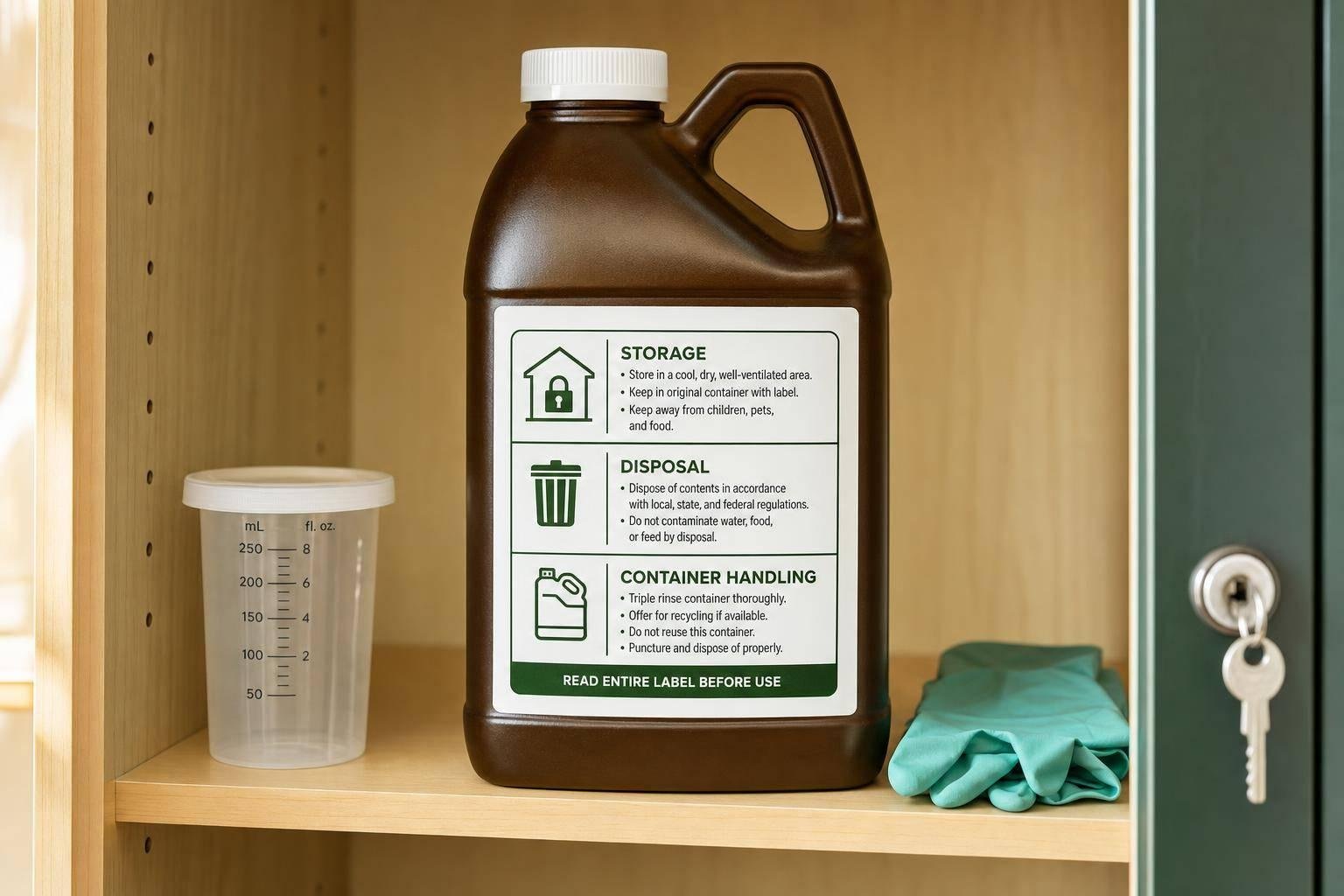
If I ignore the label’s storage or disposal directions, I can break federal law. That is the main point of this topic, and it applies before, during, and after I use a pesticide.
Here’s the short version:
- The label is legally enforceable under FIFRA
- I should find the STORAGE AND DISPOSAL section and read it before I open the product
- I need to follow directions for storage, leftover product, spray mix, rinsate, and empty containers
- Container type matters: nonrefillable, refillable, bags, fiber drums, household products, and aerosols all have different steps
- State and local rules may be stricter than the label, so I should check those too
A few facts stand out:
- EPA rules at 40 CFR 162.10 require storage and disposal statements on many pesticide labels
- Front-panel size can affect the required label text size, from 6-point to 12-point
- Plastic container recycling programs often split by size, such as 55 gallons or less for one program and larger sizes for another
What I take from this article is simple: I should not guess. I should read the label, keep the product in its original container, manage rinsate the way the label says, and dispose of each container based on its exact type. That lowers legal risk and helps prevent spills, leaks, and misuse.
Before I store, mix, rinse, or throw anything away, I want the label in front of me.
EPA Authority and the Label Sections You Must Follow
How FIFRA Makes Label Directions Enforceable
FIFRA governs pesticide sale, distribution, use, and disposal up to the point when the pesticide becomes waste. That means the label’s storage and disposal directions are enforceable requirements, not casual advice. Under EPA labeling rules, pesticide products must include proper storage and disposal statements, and a product that fails to meet those labeling standards can be treated as misbranded under FIFRA. So if you need a starting point, the Storage and Disposal section is it.
Once a pesticide becomes waste, disposal falls under RCRA. Until that point, the label controls.
"Pesticides are regulated under FIFRA until they are disposed, after which they are regulated under the Resource Conservation and Recovery Act (RCRA), which ensures responsible management of hazardous waste and non-hazardous solid waste." – US EPA
That handoff matters because your legal duties don’t stop at purchase or use. They continue through disposal. The next step is knowing where EPA says those instructions must appear on the label.
Where to Find the Storage and Disposal Section on a Label
EPA puts these directions in one set place. Storage and disposal statements must appear together under the heading STORAGE AND DISPOSAL within the Directions for Use section. The heading has to be in all caps, and the required type size depends on the size of the label’s front panel.
| Label Front Panel Size (sq. inches) | Required Type Size |
|---|---|
| 10 and under | 6 point |
| Above 10 to 15 | 8 point |
| Above 15 to 30 | 10 point |
| Over 30 | 12 point |
EPA also allows a boxed format, which can make the section easier to spot. In most cases, this section includes four parts:
- A general “do not contaminate” statement
- Storage instructions
- Pesticide disposal instructions
- Container handling or residue-removal directions
There’s one exception for household-use products. They can leave out the full heading, but they still must include simplified disposal directions. All other products use the full STORAGE AND DISPOSAL heading.
sbb-itb-c4006de
How to Read Storage Instructions on a Pesticide Label
Common Storage Statements and What They Mean
Once you know what these common storage statements mean in day-to-day use, the label gets a lot easier to follow.
| Storage Statement | What It Requires in Practice |
|---|---|
| "Store in original container only" | Keep pesticides in their original, labeled containers so the label stays with the product |
| "Do not contaminate water, food, or feed by storage and disposal" | Keep pesticides away from water, food, and feed |
| "Store in a cool, dry place" | Protect the product from sunlight, moisture, and temperature extremes |
| "Keep out of reach of children" | Store the product in a locked area |
These basic directions often get more specific when the label talks about temperature, security, or the type of container.
Temperature, Security, and Separation Requirements
Temperature matters because storage directions are meant to avoid conditions that can change how the product performs. That includes freezing, too much heat, moisture, sunlight, and friction. In plain terms, the storage area needs regular checks for heat, cold, and damp conditions.
Storage needs can also shift based on the product’s formulation and packaging. That’s why many labels add instructions tied to the product itself.
Storage Differences by Formulation and Container Type
Formulation and container type can change the storage risk, so labels often include extra handling directions.
Liquid formulations can be affected by heat, and some containers may warp or fail when temperatures swing too far. Labels may also tell you how to position containers to avoid breakage, crushing, or damage from stacking. Glass containers need extra care because they break more easily, so labels may include stacking and positioning directions to lower that risk.
Dry formulations in bags or fiber drums can be sensitive to moisture, friction, and stacking pressure. Labels for these products may tell you to keep the packaging dry and avoid stacking too high.
Aerosols come with pressure-related storage warnings because heat can build pressure inside the container. Labels may ban storage in high-heat areas and warn against puncturing or incinerating the container.
Reviews the requirements for proper storage and disposal of pesticides (CC)
How to Read Disposal and Container Handling Directions
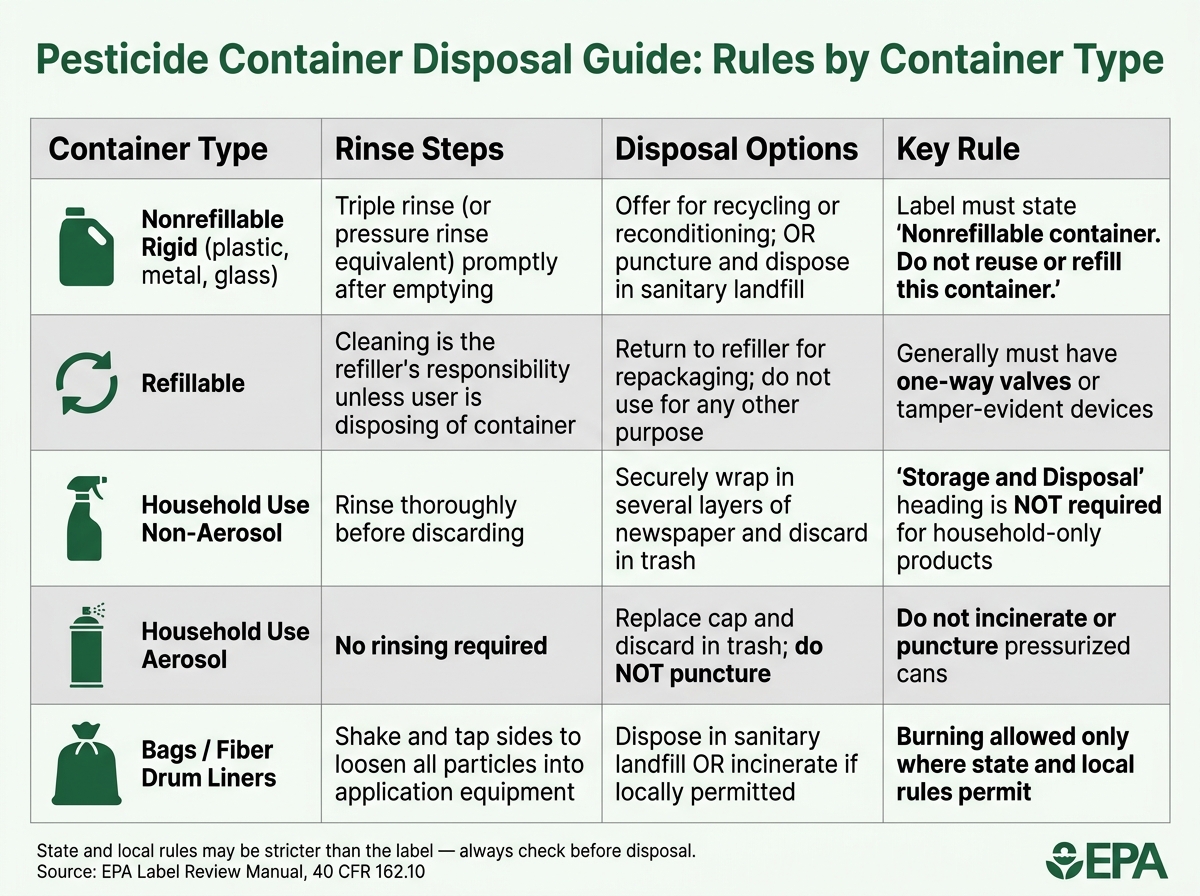
Pesticide Container Disposal Guide: Rules by Container Type
After storage, the next part of the label covers disposal and container cleanup. Read that section carefully. It tells you what to do with leftovers, rinsate, and empty containers. And one thing matters here: state and local rules can be stricter than the label.
Disposing of Unused Pesticide, Residues, and Rinsate
Use leftover product only as the label directs. If you have leftover spray mix or extra pesticide, the label will usually tell you to apply it to a labeled site at the labeled rate.
If you can’t dispose of these wastes through labeled use, contact your State Pesticide or Environmental Control Agency, or the Hazardous Waste representative at the nearest EPA Regional Office for guidance.
Some labels also use conditional wording such as "only where state and local rules allow" for disposal methods like burning or landfilling. That’s your signal to stop and check local rules before you do anything.
Once you’ve dealt with leftover product, move to the container directions.
Nonrefillable, Refillable, and Household-Use Containers
The type of container changes the cleanup steps.
| Container Type | Rinse steps | Disposal Options | Key rule |
|---|---|---|---|
| Nonrefillable rigid (plastic, metal, glass) | Triple rinse (or equivalent) promptly after emptying | Offer for recycling, reconditioning, or puncture and dispose of in a sanitary landfill | Label must say: "Nonrefillable container. Do not reuse or refill this container." |
| Refillable | Cleaning is the refiller’s responsibility unless the user is disposing of the container | Return to refiller for repackaging; do not use for any other purpose | Generally must have one-way valves or tamper-evident devices |
| Household Use (non-aerosol) | Rinse thoroughly before discarding | Securely wrap in several layers of newspaper and discard in trash | "Storage and Disposal" heading is not required for household-only products |
| Household Use (aerosol) | No rinsing required | Replace cap and discard in trash; do not puncture | Do not incinerate or puncture pressurized cans |
| Bags / Fiber Drum Liners | Shake and tap sides to loosen all particles into application equipment | Dispose of empty bag or liner in a sanitary landfill or by incineration if locally permitted | Burning is allowed only where state and local rules permit |
Triple-Rinsing, Pressure-Rinsing, and Preventing Container Reuse
For nonrefillable rigid containers, residue removal comes first. The label will require either triple-rinsing or an equivalent pressure-rinse method. The point is simple: remove residue so the container can be recycled or disposed of as non-hazardous waste. Rinsate should go back into the application equipment or be handled as pesticide waste.
After rinsing, many labels also tell you to puncture or crush the container before landfill disposal. That step helps stop someone from reusing the container for something else. Check state and local rules before puncturing.
Training, Compliance Resources, and Key Takeaways
Where Applicators Can Build Label-Reading Skills
EPA’s Label Review Manual, Chapter 13, explains storage, disposal, and rinsing rules for rigid and non-rigid containers. EPA also offers Label Review Training and infographics that show applicators where to find and how to read key label sections, including Directions for Use and Storage and Disposal.
Knowing where the directions are is step one. The next part is being able to read them fast and use them on the job without second-guessing. For applicators who want more structured practice, Online Pest Control Courses provides state-approved training on pesticide laws, formulations, environmental impact, and pest management.
When disposal goes beyond what the label covers, state collection programs can fill the gap. Many states run Clean Sweep programs that hold collection events for farmers and commercial applicators to safely dispose of pesticides that can’t go through standard household hazardous waste channels. Your local cooperative extension office or state agency can help you find events in your area.
For recycling, the path depends on container size:
Conclusion: Storage and Disposal Points to Remember
"The label is the law!" – US EPA
Follow the label exactly, check state and local rules, and use the right disposal method for the container type.
FAQs
What happens if I don’t follow the label?
Using a pesticide in any way that does not match its label is a violation of federal law.
That label isn’t just guidance. It’s legally enforceable. Misuse can include improper use, storage, handling, or disposal.
If you don’t follow the label, you may face enforcement action. Those instructions are there to help protect human health and the environment.
How do I know if my container is refillable or nonrefillable?
Check the product label under Storage and Disposal. Pesticide labels are legally required to state whether the container is refillable or nonrefillable. They also need to include instructions for handling the container and, when allowed, reusing it.
A nonrefillable container will usually say "Nonrefillable container" and "Do not reuse or refill this container." A refillable container will say that it is refillable and will include instructions about what may be used to refill it.
When do state or local rules override the label?
Under the Federal Insecticide, Fungicide, and Rodenticide Act, the pesticide label is considered law. That means users must follow the label as written. If someone uses a product in a way that conflicts with its labeling, that use violates federal law.
Because federal requirements set the standard for legal use, they usually take priority. Online Pest Control Courses offers state-approved training and recertification on pesticide laws and management strategies to help applicators stay compliant.