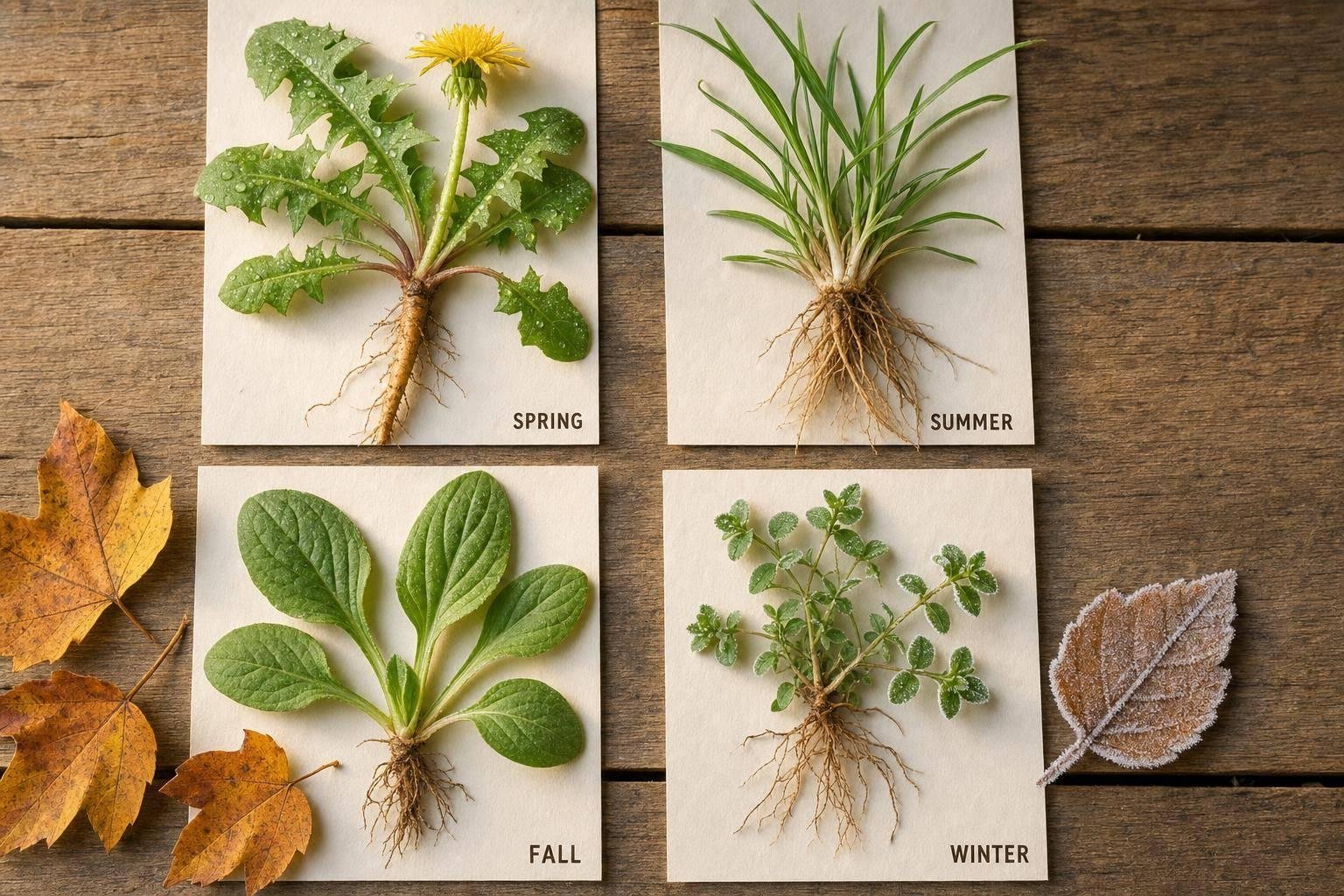
If I want to identify a weed faster, I start with the season. A weed that flowers in early spring is often a winter annual. A grass growing hard in March is less likely to be crabgrass. And when soil reaches 50°F to 55°F for three days, summer annuals like crabgrass often begin to germinate.
I use a simple check: when it showed up, where it is growing, what the leaves and stems look like, and whether it spreads by seed, roots, rhizomes, stolons, or tubers. That helps me sort weeds into summer annuals, winter annuals, biennials, and perennials before I think about control. Professional applicators can also earn Massachusetts pest control CEUs to stay current on identification and management techniques.
Here’s the short version:
- Spring: look for winter annuals already blooming, plus early perennial green-up
- Late spring to summer: watch for warm-season annual seedlings like crabgrass and foxtail
- Fall: check for winter annual seedlings and first-year biennial rosettes
- Winter: look for green rosettes and other weeds that stayed alive through cold weather
- Field clues matter: leaf veins, stem shape, seed heads, and root parts can confirm the ID
- Scout every 1 to 2 weeks: that helps you catch weeds before they set seed
A few fast field clues can save time:
| Clue | What I look for |
|---|---|
| Season | Spring bloom, summer seedling flush, fall rosettes, winter green growth |
| Leaf veins | Parallel veins often mean grass or sedge; branching veins often mean broadleaf |
| Stem shape | Round or flat can point to grasses; triangular stems often point to sedges |
| Seed head | Finger-like spikes, panicles, or drooping clusters can narrow the list |
| Roots/spread | Taproots, rhizomes, stolons, and tubers help separate annuals from plants that come back |
Bottom line: I get the best weed ID when I pair timing with plant traits. That simple combo cuts down lookalikes and helps me make a better call in the field.
Seasonal Weed Growth Patterns and Early Scouting
How Annuals, Biennials, and Perennials Behave Through the Year
Start with the season. Then narrow the weed by life cycle.
That simple step saves time. Summer annuals come up when spring soil turns warm. Winter annuals germinate in late summer or fall. Biennials form a rosette in year one, then bolt in year two. Perennials come back from roots in early spring.
Here’s the quick breakdown:
| Weed Type | Germination Timing | Best Time to Scout |
|---|---|---|
| Summer Annual | Mid-to-late spring | Summer, active growth |
| Winter Annual | Late summer/fall | Early spring, bloom and seed set |
| Biennial | Summer (Year 1) | Year 1 rosette; Year 2 bolting |
| Perennial | Spring or via roots | Early spring, first green-up |
Where Weeds Show Up First
After timing, location gives you the next fast clue.
Weeds often show you what’s wrong with a site. Thin turf, compacted soil, shade, and disturbed ground all leave a trail. Crabgrass often shows up first along sidewalks and driveways, where surfaces heat up sooner. Goosegrass and prostrate knotweed often point to compaction. Ground ivy usually points to shade.
In rights-of-way and field margins, check fencerows, idle land, and spots where hay was fed over winter. Those areas are common entry points for weeds like multiflora rose and common burdock. When you scout, record both the weed and the site issue. That extra note can make control choices much clearer later, especially when following a pesticide safety course.
When to Inspect in Each Season
Use those growth patterns to decide when to look.
In early spring, check for overwintered biennial rosettes like musk thistle and winter annuals such as henbit and chickweed that are already starting to bloom. This is also the point when established perennials like dandelions and quackgrass show their first green growth.
By late spring into early summer, shift your attention to warm-season annuals. Watch for crabgrass and foxtail seedlings as soil temperatures climb. In fall, scout for winter annual seedlings such as annual bluegrass. During warm winter breaks, low-growing rosettes of biennials like wild carrot often stand out on bare or dormant ground. At that stage, they’re much easier to control than they are in year two.
Match scouting time as closely as you can to weed growth stage. That’s how you catch the best control window. During active growth, inspect every 1 to 2 weeks so you can spot weeds before roots go deeper or seed is set.
sbb-itb-c4006de
Identifying Weeds in the Lawn – Cool Season Winter and Spring Weeds
Visual Traits to Check in the Field
Once you know the season and the weed type you’re likely dealing with, the plant’s physical traits help confirm the ID. The simplest way to do this is to check a few dependable markers.
Start with the leaves. Then use the stems and seed heads to back up what you’re seeing.
Leaf, Stem, Color, and Seed Head Clues
Begin with the leaf. Vein pattern is one of the fastest ways to sort weeds in the field: parallel veins usually mean grasses or sedges, while a branching, net-like pattern points to a broadleaf weed. Then look at the leaf tip and surface. Annual bluegrass, for example, has a boat-shaped leaf tip. It’s a small detail, but it’s a solid way to tell it apart from other grassy weeds. Leaf hair matters too. Smooth leaves and fuzzy leaves can send you down very different paths.
The stem gives you another set of clues. A flat stem suggests barnyardgrass. If you’re checking grasses, look closely at the collar region, where the blade meets the sheath. That area contains two parts worth checking: the ligule and the auricles. A ligule may look like a fringe of hairs, a thin flap, or it may not be there at all. Auricles are small clasping appendages. They’re easy to spot in Canada wildrye and jointed goatgrass, but absent in most foxtails and crabgrass. A 10x pocket lens helps a lot here in the field.
Color and seed head shape help finish the job. A bright white midrib down the leaf is a strong sign of johnsongrass. Purplish blotches on stems and sheaths point toward shattercane or sandbur. Seed heads are just as useful: crabgrass makes finger-like spikes, annual bluegrass forms a small pyramidal panicle, and wild oat has drooping, nodding clusters. If the weed has already reached the seed head stage, move fast. A single large crabgrass plant can produce 100,000 or more seeds in one season.
How to Tell Grasses, Broadleaf Weeds, and Sedges Apart
One of the fastest field rules is simple: sedges have edges. Run your fingers along the lower stem. If it feels angular or three-sided, it’s probably a sedge. Grasses usually feel round or a bit flat, and they have visible nodes, or joints, along the stem. Broadleaf weeds tend to have wider leaves with branching veins, and their flowers are often easier to see.
| Feature | Grasses | Broadleaf Weeds | Sedges |
|---|---|---|---|
| Stem Shape | Round or flat; hollow with nodes | Various; often solid or branched | Triangular; solid; no nodes |
| Leaf Veins | Parallel | Net-like or branching | Parallel |
| Leaf Arrangement | 2-ranked (two rows) | Opposite, alternate, or whorled | 3-ranked (three rows) |
| Root System | Fibrous; may have rhizomes/stolons | Often taproot or branched | Fibrous with tubers or rhizomes |
| Nodes Present | Yes | No | No |
Seedlings give you one more fast check. Grasses and sedges come up with one leaf, while broadleaf weeds emerge with two seed leaves.
If the top growth still leaves you guessing, dig at the base and check how the plant spreads.
Root and Spread Clues
Roots often settle the ID, especially when you’re sorting annuals from perennials. If you cut annuals just below the root crown, they will not regrow. Dandelions are a different story. They have deep taproots that store energy, and they can come back from small root pieces left in the soil. Quackgrass spreads by rhizomes, which are horizontal underground stems. Those rhizomes send up new shoots and roots, which is why quackgrass forms thick, stubborn patches. Stolons do a similar job above ground. Creeping bentgrass uses them to root at the nodes and build mats.
Sedges such as nutsedge make things harder. Their underground tubers, or nutlets, help them spread fast and make them hard to remove by simple pulling. When you dig around the base of a seedling, also look for attached seeds or burs, such as longspine sandbur, and check for root parts like rhizomes or tubers. That below-ground proof, paired with what you saw above ground, is often enough to lock in the ID.
Identifying Weeds by Season: Spring Through Winter
Use the growth-stage clues above to match each weed to the season you’re scouting.
Spring and Early-Summer Weeds
When soil temperatures hit 50°F to 55°F for three straight days, summer annuals like crabgrass, foxtails, and pigweed start to germinate and take off. These seedlings come up fast and can spread in a hurry.
Spring can also be a little tricky because some weeds you see then didn’t start growing then. They’re winter annuals that germinated in fall and are now finishing their life cycle. If a weed is already flowering in spring, that’s a strong sign it may be a winter annual, so confirm that before it sets seed. At the same time, established perennials like dandelions and Canada thistle often surge in spring, using stored root energy to send up strong new growth.
When seedlings are still small, use the leaf and stem traits from the previous section to lock in the ID.
Late-Summer and Fall Weeds
As soil temperatures fall below 70°F, winter annuals start to sprout. This is the time to watch for tiny new seedlings as the ground cools. They’re easy to overlook, especially if you’re moving too fast.
Fall is also a good time to spot biennials like wild carrot and common burdock. They often show up as low rosettes without a bolting stem yet. Perennials can stand out in fall too, before top growth dies back and dormancy starts.
Winter Weeds and Overwintering Growth
In mild conditions, winter annuals and some cool-season perennials can stay green through winter. Rosettes that formed in fall often hold through the cold months, and some woody weeds like broom stay evergreen.
If you find a low green rosette in January or February, it likely came from a winter annual or biennial that germinated months earlier. Very early flowering in late winter or early spring is another strong clue. Pair those seasonal signs with the field traits above before moving on to the step-by-step workflow.
| Season | Weed Type | Key Visible Clues |
|---|---|---|
| Spring | Summer annuals | Upright seedlings, fast growth as soil warms |
| Spring | Winter annuals | Already flowering or setting seed; germinated the previous fall |
| Fall | Winter annuals | New sprouts as soil cools; small seedlings |
| Fall | Biennials | Low rosettes; no bolting stem yet |
| Winter | Overwintering weeds | Green rosettes through cold weather; very early flowering |
A Seasonal Identification Workflow and Final Takeaways
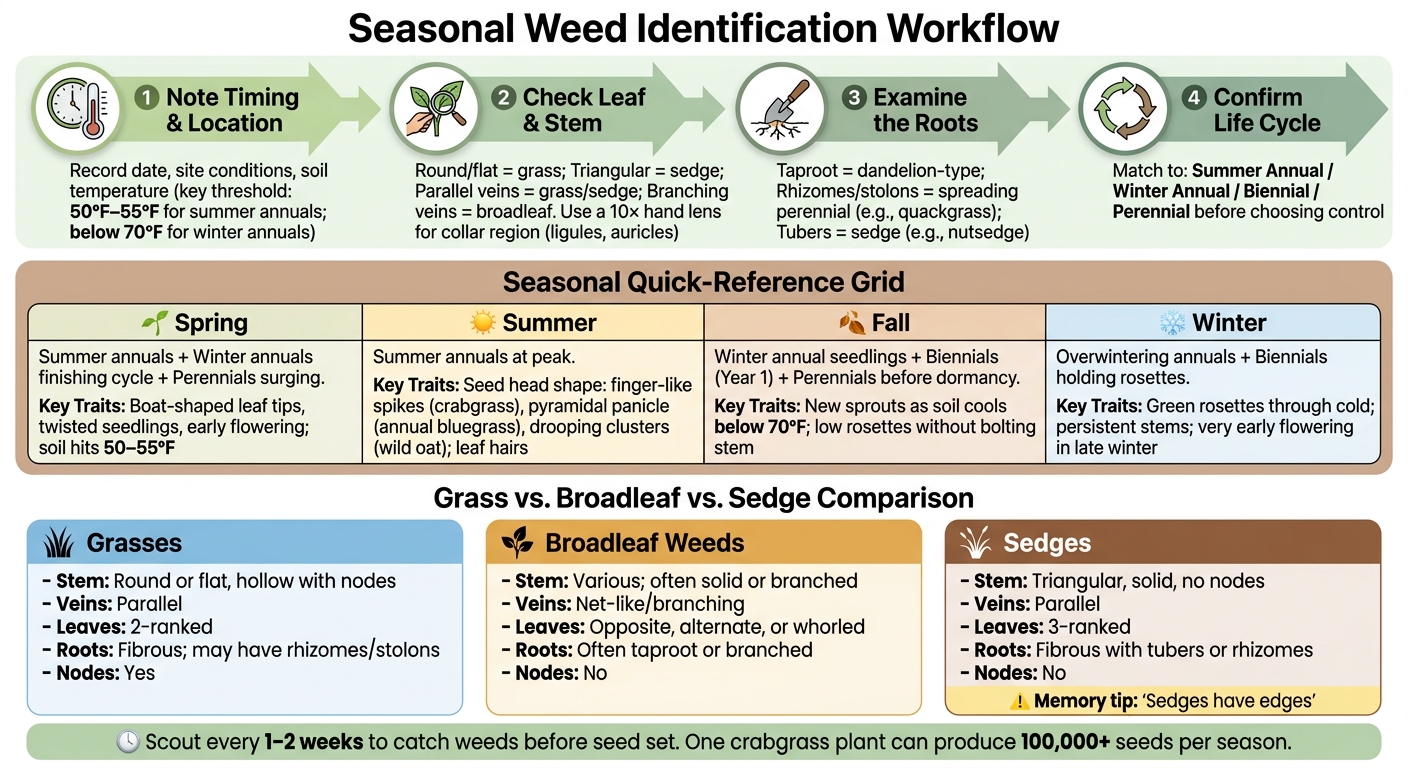
Seasonal Weed ID Workflow: How to Identify Weeds by Season
Step-by-Step Weed ID Workflow
Use the seasonal and visual clues above as a repeatable field check before you pick a control method.
"The first step of a successful weed management program is to ‘know your enemy.’" – Debalin Sarangi and Amit Jhala, University of Nebraska-Lincoln
Go through these steps each time you scout a new weed:
- Note when and where it appeared. Write down the date, site conditions, and soil temperature if you can.
- Check the leaf and stem. Is the stem round, flat, or triangular? Do you see hairs, a waxy bloom, or a twisted leaf blade? A 10× hand lens helps with grass collars, where ligules and auricles can be tough to spot.
- Look at the roots. Dig with care around the base. A taproot points to dandelion-like growth. Rhizomes, stolons, or tubers suggest spread through underground or creeping stems.
- Confirm the life cycle. Match the plant to an annual, biennial, or perennial pattern before you decide what to do next.
Use the table below as a quick seasonal cross-check:
| Season | Key Traits to Check |
|---|---|
| Spring | Boat-shaped leaf tips, twisted seedlings, early flowering |
| Summer | Seed head shape (panicle, spike, finger-like), leaf hairs |
| Fall | Rosette pattern, new green clumps, root structure |
| Winter | Green rosettes, persistent stems, dormant seed heads |
When to Use a Field Guide or Training Resource
When seedlings are tiny or the traits don’t line up cleanly, stop and double-check with a guide. Some cases need more than a fast visual scan.
Seedlings are the toughest stage to identify, and many species look almost the same before true leaves show up. Grasses can be even more confusing. If you don’t inspect the collar region under magnification, it’s easy for even seasoned scouts to mix up one species with another.
For pesticide applicators who need state-approved recertification, Online Pest Control Courses offers mobile-friendly training with CEUs, CCUs, and instant certificate downloads.
Conclusion: Key Points for More Accurate Seasonal Weed ID
Accurate weed ID depends on seasonal timing and plant morphology working together. One without the other can lead you in the wrong direction. Scout every 1 to 2 weeks, and log what shows up, when it appears, and where you found it.
FAQs
What if I can’t identify a weed at the seedling stage?
If you can’t identify a weed at the seedling stage, take it to your local extension office for expert help.
When you’re out in the field, pay close attention to a few basic traits: leaf shape, size, arrangement, and stem structure. A magnifying lens can help you spot small details that are easy to miss.
And even if you can’t pin down the exact species, you’re not stuck. Knowing whether the weed is an annual, biennial, or perennial can still point you toward the right control method.
Can one weed change appearance across seasons?
Yes. A lot of weeds can look almost like different plants from one season to the next because they change as they move through each life stage.
For example, biennials like Scotch thistle often begin as a low, prickly rosette. Later, they shoot up into tall stems with flowers.
Annual weeds may vanish after the first frost. Perennial weeds, on the other hand, may turn brown or dry out while still leaving visible plant remains behind.
Why does the same weed keep coming back every year?
Weeds often come back because of how they grow and reproduce.
Perennial weeds make it through winter in a dormant state, then grow back from roots that are already established in the ground.
Annual weeds come back for a different reason: they drop seeds into the soil. Those seeds can stay alive for years and sprout when the timing is right. If you don’t remove weeds before they go to seed, you’re often setting yourself up for more weeds later.