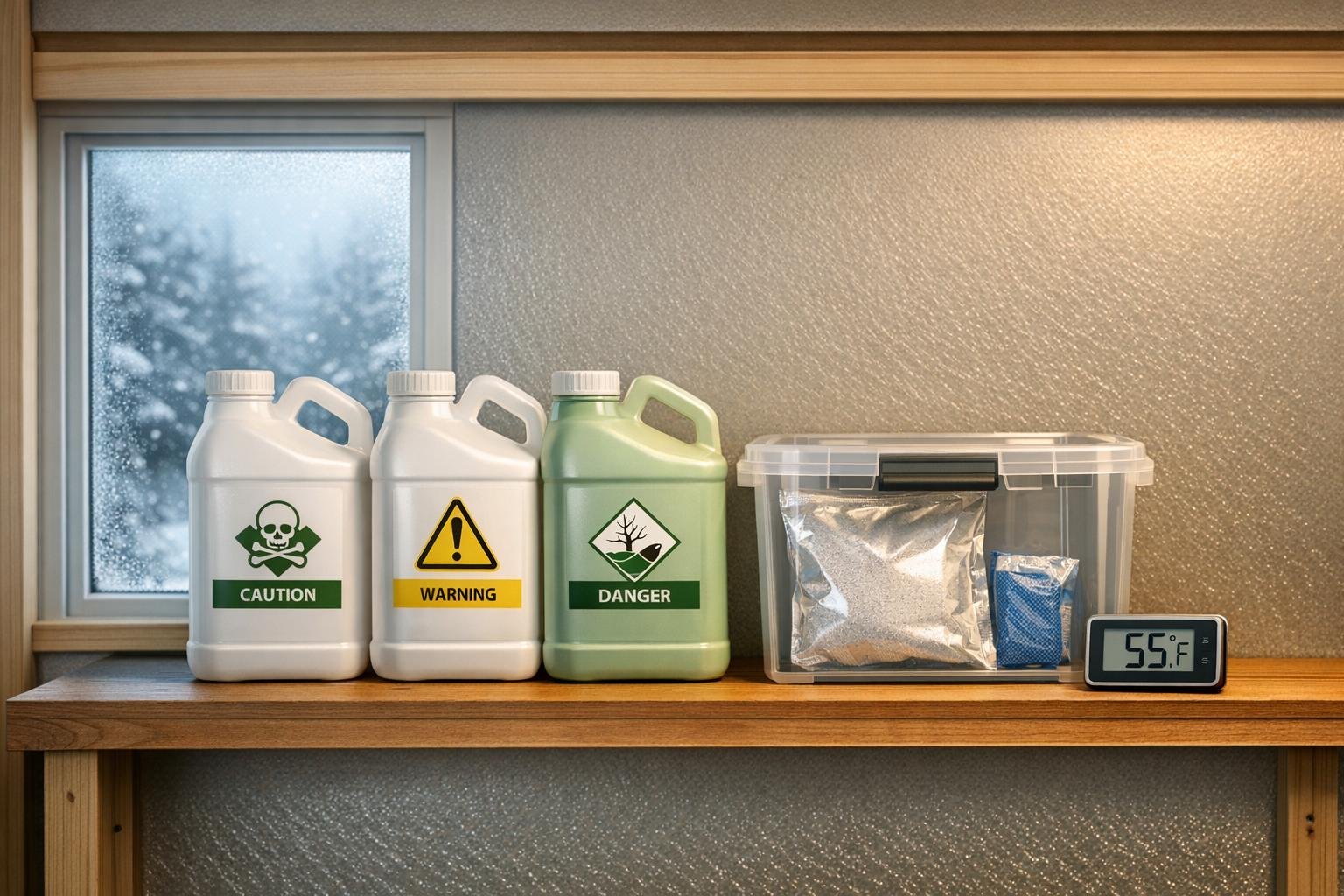
When temperatures drop below freezing, improper pesticide storage can lead to cracked containers, product separation, and reduced effectiveness. Frozen pesticides may harm crops, clog equipment, or even pose safety risks. To prevent these issues:
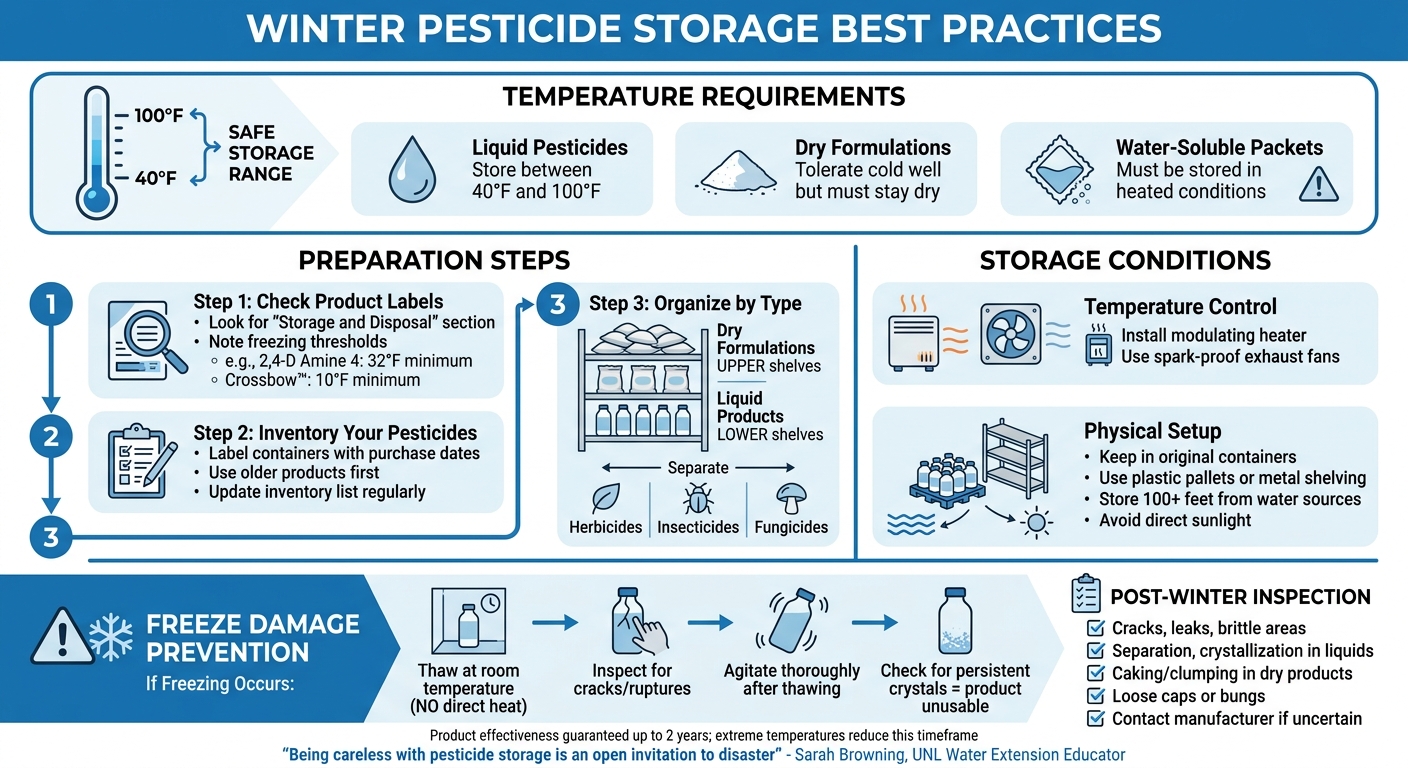
- Store liquids between 40°F and 100°F to maintain potency.
- Check labels for storage instructions and freezing thresholds.
- Organize storage areas: Keep dry formulations above liquids and separate herbicides, insecticides, and fungicides.
- Inspect containers for cracks, leaks, or damage after winter.
- Thaw safely at room temperature and agitate liquids to restore uniformity.
Proper storage ensures your pesticides remain effective and safe to use when spring arrives.
Winter Pesticide Storage Best Practices Guide
Pesticide Storage Tips | Keep Products Safe & Effective
sbb-itb-c4006de
Preparing Pesticides for Storage
Taking the right steps to prepare pesticides for winter storage helps maintain their quality and effectiveness.
Check Product Labels
Start by reading the label on each pesticide container. The "Storage and Disposal" section will tell you the minimum temperature the product can tolerate before it freezes or forms crystals. Look for clear instructions like "DO NOT allow this product to freeze" or "DO NOT store below 32°F".
Each product has its own temperature threshold. For example, 2,4-D Amine 4 can handle temperatures as low as 32°F, while Crossbow™ is safe down to 10°F. Some labels also provide guidance on restoring frozen pesticides. For instance, Cobalt® with chlorpyrifos can be salvaged by storing it at 50-70°F and agitating it to dissolve any crystals. Cecil Tharp, MSU Extension Pesticide Education Specialist, advises:
"Always read the pesticide product label to determine whether a pesticide can freeze with no adverse effects".
Once you’ve reviewed the labels, organize your storage area to prevent cross-contamination. If you can’t find storage details on the label, reach out to the manufacturer for clarification.
Inventory Your Pesticides
Keeping an up-to-date inventory is key to avoiding waste. Clearly label each container with its purchase date and update your inventory list whenever you add or remove a product. Use older pesticides first, as many have limited shelf lives. Fred Fishel from the University of Missouri Extension highlights the importance of this practice:
"Keep an up-to-date inventory of the pesticides you have in storage. Each time a pesticide is added to or removed from the storage site, update the inventory list".
To minimize risks, group pesticides by type. Store dry formulations above liquids to prevent contamination from leaks. Keep herbicides separate from insecticides and fungicides, and isolate volatile products like certain 2,4-D formulations to prevent their vapors from affecting nearby chemicals. Protect labels by covering them with transparent tape or lacquer to ensure they remain legible throughout the winter.
Setting Up Proper Storage Conditions
When preparing pesticides for winter storage, maintaining the right environment is key to preserving their effectiveness.
Control Temperature and Humidity
For liquid pesticides, a storage temperature between 40°F and 100°F is generally safe. Thanks to hydrocarbon solvents, many liquid formulations resist freezing at 32°F. However, if temperatures drop too low, the active ingredients can separate from the solvents, diminishing their effectiveness. On the other hand, dry formulations like wettable powders and granules tolerate cold well but need to stay dry to avoid clumping or breaking down. Water-soluble packets are particularly sensitive – they absorb moisture easily and become brittle when frozen, so they must be stored in heated conditions.
To maintain steady temperatures and remove vapors, consider installing a modulating heater and spark-proof exhaust fans.
Organize Storage
Once temperature and humidity are under control, proper organization plays a critical role in protecting pesticides. Always keep them in their original containers with intact labels to ensure storage and safety instructions remain accessible. Use plastic pallets or metal shelving to keep containers off the floor, protecting them from moisture or flooding. Place dry formulations on upper shelves and liquid products on lower ones to prevent cross-contamination. Heavier containers should be stored on lower shelves for added stability.
Avoid areas exposed to direct sunlight, as it can cause temperature swings and weaken containers. Ensure the storage space is at least 100 feet away from water sources to reduce contamination risks. Whenever possible, use non-porous metal or plastic shelving instead of wood, which can absorb chemicals and is harder to clean.
Preventing and Handling Freeze Damage
Even with the best storage practices, extreme cold can sometimes lead to freeze damage. When this happens, acting quickly and carefully is the key to minimizing harm.
Thaw Frozen Liquids Safely
Start by inspecting the frozen container for any cracks or ruptures. If you notice damage, place the container in a waterproof bucket or secondary containment to catch any leaks during thawing.
Always thaw liquids at room temperature. Avoid using direct heat sources like flames, space heaters, or other high-temperature devices, as these can create fire hazards and may degrade the chemical’s quality. Thawing can take time, so patience is essential. Once the liquid is fully thawed, agitate it thoroughly to ensure the formulation is evenly mixed again.
"A previously frozen pesticide can plug spray equipment, have poor product performance and/or damage crops if the proper thawing and mixing procedures are not followed." – Cecil Tharp, MSU Extension Pesticide Education Specialist
After mixing, check for any remaining solid crystals in the container. If crystals persist and cannot be dissolved, the product is no longer usable and must be disposed of following the label’s disposal instructions.
Next, focus on protecting dry formulations to avoid moisture-related problems.
Keep Dry Formulations Protected
Dry products like wettable powders and granules generally tolerate cold well, but moisture is their biggest threat. Exposure to water can cause caking and clumping, making the product hard to apply and less effective. To prevent this, always store these products in their original, tightly sealed packaging. Keep them elevated on pallets or shelving to avoid contact with damp floors, especially concrete.
Water-soluble packets require extra care. Freezing can make them brittle and prone to shattering during handling. To avoid this, always store these packets in heated areas.
Inspecting Pesticides After Winter
Keeping pesticides in good condition requires a thorough inspection after winter. Cold weather can cause damage that’s not immediately visible, potentially leading to application problems or even safety risks. Post-winter checks are essential to spot and address these issues before they escalate. Start by carefully examining each container for any signs of winter-related damage.
Check Containers and Products
Take a close look at every container for cracks, leaks, or brittle areas – this is especially important for plastic containers and water-soluble packets. The temperature swings during winter can weaken materials, which might result in loose caps or bungs. Make sure all closures are tightly secured.
"All pesticide containers should be checked often for corrosion, leaks, and loose caps or bungs. These dangerous conditions must be corrected immediately." – Oklahoma State University
For liquid pesticides, watch for signs like separation, crystallization, or coagulation. Unusual odors or pressure buildup when opening a container could signal that the product has deteriorated or leaked. Dry products, such as wettable powders, should also be inspected for caking or clumping, as these issues often result from moisture exposure. If a leak is found, position the container so the puncture is at the top to stop the flow, or transfer the contents into a sturdy, properly labeled container without delay.
If you’re unsure about a product’s condition or notice any irregularities, reach out to the manufacturer for guidance.
Contact Manufacturers When Needed
When in doubt about the effectiveness of a pesticide after winter storage, it’s best to contact the manufacturer before using it. This is particularly important if the pesticide label is unreadable, storage information is missing, or the product looks unusual after thawing. Keep in mind that most manufacturers guarantee product effectiveness for only up to two years, and exposure to extreme temperatures can reduce this timeframe significantly.
"If a liquid pesticide does freeze, it may be less effective. Apply a degraded pesticide next year… and you have just wasted your time." – Clyde Ogg, Pesticide Safety Education Coordinator, University of Nebraska-Lincoln
Summary and Training Resources
Storing pesticides safely during freezing weather requires attention to detail. Always refer to product labels for specific storage temperature guidelines. For example, most liquid pesticides need to be stored between 40°F and 100°F to remain effective. Keep pesticides in their original, clearly labeled containers in a temperature-controlled environment. Dry formulations should be stored on pallets, off the floor, to avoid moisture issues, while liquid pesticides should be inspected for any signs of freeze damage.
As winter ends, check all containers for possible damage. If a liquid pesticide develops persistent crystals after being thawed and thoroughly agitated, it’s no longer effective and must be disposed of according to the label instructions.
"Being careless with pesticide storage is an open invitation to disaster, in the form of a pesticide poisoning or spill which could contaminate ground or surface water." – Sarah Browning, Extension Educator, UNL Water
To stay informed about safe pesticide storage and handling practices, consider state-approved training options. Online Pest Control Courses (https://onlinepestcontrolcourses.com) offers courses covering pesticide laws, formulations, environmental considerations, and proper storage techniques. These courses provide CEUs and CCUs, are accessible on various devices, and include instant certificate downloads, ensuring applicators remain up-to-date with safety standards – even during challenging weather conditions.
FAQs
Can I use a pesticide that froze overnight?
If pesticides freeze overnight, avoid using them unless the label explicitly mentions they can be thawed and safely reactivated. Freezing can lead to the separation of active ingredients and carriers, which not only reduces their effectiveness but may also harm your equipment. Always refer to the product label for specific instructions before proceeding.
How do I know if a frozen pesticide is ruined?
After thawing, if the pesticide displays signs like separation, crystallization, or coagulation, it’s probably no longer usable. These changes can compromise its performance and might even lead to equipment problems. Always inspect for these issues before using the product to ensure safe and effective application.
What’s the safest way to thaw a frozen liquid pesticide?
Before you start thawing a frozen liquid pesticide, inspect the container carefully. Make sure there are no cracks or leaks that could cause spills or contamination. Once you’ve confirmed the container is intact, place it in a dry area where the temperature stays above freezing, but keep it away from direct heat sources.
Let the pesticide warm up gradually. After it has thawed, gently shake or roll the container to ensure the ingredients are properly mixed. Always follow the manufacturer’s instructions for handling and mixing.
Avoid shortcuts like using a microwave or applying direct heat, as these methods can damage both the pesticide and the container, potentially making the product unsafe or ineffective. Patience and caution are key!